FDEInterviews logo
AI & ML ENGINEERING

Reflection AI ML Engineer interview questions

Reflection AI does not run a classic forward deployed program. Founded by former DeepMind researchers, it positions itself as an open frontier lab and originally focused on autonomous coding agents. Our content covers the coding, ML, and systems depth its engineering loops test, with a research and agent-systems emphasis.

The Reflection AI ML Engineer interview process

Partial public data

How the Reflection AI ML Engineer interview experience actually runs — the rounds, what each stage tests, and the signals candidates report. Last reviewed July 31, 2026.

RoleResearch, research-infrastructure, or product engineering (tracks differ)LoopRecruiter call → technical phone screen → onsite (4–6) → closing conversation with a founder or team lead
  1. 1
    Recruiter callBackground, motivation, and which track fits: research, research-infrastructure, or product engineering.
  2. 2
    Technical phone screenWith an engineer or researcher; coding and role-relevant depth.
  3. 3
    Onsite (4–6 rounds)Track-dependent. Research leans on reinforcement learning, rewards, credit assignment, and evaluation over memorized architectures; research-infrastructure probes distributed training and keeping large GPU clusters reliable; product engineering covers the agent harness and code-comprehension pipeline behind Asimov.
  4. 4
    Closing conversationWith a founder or team lead on fit and direction.
WHAT THEY'RE EVALUATING
  • Reflection's public bet is agentic reinforcement learning for coding, so research rounds circle around rewards, credit assignment, and evaluation more than architecture trivia
  • A small frontier lab hiring specialists across three distinct tracks; depth in your track matters more than breadth
  • Systems maturity: training frontier models on very large token budgets while keeping clusters alive

Compiled from public interview guides for this specific lab (we exclude third-party summaries that conflate Reflection AI with unrelated companies); tracks and rounds vary, so confirm with your recruiter.

Compiled from our research and publicly available information (candidate reports and company interview guides). Interview loops change and are continuously iterated, and they vary by team, level, and region. Treat this as directional preparation, not an official spec, and confirm the exact rounds with your recruiter or hiring point of contact.

Reflection AI ML Engineer salary

What we can trace, labelled by where it came from. We publish a band only where there is a source behind it, so some of this page is a gap rather than a number.

NO TRACEABLE BAND

We have not found a compensation figure for this role at Reflection AI that we can trace to an employer posting or a public aggregator. Rather than publish an estimate, we are naming the gap. Their careers page is the authority, and postings in some jurisdictions are required to state a range.

HIRING FROM INDIA
Global AI lab, India-based hire

A US or EU AI company with no large India engineering centre. An India-based hire here is usually a global-remote contract, often USD-denominated, which is the highest-paying route into the role from India and also the hardest to get.

LEVELREPORTED FOR THIS EMPLOYER TYPE
Junior (0-2 yrs)₹35 LPA - ₹55 LPA
Mid (3-6 yrs)₹55 LPA - ₹90 LPA
Senior (7+ yrs)₹90 LPA - ₹1.5 Cr

Reported range for this type of employer, not a figure reported for this company. Whether an India-based hire is possible at all depends on their entity and visa position, so check their careers page before you plan around it.

Full method, US bands by level, and the three India tiers side by side are in the FDE salary guide, including what actually moves your number between these tiers.

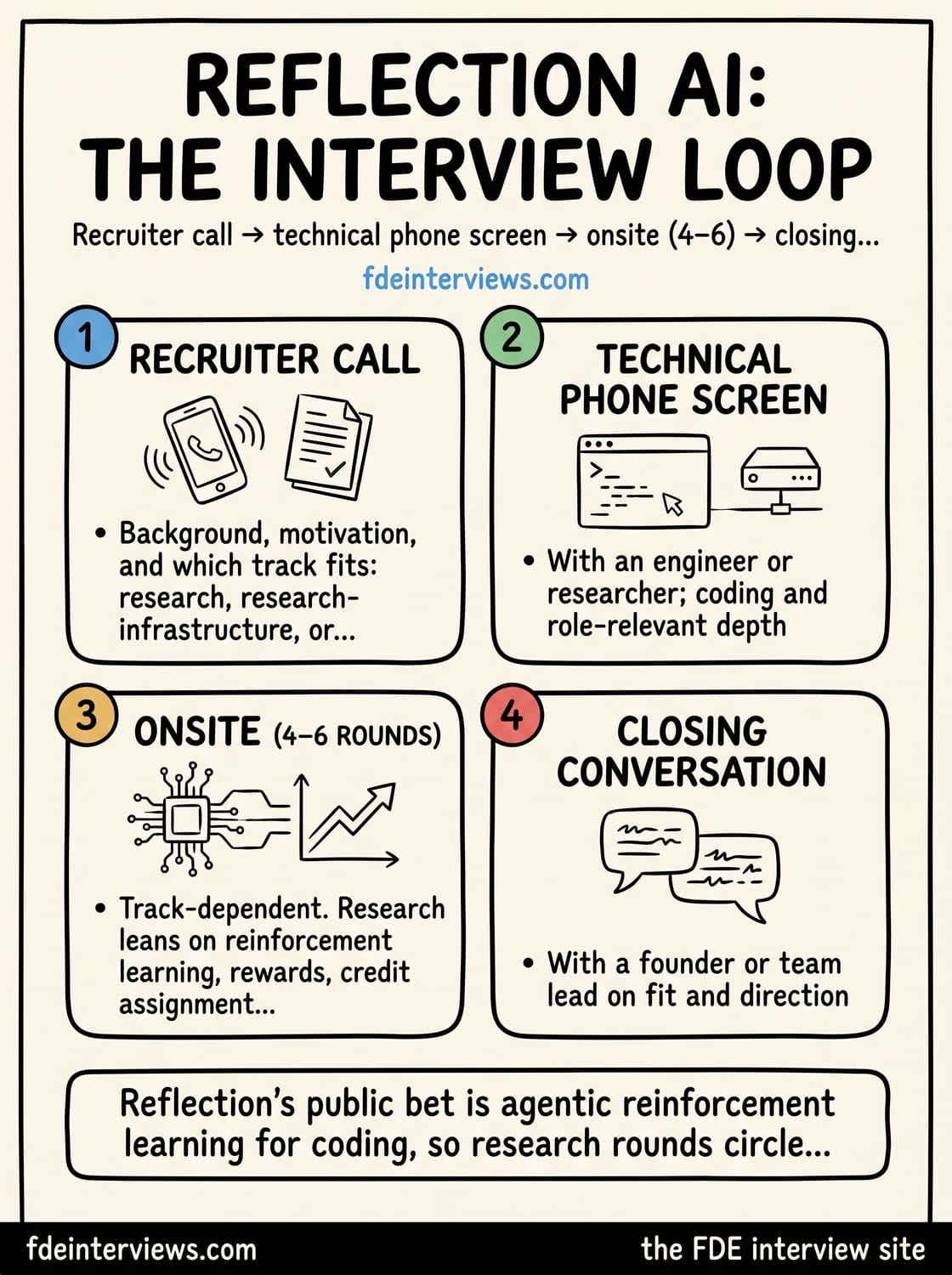
THE ONE-PAGE VERSION
Infographic of the Reflection AI interview loop, round by round: Recruiter call, Technical phone screen, Onsite (4–6 rounds), Closing conversation.
↧ DownloadShare on X ↗Share on LinkedIn ↗

Representative ML Engineer questions for Reflection AI's loop

Reflection AI's loop draws from these tracks. Here are the highest-signal questions in each, ordered by what candidates rate most useful.

16 questions · 16 unlocked for you

Go deeper on the topics Reflection AI's loop tests

The tracks that map to a Reflection AI ML Engineer loop, ordered easy to hard.

The concepts Reflection AI's ML Engineer loop assumes you know

The vocabulary and mental models behind Reflection AI's questions, from our curriculum. Start with the foundations free; the deeper, interview-defining ideas are part of premium.

FOUNDATIONS OF LLMS & GENAI

Foundational
Tokenization & TokensA language model does not read characters or words. It reads tokens: sub-word chunks produced by a tokenizer, each mapped to an integer the model embeds. Tokens are the unit of the context window and of billing, and the way text splits into them explains a surprising number of model quirks, which is why almost every loop opens here.
Foundational
The Context WindowThe context window is the fixed number of tokens a language model can attend to at once, and input and output share that same budget. Understanding it is what separates engineers who can size a prompt, control cost and latency, and decide when to reach for RAG from those who just paste everything in and hope.
Foundational
Embeddings & Vector RepresentationsAn embedding turns a piece of text into a list of numbers positioned so that similar meanings land near each other in space, which lets you search by meaning instead of by keyword. Embeddings are the engine under RAG, semantic search, clustering, and deduplication, so FDE loops expect you to explain cosine similarity and the pitfalls that quietly break a vector index.
Advanced🔒 Premium
LoRA and Parameter-Efficient Fine-tuningFull fine-tuning updates every weight in a model, which is expensive to train and produces a full-size checkpoint per task. LoRA freezes the base model and trains small low-rank adapter matrices instead, giving tiny swappable checkpoints; QLoRA adds a quantized frozen base so the whole thing fits on a single GPU. FDE loops probe it because it is how you adapt a model on a customer's data without their budget or their hardware blowing up.

RETRIEVAL & AGENTS

Foundational
Retrieval-Augmented Generation (RAG)RAG grounds a language model in your own data by retrieving relevant passages at query time and putting them in the prompt, so the model answers from real sources instead of memory. It is the default pattern for almost every enterprise FDE deployment, which is why nearly every loop tests it.
Foundational
Vector DatabasesA vector database stores embeddings alongside metadata and answers nearest-neighbor queries fast using approximate indexes. The real interview question is not how they work but when you actually need one instead of a library or plain Postgres with pgvector.
CoreSign in
Hybrid Search (Lexical + Vector)Hybrid search runs a keyword retriever (BM25) and a dense vector retriever side by side, then merges their result lists, because each one misses cases the other catches. Vectors lose exact codes and rare jargon, BM25 loses paraphrase, and combining them with Reciprocal Rank Fusion usually beats either alone.
Advanced🔒 Premium
Agent MemoryAgent memory is how an agent carries state across turns and sessions. Short-term memory is the conversation and scratchpad living inside the context window, bounded and expensive. Long-term memory is an external store the agent writes to and retrieves from on demand, usually via RAG, so it can recall facts from last week without holding them in the prompt. FDE loops probe this because the hard parts, summarization, what to persist, and stale or contradictory memory, are where agents quietly break.

ML INFRASTRUCTURE & SERVING

CoreSign in
GPU Memory and VRAMVRAM is the budget that decides which models you can actually run. It is spent on three things: model weights, the KV cache, and activations. Knowing the back-of-envelope arithmetic (a 7B model at fp16 is roughly 14GB of weights) is what separates a candidate who has deployed an LLM from one who has only read about it.
CoreSign in
QuantizationQuantization stores model weights (and sometimes activations) in fewer bits, fp16 down to int8 or 4-bit, which cuts memory and speeds inference. The quality hit is usually small at int8 and larger at 4-bit. Knowing post-training quantization versus quantization-aware training, and when each is acceptable, is standard FDE interview ground.
CoreSign in
Knowledge DistillationDistillation trains a small student model to mimic a large teacher, learning from the teacher's full output distribution rather than just hard labels. The soft targets carry extra signal about how the teacher 'thinks', so the student keeps much of the quality at a fraction of the size and latency. Knowing when distillation beats quantization or pruning is standard FDE ground when you have a latency or cost budget to hit.
Advanced🔒 Premium
Continuous BatchingStatic batching runs a fixed group of requests to completion together, so a batch of one short reply and one long reply makes the GPU idle while it waits on the longest. Continuous batching adds and evicts sequences from the running batch every decode step, keeping the GPU saturated and multiplying throughput. It is the scheduling trick at the heart of vLLM and every modern LLM serving stack.

CODING & ENGINEERING CRAFT

Foundational
Parsing Messy, Real-World DataCustomer files are dirty: inconsistent quoting, missing headers, junk rows, encodings that lie. The job is to parse defensively, skip and log bad rows instead of aborting the whole batch, and keep parsing pure and separate from business logic so it stays testable and deterministic. This is most of what early FDE data-ingestion work actually is.
Foundational
Big-O That Actually MattersOn a deployment, Big-O is not a whiteboard puzzle; it is the one calculation that tells you whether the customer's data fits in the approach you picked. The skill is spotting the term that dominates at their scale, knowing when brute force dies and you need an index or ANN, and recognizing when constant factors and memory decide the outcome instead of the exponent.
CoreSign in
Testability and Dependency InjectionCode that reaches out to the clock, the network, the filesystem, or a random generator cannot be tested deterministically, because its output depends on the world. The fix is to separate pure logic from side effects and inject the things that touch the world (the clock, I/O, randomness) so a test can pass fakes. When you inherit untestable code, pin its current behavior with a characterization test first, then refactor under that net.
CoreSign in
Streaming and BackpressureStreaming processes data one chunk at a time so memory stays flat no matter how big the input is. The moment a producer outruns its consumer, you need backpressure: a bounded buffer that makes the producer wait instead of piling unbounded work into memory. In Python this is generators and chunked reads for the streaming half, and a bounded queue (or a blocking put) for the backpressure half. Get it wrong and a 50 GB file or a fast upstream OOMs the box.

Where to apply, and official Reflection AI resources

Straight from Reflection AI: open roles and the company's own hiring guidance. Prep here, then apply there.

External links to Reflection AI's own pages. Roles and processes change; always confirm on the official site.

ABOUT THE ROLE
REFLECTION AI INTERVIEW FAQ
What is the Reflection AI ML Engineer interview process?

Research, research-infrastructure, or product engineering (tracks differ). Typical loop: Recruiter call → technical phone screen → onsite (4–6) → closing conversation with a founder or team lead. Stages: Recruiter call → Technical phone screen → Onsite (4–6 rounds) → Closing conversation. Key focus: Reflection's public bet is agentic reinforcement learning for coding, so research rounds circle around rewards, credit assignment, and evaluation more than architecture trivia. Compiled from public reports; loops change over time, so confirm the exact rounds with your recruiter.

Does Reflection AI hire Forward Deployed Engineers?
What does a Reflection AI interview test?
What is the Reflection AI salary?

Walk into your Reflection AI ML Engineer interview ready

Unlock every FDE interview answer, ordered easy to hard, plus the full concept curriculum, for 6 months. One payment, no auto-renewal. Free questions and concepts in each track, no card needed to start.

Or create a free account to unlock more free answers per topic.

Other ML Engineer interviews to prep

Companies whose loops test the same tracks as Reflection AI's.

Independent and not affiliated with Reflection AI. All trademarks belong to their owners.