
September 2026 / Included with Premium
The Forward Deployed Engineer Field Guide
A practical guide to making the move and doing the work.
Choose a role that fits your experience. Learn how to turn a customer problem into a bounded deployment, test whether it helps, and leave a system someone else can operate. Build evidence you can take into an interview.
The full PDF is included while your Premium access is active. Keep your downloaded copy for personal study.
Already a member? Sign in to download →

- illustrated pages
- 42
- practical chapters
- 16
- technical diagrams
- 8
- glossary terms
- 30
Look inside
Read the reasoning. Inspect the diagrams.
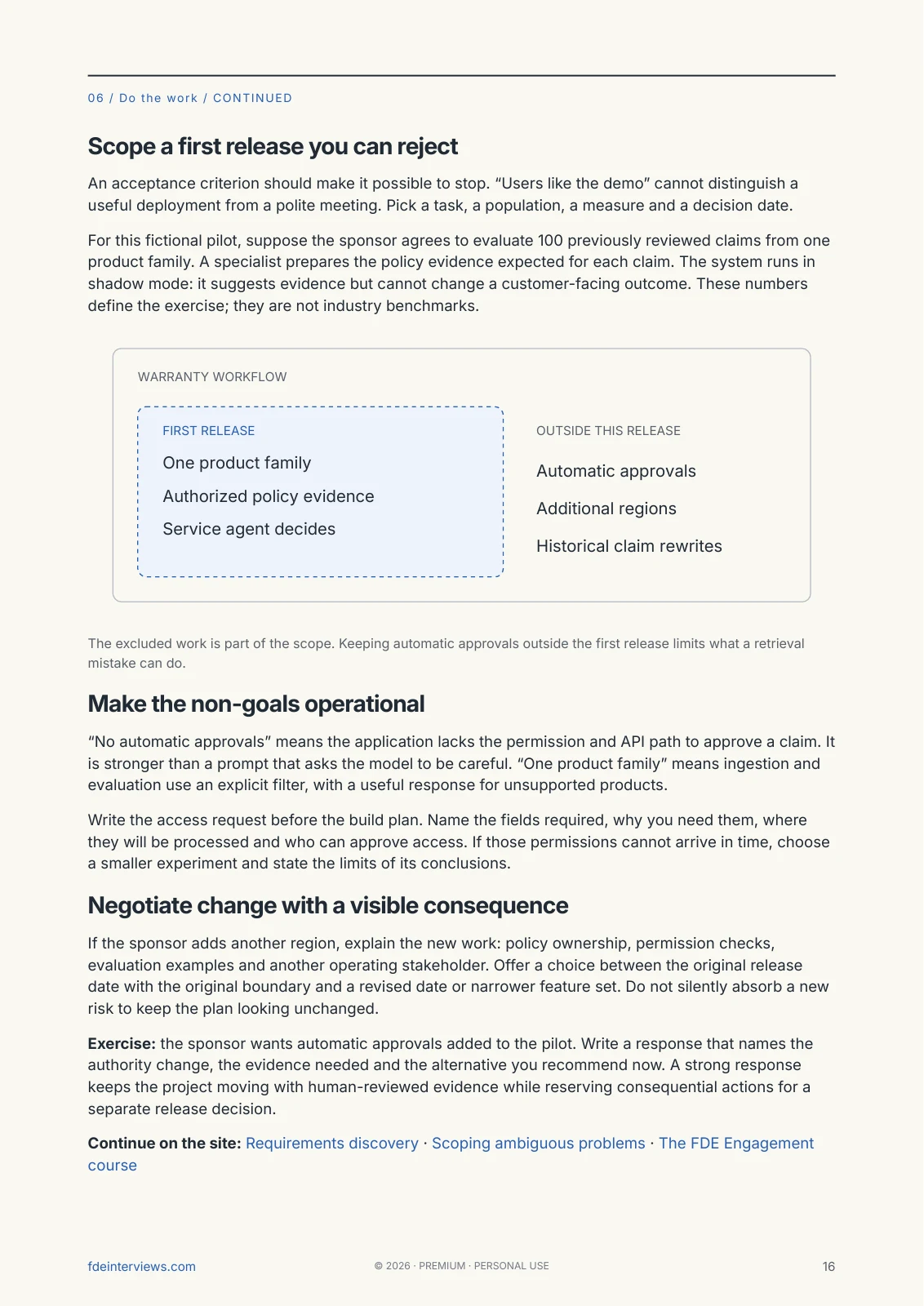
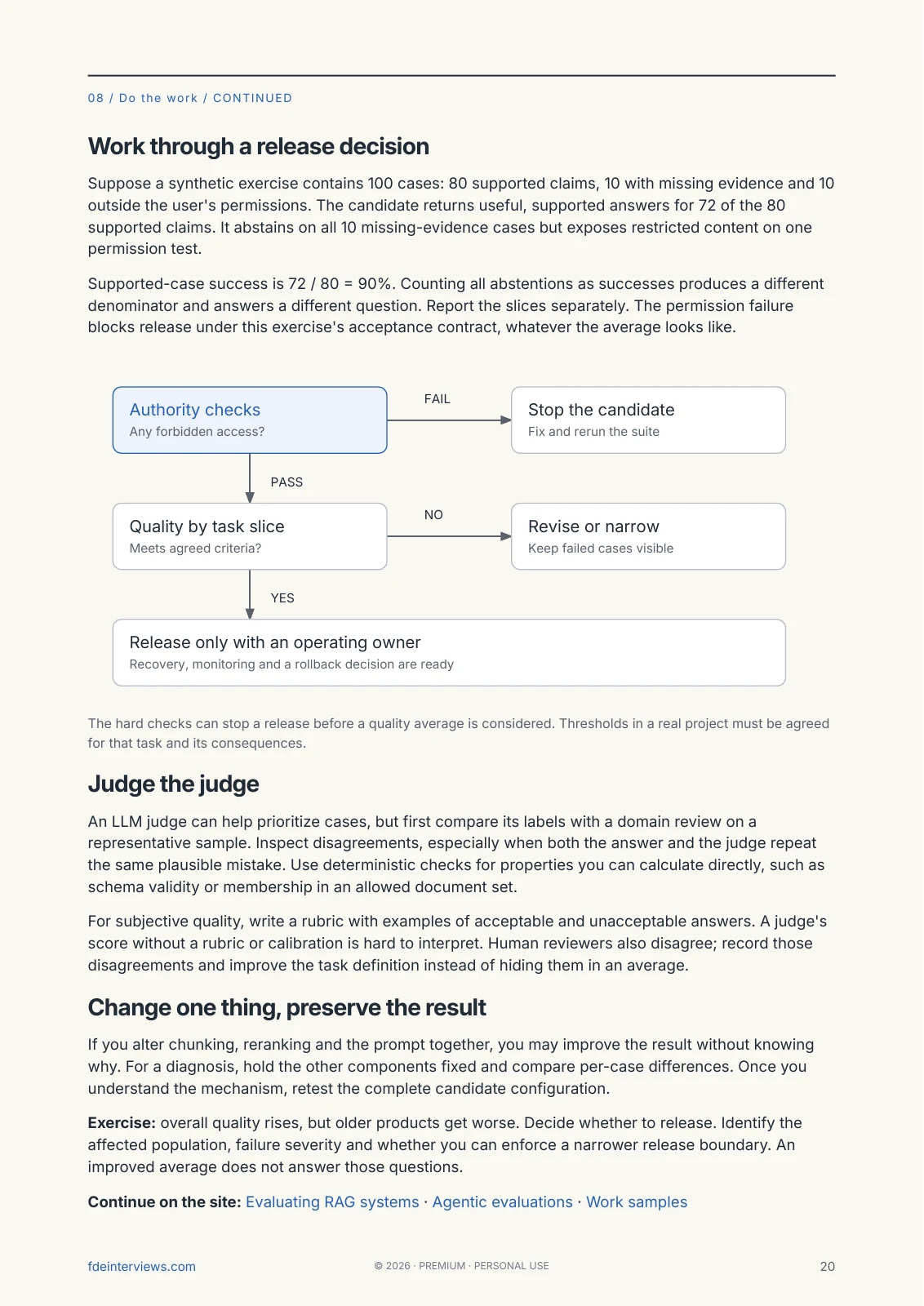
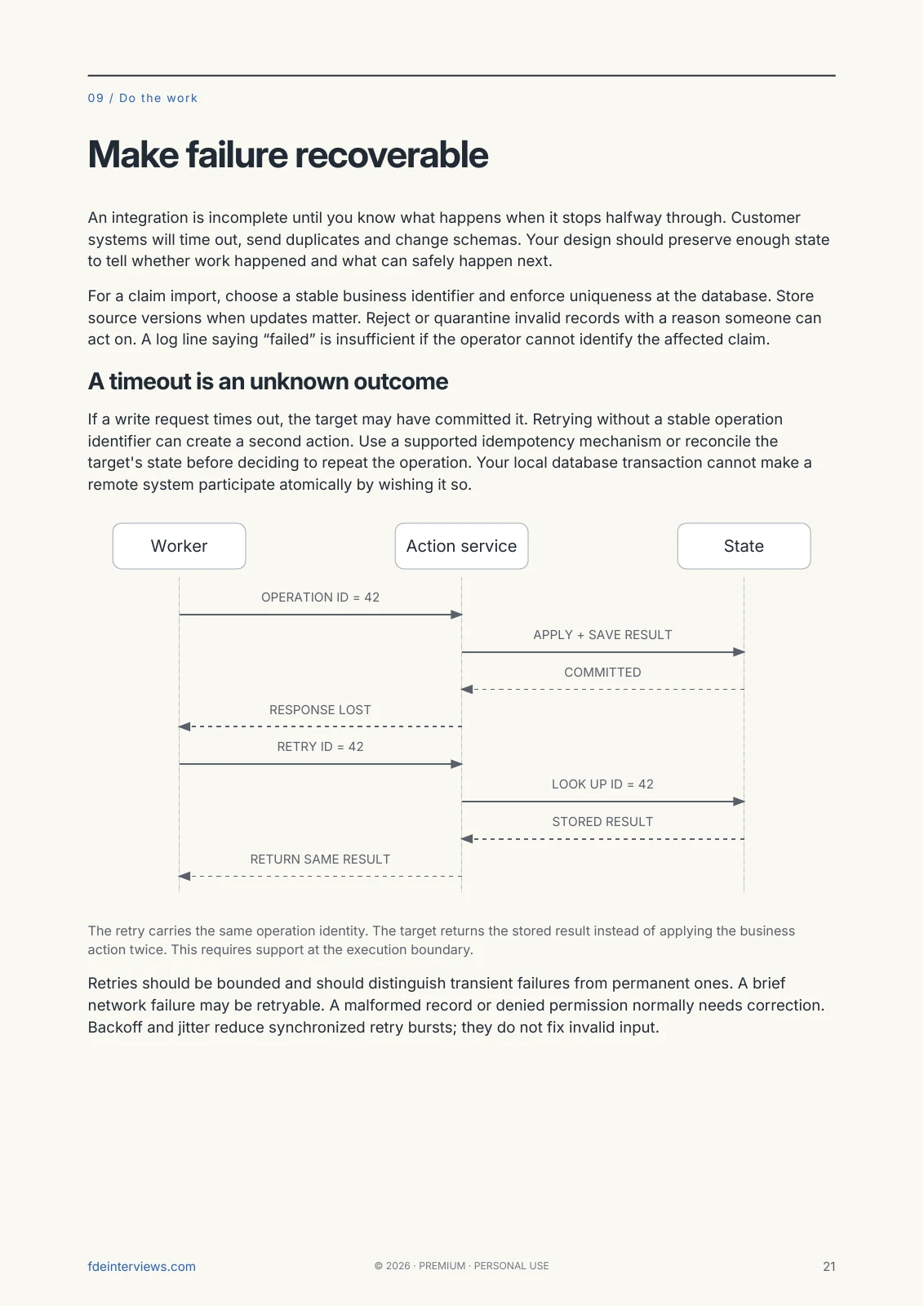
These are full pages from the PDF: a bounded pilot, an evaluation that can stop a release, and a write that can recover after a timeout. Open any page to read it at full size.
One case, followed through
A customer asks for a chatbot.
Where do you start?
The guide follows a fictional warranty-review workflow. You investigate why agents struggle to find the correct policy, then decide what the first release should prove. The same case continues through permissions, evaluation, recovery and value measurement.
It gives the engineering choices a context. A correct citation may still point to an obsolete policy. A useful answer may still cost more review time than it saves. The worked examples name those failures and ask what you would change.
All customer-case numbers are hypothetical teaching assumptions. No customer results or company interview rounds are invented.
Contents
A route from the role to the work.
- 01Choose the role · p. 5
Read the work behind the title
Separate the job description from the work you will actually own.
- 02Choose the role · p. 7
Decide what you want the move to change
Assess the daily work, commercial expectations and career costs before pursuing the title.
- 03Build the missing skills · p. 9
The software engineer's transition
Keep your production habits and learn to discover the right problem before implementing it.
- 04Build the missing skills · p. 11
The project and program manager's transition
Convert delivery experience into technical ownership with observable implementation evidence.
- 05Build the missing skills · p. 13
The engineering manager's transition
Test your current implementation depth and the economics of returning to direct delivery.
- 06Do the work · p. 15
Discover the decision before designing the system
Recover the workflow, the baseline and the people who can approve a useful first release.
- 07Do the work · p. 17
Choose the smallest system that can prove value
Decide when rules, retrieval, a fixed workflow or an agent are warranted.
- 08Do the work · p. 19
Build an evaluation that can change your mind
Separate retrieval, answer quality, authority and business usefulness.
- 09Do the work · p. 21
Make failure recoverable
Design for retries, partial completion, safe rollback and evidence during incidents.
- 10Do the work · p. 23
Measure value without inventing a success story
Calculate the economics of a workflow and distinguish an estimate from an observed result.
- 11Do the work · p. 25
Keep the customer informed and the boundary clear
Communicate uncertainty, negotiate scope and hand over a system someone else can operate.
- 12Prove your readiness · p. 27
Prepare for the work an interview can observe
Practice decomposition, implementation, technical judgment and customer communication without inventing a universal loop.
- 13Prove your readiness · p. 29
Build a portfolio a skeptical engineer can inspect
Produce a small engagement dossier with a working system, failures and a handover.
- 14Prove your readiness · p. 31
Search for responsibilities, then evaluate the offer
Find relevant roles across titles and compare the evidence behind each opportunity.
- 15Keep improving · p. 33
Run a four-week evidence sprint
Organize preparation around inspectable artifacts and adapt the pace to your actual gaps.
- 16Keep improving · p. 35
Make the work compound
Retain technical depth, extract reusable learning and choose your next role from evidence.
Also inside: two working templates, a 30-term glossary and a short list of official sources.
Keep learning from the page.
Clickable chapter links connect the guide to the material you can practice on the site. Start with the course that matches your experience.
Foundations →
Find the real task, understand the environment and deliver a first useful slice.
The FDE Engagement →
Carry a customer problem through scoping, evaluation, value and handover.
Hard Deployments →
Work through restricted environments, recovery and engineering that can be reused.
Study requirements discovery, permission-aware RAG and idempotency, then put them to work in a work sample.
The online companion
Read a chapter. Work through the decision.
Follow the guide into a worked question, a reference concept or a course exercise. Articles are public; questions, concepts and lessons follow their displayed access level. The exercises include synthetic inputs and make their evidence limits explicit.
01Chapters 1–5 and 14
Choose the role and assess your starting point
Write an evidence inventory and resolve the responsibilities the posting leaves unclear.
02Chapters 6 and 11
Turn discovery into an acceptance decision
Define the admitted workflow, evidence and approvals before committing to a release.
03Chapters 7–8
Choose a system and test its evidence
Compare a simple baseline with the AI approach, then test missing and inapplicable source material.
04Chapter 9
Make release and recovery inspectable
Rehearse a release and explain how the system behaves after a partial failure.
05Chapters 10–11
Reconcile value with actual use
Check the denominator, review effort and operating costs before presenting a benefit claim.
06Chapters 12–16
Defend your work and prepare the next engagement
Test a portfolio claim under changed requirements, then identify what another engineer can reuse.
Before you download
What is The Forward Deployed Engineer Field Guide?
An illustrated, 42-page guide to moving into forward deployed engineering and doing the work. It covers role selection, career transitions, discovery, AI system design, evaluation, production recovery, customer communication, interviews and portfolio evidence.
Who is the field guide for?
Software engineers, project and program managers, and engineering managers considering FDE work, plus practitioners who want a practical reference for customer engagements. The transition chapters distinguish each starting point instead of assuming the same skill gaps.
Do I need Premium to download the guide?
Yes. The complete PDF requires sign-in and active FDEInterviews.com Premium access. Three selected sample pages are public. The industry report, The State of Forward Deployed Engineering 2026, remains free with an account.
Is it included in my existing Premium access?
Yes. There is no separate purchase. You can download the guide while your Premium access is active and keep the copy for personal study. Redistribution, resale and public uploads are not permitted except where allowed by law or written permission.
How does the guide connect to the courses and concepts?
Chapter links lead to the site's concept explanations, question bank, work samples and the Foundations, FDE Engagement and Hard Deployments courses. The PDF includes clickable links and a reading route for each starting point.
Were AI tools used to create the guide?
Yes. AI tools assisted research organization, drafting, editing and illustration. FDEInterviews.com confirms that the guide was manually curated, compiled and reviewed by its human editorial team. The customer scenarios and worked numbers are hypothetical teaching examples.
Is this the forthcoming FDE Interview Book?
No. The Field Guide is available now and spans the career transition and customer work. The FDE Interview Book is a separate forthcoming title, currently planned for November 2026.
Your next customer problem deserves a clearer plan.
© 2026 FDEInterviews.com. Personal study only, subject to our Terms of Service and applicable law. The complete guide requires active Premium access; selected samples are public. AI-assisted, manually curated and reviewed by the FDEInterviews.com editorial team, as confirmed by the publisher. Independent educational material; no company affiliation or guarantee of interview or employment outcomes.