
Hard Deployments
The deployments that break people: open-weight models on hardware you did not buy, environments with no internet, one platform serving tenants who must never see each other, an engagement already on fire when you arrive, and the arithmetic that decides all of it. The hardest material on this site.
Every other course on this site is about doing the job well. This one is about the deployments where doing the job well is not sufficient, because the environment itself is hostile to the way software is normally built.
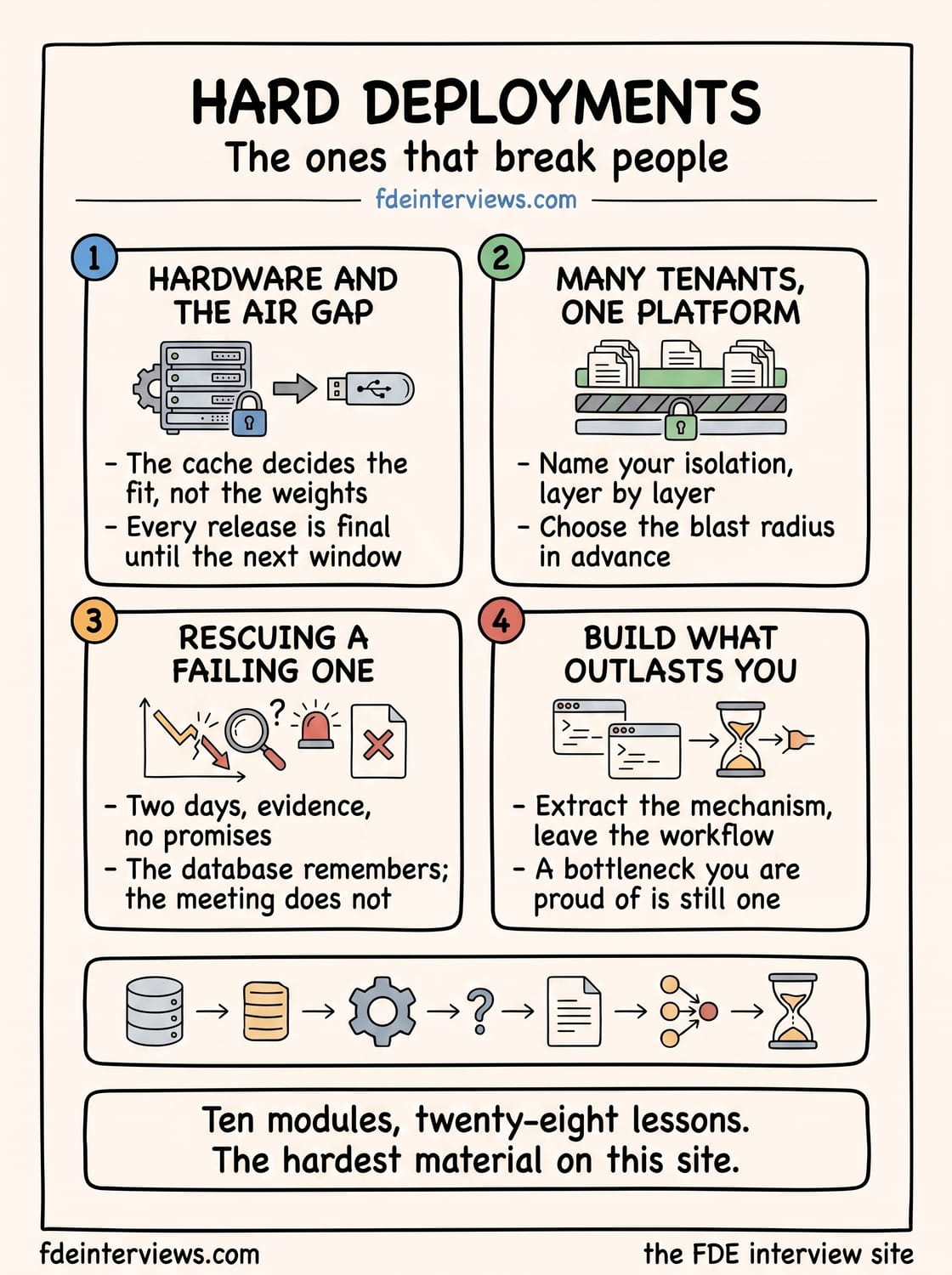
There is no internet. The hardware was bought two years ago by somebody who has left. The model weights have to cross a boundary on physical media, with a signature, and be validated by a person who is not you. Eleven tenants share one platform and two of them are competitors. The engagement has been running for five months, nothing works, and you have been given a fortnight.
None of that is exotic. It is where the largest contracts live, it is why the role exists at all, and it is the work that separates an engineer who can run a deployment from one an account will ask for by name.
This course is technical first. The arithmetic of whether a model fits in the memory available. The scheduler behaviour that decides whether one tenant can ruin the median for everyone else. The forensic method for proving what happened from rows in a table. Leadership is the last module rather than the theme, because at this level the influence follows the judgment rather than replacing it.
Two of these modules assume you will never have the access you want. Read them in order: the sequence is a deployment getting harder, and the later modules assume the constraints established in the earlier ones.
When you finish, you can
- Size and serve an open-weight model on hardware you do not control, and say why it fits before anyone buys it
- Deploy, update and evidence a system inside an air gap, where nothing calls home and every change is a one-way door
- Architect multi-tenant isolation you can actually defend, with quotas, fair scheduling and a bounded blast radius
- Find where the money and the milliseconds go across a portfolio, and pull the three levers that move them
- Run agents over long horizons: durable state, memory that does not rot, and oversight across a fleet
- Diagnose a failing deployment in 48 hours from logs and data, in a codebase nobody will explain
- Extract a real platform from three bespoke builds and migrate customers off the one-off without breaking them
BEFORE YOU START · The FDE Engagement, or several years running deployments end to end. You should already be comfortable with an eval harness, an entitlement model, and owning a production system inside somebody else's environment. This course assumes all of that and starts from there.

Syllabus
Serving on hardware you did not choose
The memory arithmetic that decides whether a model runs at all, the difference between throughput and latency once you are batching, and how to size a box before the customer buys it rather than after.
- Budget weights, resident cache and runtime memory in consistent units30 minfree
- Measure throughput and user latency before choosing a batching policy30 minsign in
- Hardware arrives on a procurement cycle and your estimate arrives in a meeting30 minpremium
- Measure throughput without losing the requests that failedproject180 minpremium
The air gap
Building for an environment with no route to the internet: vendoring everything your build silently assumes, moving an update through a one-way door, and producing the evidence a regulator will accept without ever phoning home.
One platform, many customers
Isolation you can defend to a security reviewer rather than describe in a diagram, scheduling that stops one tenant ruining the median for everyone, and a blast radius small enough that a bad hour is not a bad quarter.
Cost and latency across a portfolio
Finding where the money and the milliseconds actually go when you run many deployments, pulling the three levers that move them without quietly trading away quality, and planning capacity against a price ceiling somebody else set.
Autonomy over long horizons
What changes when an agent's work spans hours rather than seconds: state that survives the process dying, memory that stays useful instead of accumulating, and oversight of a fleet where the correlated failure is the one that hurts.
Rescue engineering
Walking into a deployment that is already failing: forming a defensible diagnosis in 48 hours without the people who built it, proving what actually happened from data rather than from accounts of it, and a fortnight's plan that restores confidence before it restores features.
- You have two days, no context, and everybody has a different theory30 minfree
- The database remembers what the meeting does not30 minpremium
- Build a recovery plan that fits the evidence, dependencies and available time30 minpremium
- Lab: diagnose a failing deployment from exports that disagree with the meetingproject120 minpremium
Reliability across a portfolio
Service levels that mean something when you run twenty deployments rather than one, running an incident inside an environment you cannot reach, and deciding in advance what the system does when the model it depends on is unavailable.
Extracting a platform from field code
Turning three bespoke builds into one thing worth maintaining: finding the abstraction that is really there rather than the one you hoped for, designing for variation without a configuration language nobody can read, and moving existing customers across without breaking them.
The practice
What makes the work repeatable by people who are not you: evaluation infrastructure that serves a fleet rather than a demo, field evidence packaged so the product roadmap can act on it, and a team where the hardest engagements do not all route to one person.
Capstone
One engagement that uses every module: an air-gapped, multi-tenant, already-failing deployment with agents in flight, three bespoke units to consolidate, and a price ceiling. The deliverable is a design and a set of decisions you can defend for two hours against somebody trying to break them.