
FDEInterviews logo
← The FDE reading room

The customer systems manual / September 2026

Systems Engineering
for Forward
Deployed Engineers

Design, ship, and operate AI systems in customer environments.

The demo works. Now the customer needs tenant isolation, a recovery path for failed writes, and a deployment their team can run. This is the engineering work that follows the architecture diagram.

95-page PDF + runnable Python companion. Included with active Premium access.

Already a member? Sign in to download

Systems Engineering for FDEs cover: illuminated blue paths connect the layers of a dark architectural model.

16 chapters / 4 engagements / 5 clinics

pages of worked reasoning
95
original technical figures
22
executable lab tracks
9
primary technical references
34

Defend the design.
Then prove it works.

For an FDE, system design starts with a customer promise and ends with evidence that another team can operate the result. A retrieval benchmark cannot tell you whether a revoked document will still reach a user. An architecture box labelled “human review” cannot tell you whether the queue fits the available staff.

Work through the decisions that close those gaps. Write acceptance tests. Calculate the memory and review budgets. Bind approval to the exact proposed action. Define what the service does after a timeout, during an outage and when the original engineer leaves.

Use it as a deployment reference or to strengthen the production reasoning behind an FDE, FDSE or Forward Deployed AI Engineer system design interview.

Open the book

Three pages. Three decisions that matter.

These are complete pages from the downloadable PDF. Open any preview to read the diagrams and annotations at full size. Each preview includes a reading note explaining what to look for.

The design changes with the customer

Four engagements.
Four different constraints.

Follow each original teaching scenario from the customer brief into architecture, capacity and failure handling. Names, workloads and numerical inputs are synthetic; they are not reports of real deployments.

Engagement A / Industrial operations / pages 55–58

The maintenance evidence workbench

The right manual can still be the wrong evidence.

A technician needs instructions for a specific equipment variant. Design ingestion and retrieval around document versions and current permissions, then carry those constraints through citations and the final response.

You work through: Evidence-generation architecture, retrieval scope and release checks.

Engagement B / Document workflows / pages 59–62

Supplier onboarding with an audit trail

Extraction accuracy has to fit the review team's capacity.

Connect packet extraction to evidence review, immutable approval and a durable registry write. Work through the staffing arithmetic and the recovery path when a write succeeds but its response disappears.

You work through: Review-capacity calculation, approval boundary and write-recovery design.

Engagement C / Restricted networks / pages 63–66

A shift handover that works offline

The site must keep working when the network stops.

Define what a local evidence package contains, how long its authorization remains usable and which actions the disconnected mode permits. Reconcile versions and conflicts when the connection returns.

You work through: Package lifecycle, access-lease policy and reconnection rules.

Engagement D / Batch processing / pages 67–70

Service-record enrichment before morning

A completed job is a manifest you can reconcile.

Plan a 96,000-record teaching workload against an eight-hour window. Calculate worker and token demand, preserve per-record versions, and account for retries and unresolved items before declaring completion.

You work through: Capacity worksheet, record-state model and completion criteria.

Inside the 95-page guide

The whole deployment lifecycle.

Sixteen core chapters lead into the engagements, five focused engineering clinics and a workbook. Each chapter connects a customer obligation to a mechanism and a way to check it.

01 / Define the system

Pages 7–18

  1. 01

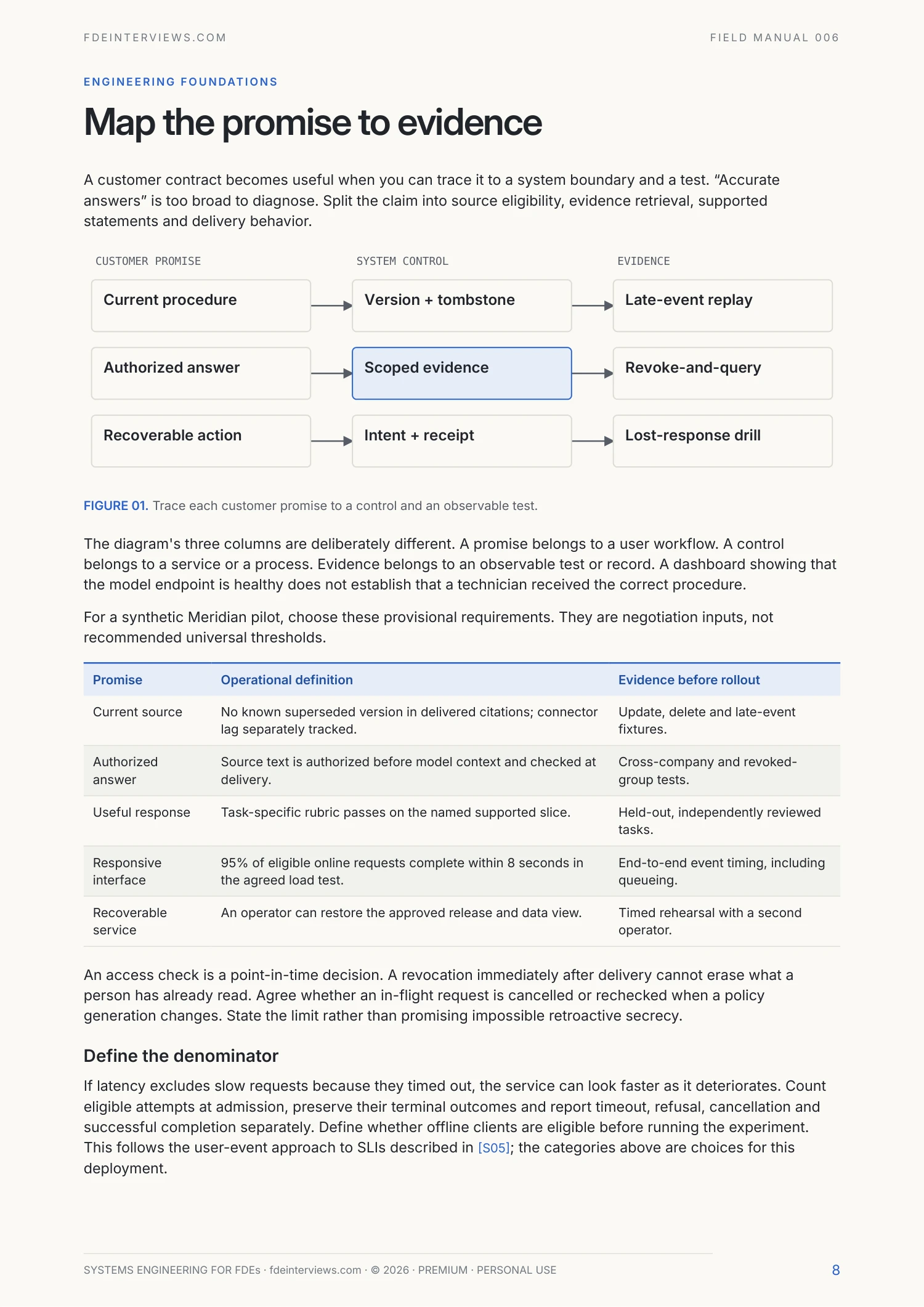
    Turn a request into a contract

    Acceptance criteria, observable evidence and assumptions that still need an owner.

  2. 02

    Choose the smallest useful mechanism

    Prompting, retrieval, model selection and when adaptation earns its cost.

  3. 03

    Make the data contract explicit

    Versions, tombstones, connector repair and live index changes.

  4. 04

    Preserve evidence through extraction

    OCR, tables, source regions and the human review queue.

02 / Build the serving path

Pages 19–30

  1. 05

    Retrieve inside the access boundary

    Lexical and dense retrieval, reciprocal rank fusion and evidence eligibility.

  2. 06

    Build context as a bounded artifact

    Token reservations, memory, citations and context failure modes.

  3. 07

    Put a contract around inference

    Routing, asynchronous task APIs, streaming and reconnection.

  4. 08

    Calculate capacity in the right units

    Weight memory, KV cache, concurrency and cost per accepted task.

03 / Bound failure

Pages 31–42

  1. 09

    Budget the whole request

    Bursts, queueing, deadlines and retry allowances.

  2. 10

    Cache a scoped result

    Cache scope, permission generations and revocation before delivery.

  3. 11

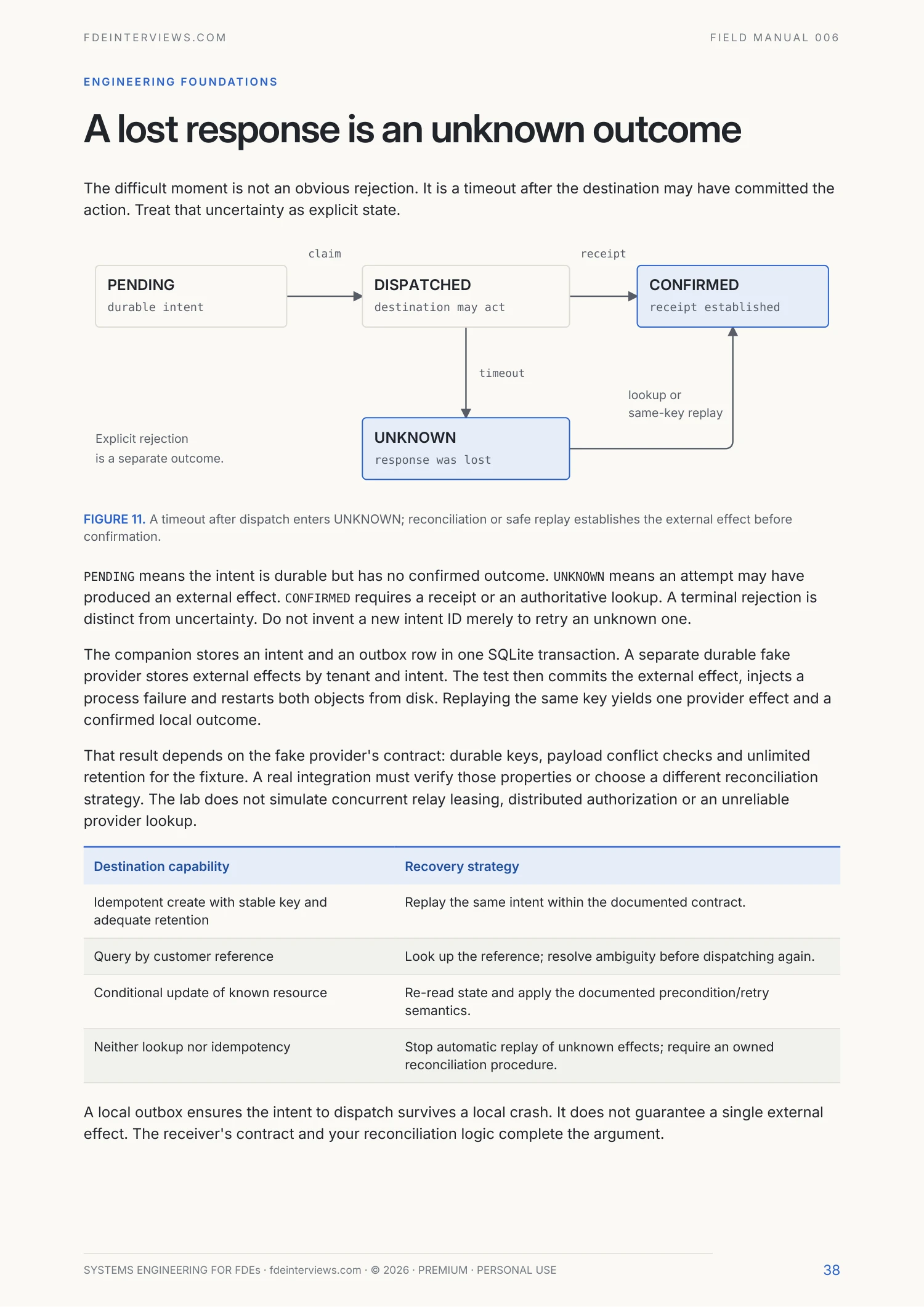
    Make actions durable and explainable

    Durable intent, approval binding, unknown outcomes and reconciliation.

  4. 12

    Evaluate the promised outcome

    Task slices, forbidden effects, confidence bounds and release gates.

04 / Put it in the customer's hands

Pages 43–54

  1. 13

    Put authority outside the prompt

    Identity, tenant isolation, generated SQL and independently enforced policy.

  2. 14

    Design for the customer's environment

    Customer-hosted infrastructure, restricted networks and offline modes.

  3. 15

    Observe the customer outcome

    Observability, service-level objectives, incident diagnosis and containment.

  4. 16

    Roll out a complete system version

    Rollout, rollback, source repair and an operator who can run the system.

Five clinics for the harder edges

Pages 71–80

  1. ARepository-aware retrieval

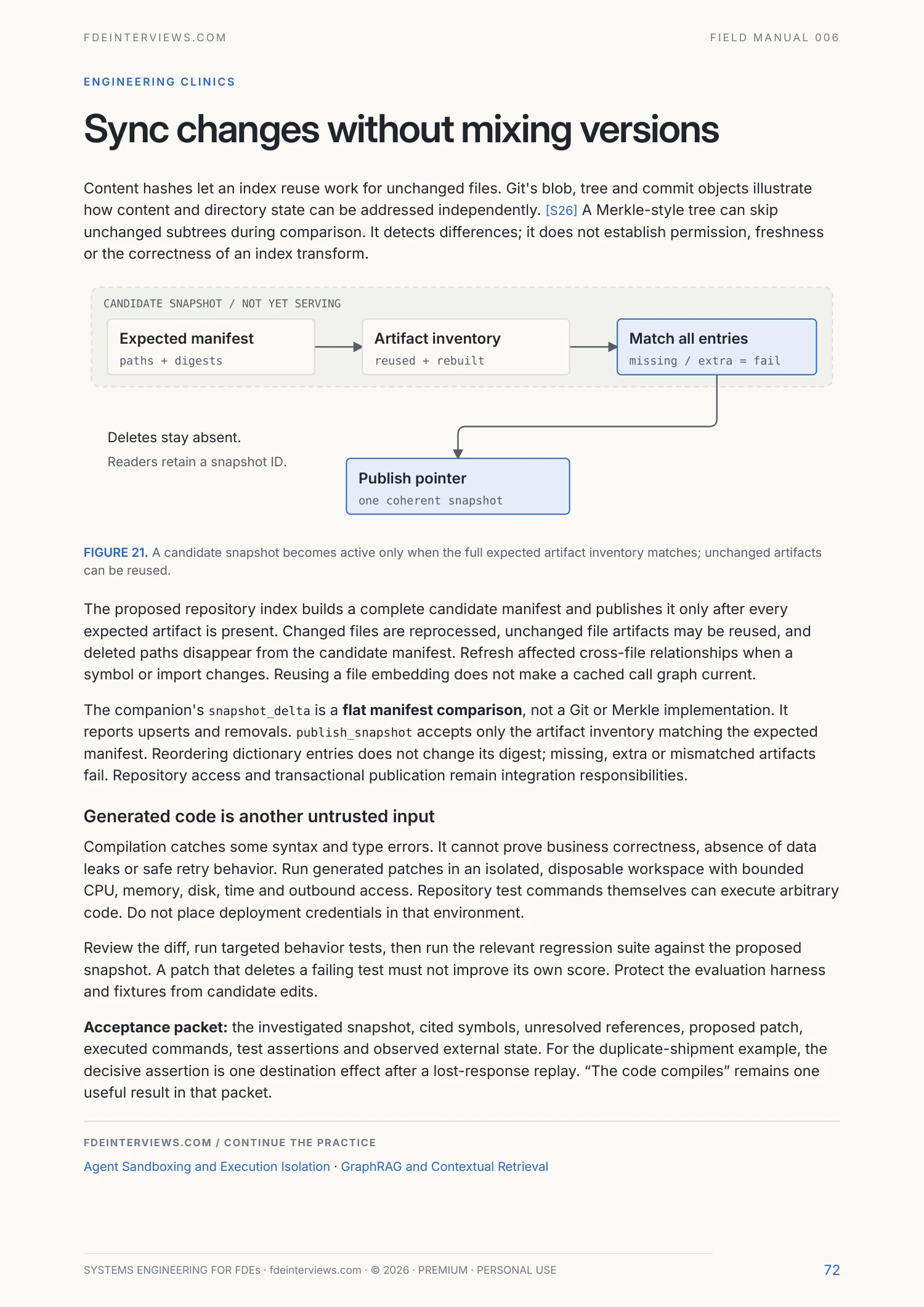
    Publish coherent snapshots, retain code provenance and decide whether graph structure improves the task.

  2. BTyped queries and ranking

    Turn a parts request into a constrained query plan and examine ranking with NDCG.

  3. CPrepared crew briefs

    Separate preparation, review and delivery; calculate when the approved-item queue needs refilling.

  4. DAgent resumption and dependency failure

    Recheck authority on resume, constrain tool protocols and reason about circuit breakers and retries.

  5. EModel adaptation and supply chains

    Put LoRA, QLoRA, runtime reproducibility and artifact provenance inside a release contract.

The workbook adds acceptance and failure worksheets, a lab route, a glossary and links back into the learning library. Nine pages of references record the technical sources.

Included / Python companion

Run the contracts.
Introduce the failure.

Nine lab tracks let you inspect revisions and tombstones, scope a cache, reserve context, budget queue deadlines, reconcile durable actions and test snapshot completeness. Ranking and release gates make their assumptions executable.

The distributed ZIP passed 78 tests and detected nine deliberately broken implementations. Run it locally with Python 3.10 or later. No API keys, paid model calls or GPU are required.

A useful lab has a failure it can catch

Permission scope
A cache that ignores a changed permission generation must fail.
Durable actions
An intent cannot silently change its payload during recovery.
Snapshot publication
An incomplete artifact inventory cannot become the active snapshot.

These are deterministic teaching models. Passing them does not verify a real provider, a model's answer quality or a concurrent production deployment.

Keep learning from the design you are working on.

The PDF links directly to concepts, interview questions and courses. Use this same reading path online when a design exposes a gap. Each resource keeps its displayed access level.

Before you download

What is systems engineering for a Forward Deployed Engineer?

It is the work of turning a customer requirement into a system that can be accepted, deployed, operated and repaired in that customer's environment. For an AI deployment, that spans data contracts, retrieval and inference, permissions, external actions, evaluation, capacity, incident response and handoff. This guide follows those responsibilities through one lifecycle.

Who should read this FDE system design guide?

Software engineers, AI engineers and Forward Deployed Engineers who can already read code and want to reason about customer deployments. It also supports FDSE and Forward Deployed AI Engineer interview preparation when you need to defend how an architecture behaves under production constraints. It assumes basic familiarity with APIs, databases and Python.

How is it different from The Agentic System Design Round?

The Agentic System Design Round is a compact collection for rehearsing ten worked design scenarios. Systems Engineering for FDEs is a 95-page engineering manual organized around the deployment lifecycle, with 16 chapters, four extended customer engagements, five engineering clinics and nine executable lab tracks. Both are included with Premium.

Does the guide cover RAG, agents and production LLM architecture?

Yes. It covers permission-aware retrieval, context budgets, routing, KV-cache memory, scoped caching, durable agent actions, evaluation and deployment. Those mechanisms sit alongside data ingestion, review capacity, security, offline operation and handoff, so you can connect a model decision to the surrounding system.

What is included in the download?

The 95-page PDF and a separate Python companion ZIP. The PDF contains 22 original technical figures, four worked engagements, five clinics, worksheets and 34 primary technical references. Clickable links connect the material to the site's concepts, interview questions and courses. Existing Premium members do not need a separate purchase.

Can I run the companion without paid APIs or a GPU?

Yes. The companion uses Python 3.10 or later and the standard library, with no model calls or API keys. Its nine lab tracks cover contracts such as revisions, retrieval and caching, context arithmetic, evaluation gates, queues, durable actions, snapshots and ranking. The distributed archive passed 78 tests and detected nine deliberately introduced defects.

Are these real customer projects or production benchmarks?

No. Customer names, workloads and numerical inputs are synthetic teaching examples. The executable checks validate selected arithmetic and modelled contracts; they do not establish real provider behavior, LLM quality or production concurrency. Primary references are cited for the technical mechanisms.

Can I preview the guide before getting Premium?

Yes. Three complete sample pages, the chapter outline, engagement summaries and the online study path are public. Sign in with active Premium access to download the complete PDF and companion. You may retain your downloaded copy for personal study under the site's terms.

How was the guide checked?

AI tools assisted drafting, research organization, illustration and verification. The publisher reviewed the guide. Checks covered source links, worked calculations, the extracted companion archive, PDF links and page layout. These checks are evidence about this educational artifact, not certification of a production system.

Systems Engineering for FDEs

Take the design all the way to handoff.

The complete 95-page guide and Python companion are included with active Premium access. Keep your downloaded copy for personal study.

© 2026 FDEInterviews.com. Personal study under our Terms of Service. Independent educational material. Synthetic scenarios and worked assumptions are labelled throughout.