
September 2026 / Included with Premium
The Agentic
System Design Round
Worked designs under customer constraints.
A payment request times out after the refund succeeds. An invoice pipeline needs more reviewers than the customer has. An evaluation improves on average while allowing a forbidden action. Work through ten designs where the customer constraints determine the architecture.
Already a member? Sign in to download →
- pages
- 38
- worked cases
- 10
- vector diagrams
- 10
- companion checks
- 15
Read the reasoning before you download.
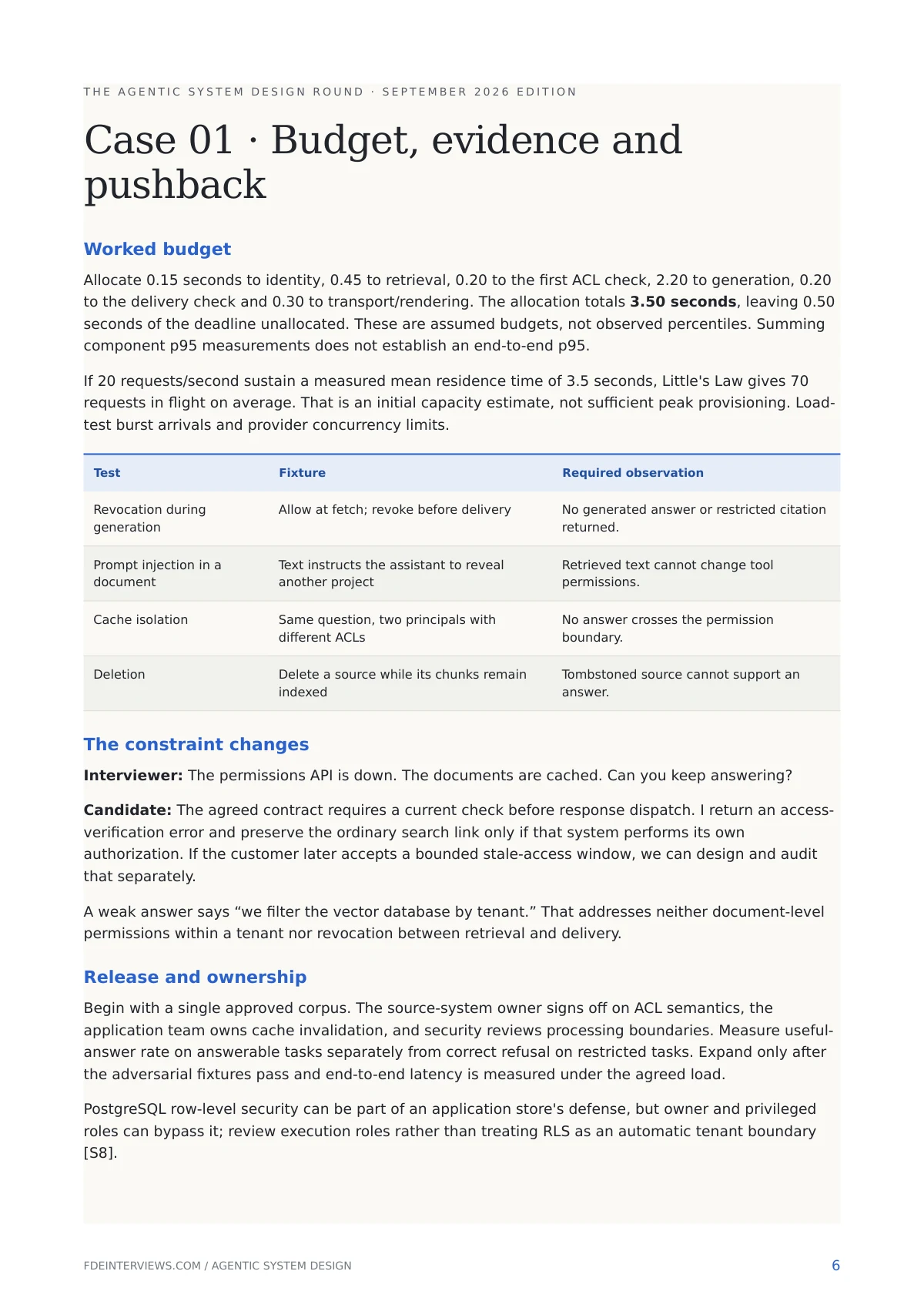
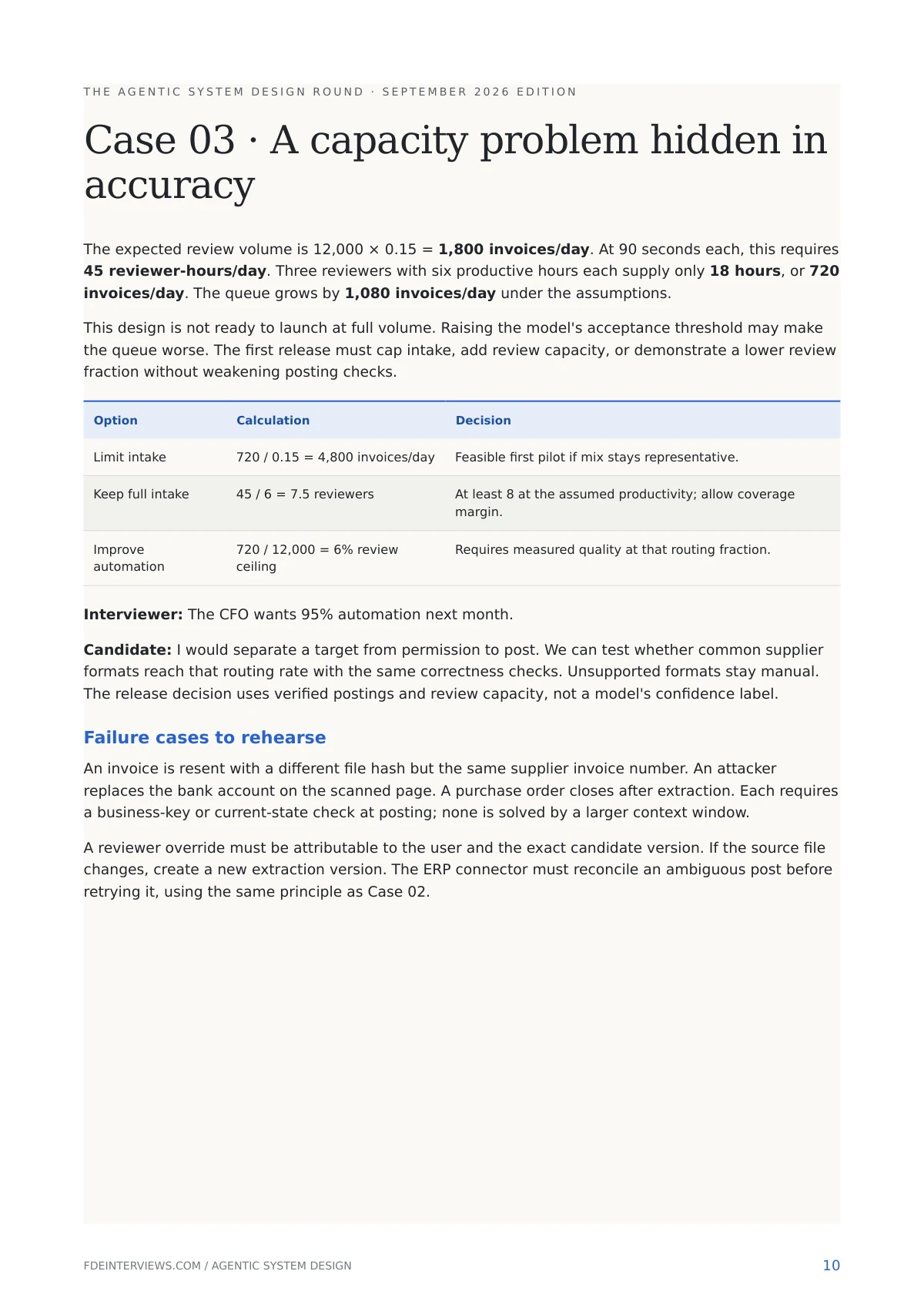
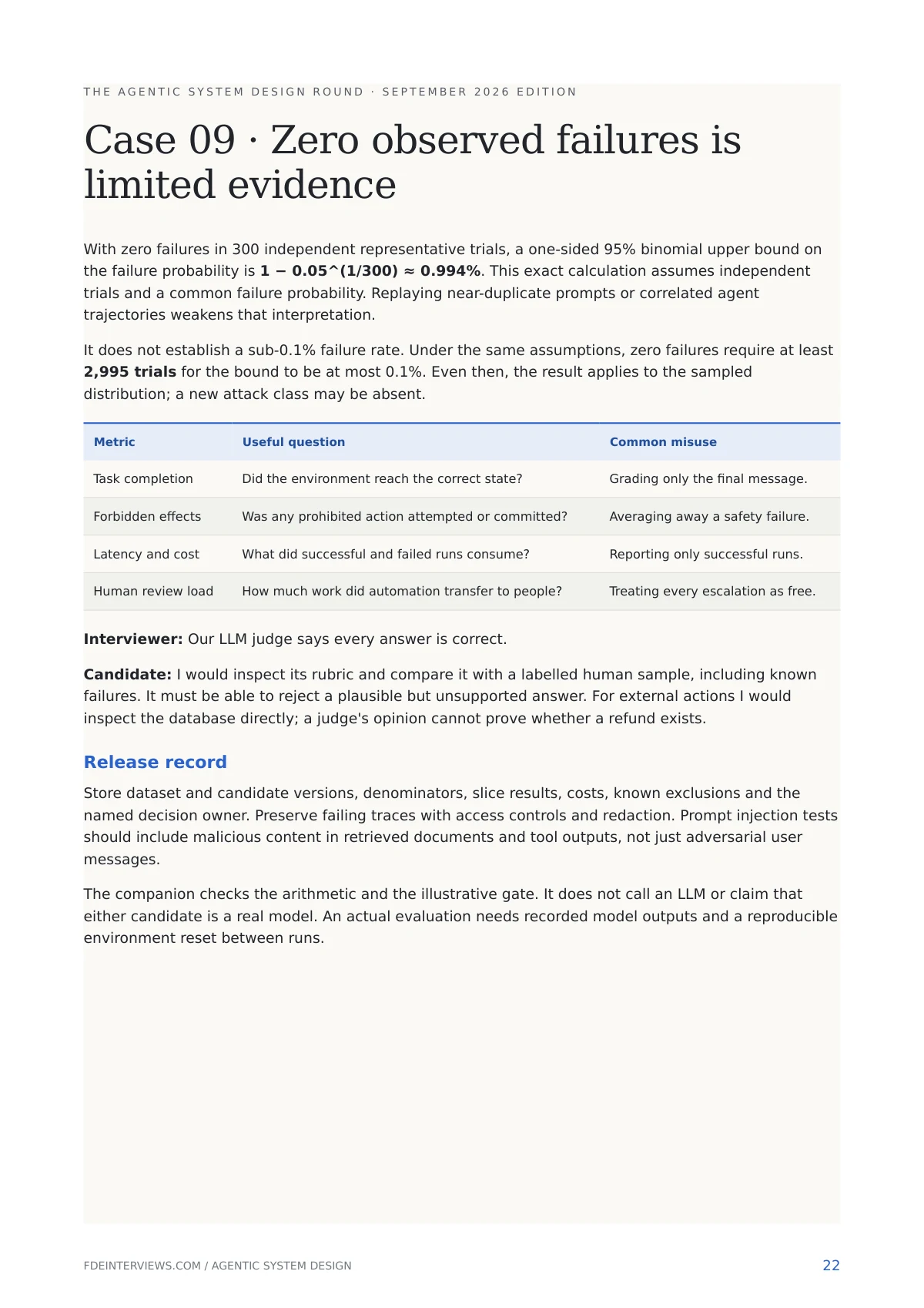
Three complete pages from the PDF: permission checks under a latency budget, a review queue that cannot keep up, and the limits of a zero-failure evaluation. Open each page at full size.
Ten customer constraints to design around.
CASE 01
Answers behind permissions
Authorize retrieved documents and check access before dispatching an answer.
CASE 02
The refund that timed out
Keep an unknown outcome distinct from failure and reconcile before another write.
CASE 03
Invoices with an audit trail
Connect extraction evidence to human review capacity and the ERP posting decision.
CASE 04
An MCP gateway with a small authority boundary
Separate tool arguments from authority and keep credentials outside model context.
CASE 05
Finish the batch before morning
Size worker concurrency, token quota and retry spend against a deadline.
CASE 06
Stop an agent that cannot finish
Enforce execution limits outside the model and preserve a useful handoff.
CASE 07
Approval that survives a changed plan
Bind approval to the exact proposal and handle duplicate dispatch.
CASE 08
Replace a rules engine without losing control
Keep one authoritative writer and define the repair work left after rollback.
CASE 09
An evaluation that can block release
Separate forbidden effects from average quality and interpret zero failures correctly.
CASE 10
Research agents with a spending limit
Defend parallelism using a critical path, evidence requirements and a shared budget.
The guide also includes design clinics, an original mock discussion, a practice rubric and worksheets. All scenarios and numerical inputs are labelled teaching assumptions. The sources support technical mechanisms, not employer pass rates.
Work the case. Study the mechanism.
These links also appear in the PDF. Questions, concepts and course lessons keep their displayed access levels.
Cases 01 and 04
Keep retrieved evidence inside its permission boundary
Cases 02 and 07
Recover actions and bind approvals
Cases 03, 05 and 06
Size queues, review capacity and execution budgets
Cases 08 and 09
Make rollout depend on evidence
Case 10 and the mock discussion
Defend the orchestration choice
Before you download
Is the guide included with my existing Premium access?
Yes. The complete PDF and verification companion are included while your Premium access is active. There is no separate purchase. Three sample pages are public.
Are these actual employer interview questions?
No. The cases, dialogues, workloads and prices are original synthetic teaching examples. Primary engineering references support the mechanisms; they do not establish employer interview formats or hiring outcomes.
What does the companion validate?
Fifteen deterministic Python checks recompute the worked numbers and exercise selected synthetic invariants, including refund replay and approval binding. They use the standard library and need no API keys. They do not validate real providers, LLM quality or concurrent database behavior.
How should I use the online study path?
Attempt a case before reading its worked design. Then use the linked concepts, questions and course lessons to study the decision you could not defend. Those resources keep their existing access tiers.
How was the guide reviewed?
AI tools assisted drafting, research organization, diagrams and verification. The publisher reviewed and approved the guide. The arithmetic and selected failure semantics were checked with executable examples, and the PDF was inspected for layout defects.