
September 2026 / Included with Premium
The Forward Deployed Engineer Case Rounds
Worked decompositions, customer conversations and the rubric that scores them.
Three rounds where a correct engineer still loses: the decomposition, the customer conversation and the learning round. Eight worked cases and six conversations, each with a transcript that passes and one that loses, annotated at the sentence where the score moved, plus an eight-dimension editorial practice card, drill cards and interviewer scripts so a friend or a model can run the round against you, and a real codebase for the learning round.
The PDF and the practice kit are included while your Premium access is active. Keep your copies for personal study and practice.
Already a member? Sign in to download →
- pages
- 100
- decomposition cases
- 8
- customer conversations
- 6
- practice kit files
- 35
What you will be able to do
Six habits, each scored from a sentence you said.
Written for two readers: the candidate with a loop next week, and the engineer who wants the job and has no interview yet.
- Find the decision behind any prompt in the first four minutes: who decides, on what schedule, and what a wrong answer costs in each direction.
- Ask the two or three questions that change the design before you draw anything, and treat a rate without a denominator as a question, not a fact.
- Choose a first slice small enough to be true, name what you cut and why, and change the board under pushback without collapsing or digging in.
- Walk into a conversation with someone who did not ask for you, learn what they must decide, say no when no is the answer, and leave with a next step that has a name and a date.
- Orient in a codebase you have never seen, find where state changes, make the smallest change that satisfies the task and prove it with a test at the boundary.
- Score your own recording using the practice card, from sentences rather than impressions, and know which two dimensions you lose.
Look inside
Read the method. Then read a board.
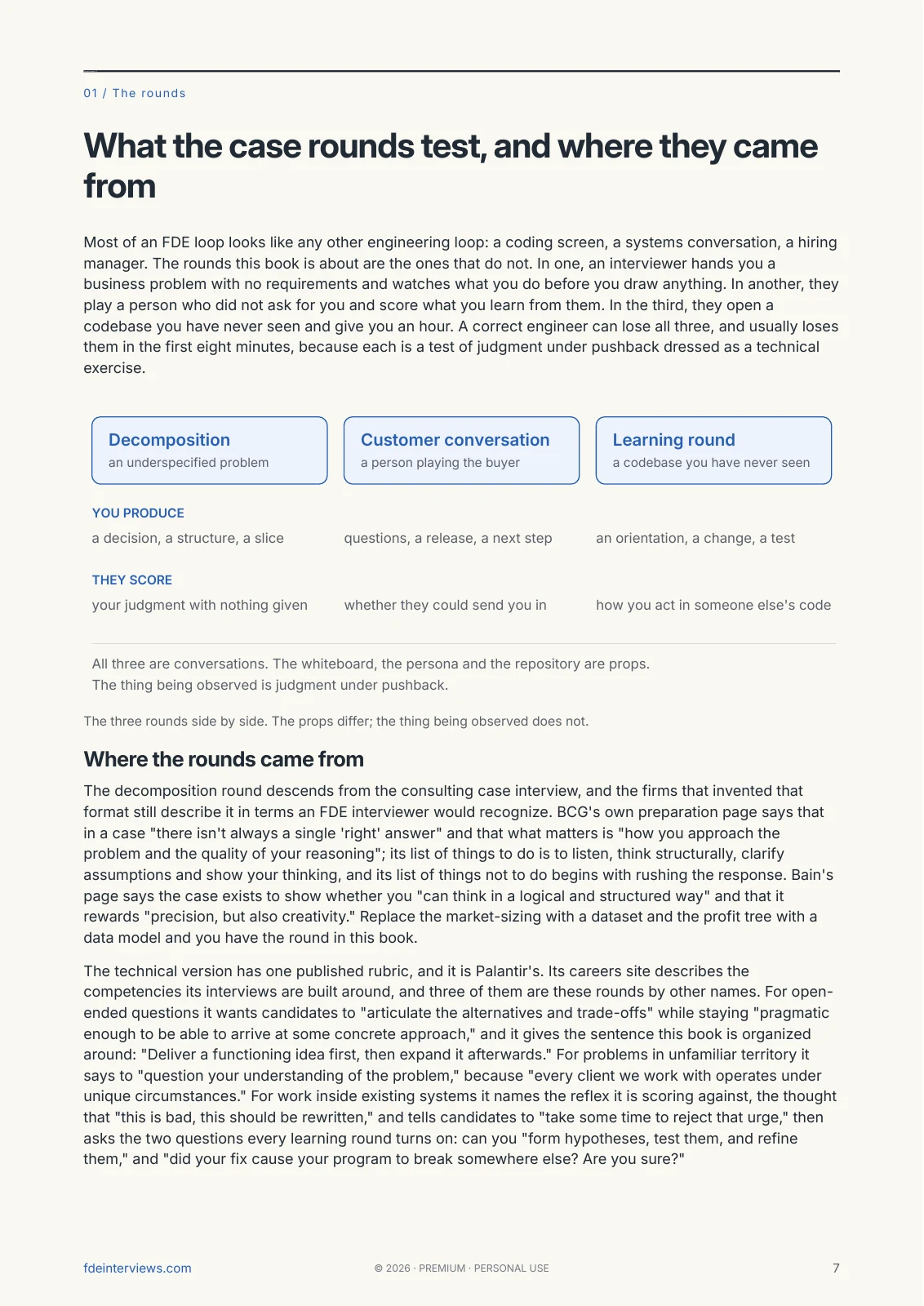
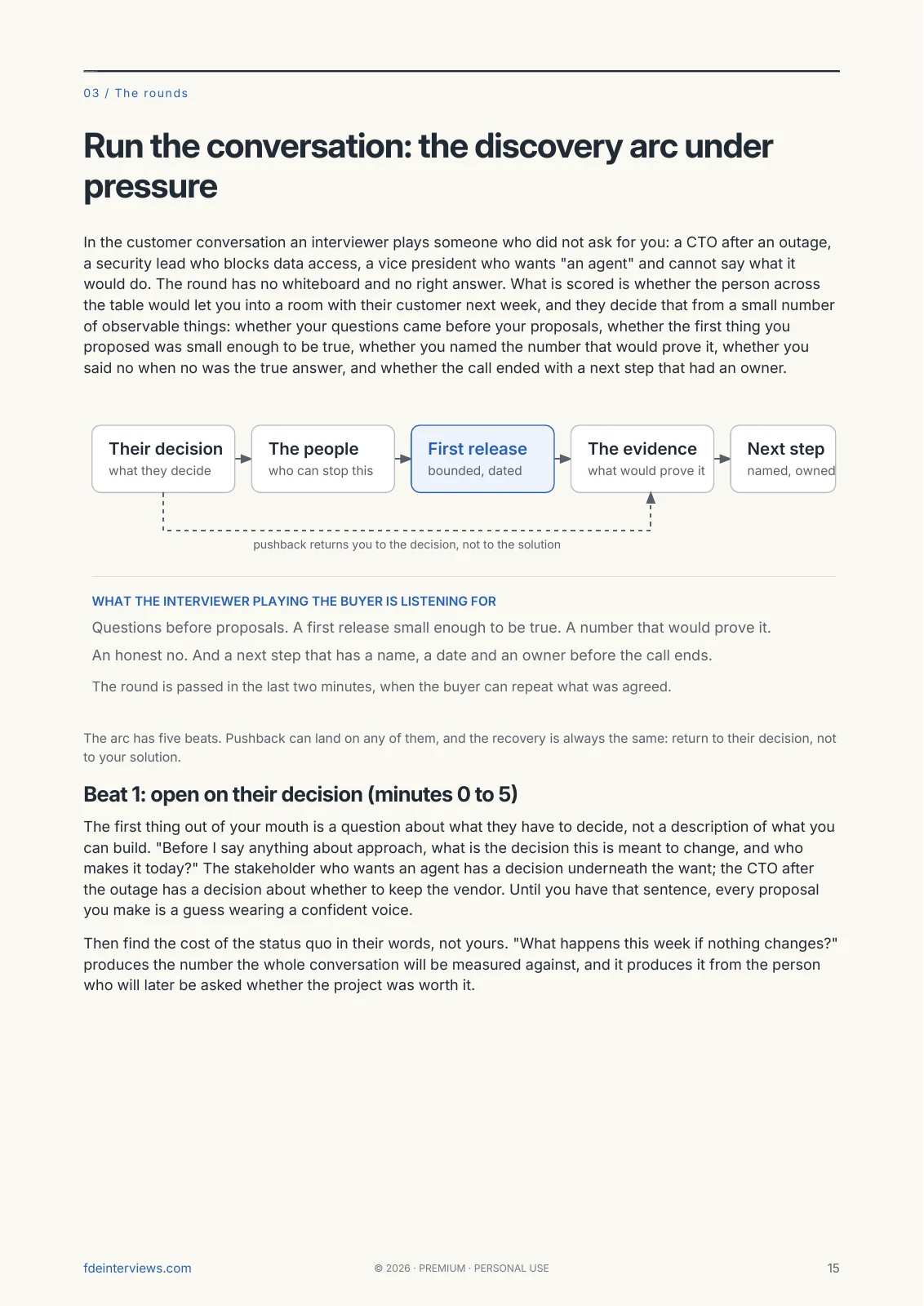
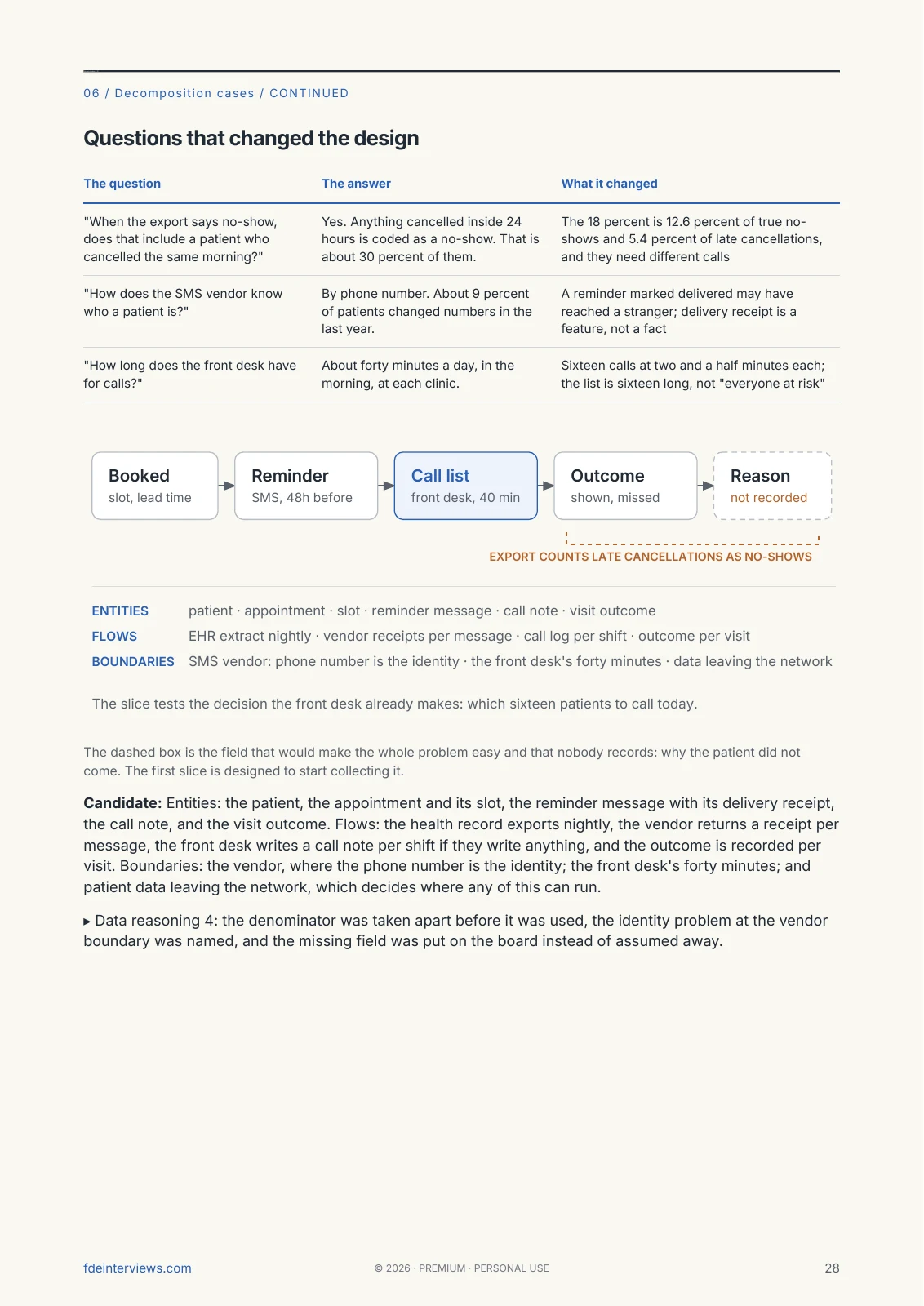
These are full pages from the PDF: what the three rounds test and where they came from, the five moves of a decomposition with the clock beside each, and a case on the board with its entities, flows and boundaries drawn the way the round expects. Open any page to read it at full size.
The decomposition cases
Eight prompts, three levels, forty-five minutes each.
- 01beginner · Data and integration · 45 min
The container terminal that pays for every slow truck
Find the decision behind the penalty; ask which clock the number is on. Taught in depth: Scoping ambiguous problems.
- 02beginner · Deployment and operations · 45 min
The clinic network whose appointments go unused
Separate a cancellation from a no-show; give the front desk forty minutes, not a model. Taught in depth: Golden dataset.
- 03intermediate · Data and integration · 45 min
Two acquired banks, one fraud picture
Join the two banks before either rule engine; count realized loss, not attempted. Taught in depth: Deduplication and LSH.
- 04intermediate · Deployment and operations · 45 min
The utility whose dispatchers assign crews by radio
Name the person accountable every forty minutes; keep them deciding. Taught in depth: Bounded autonomy and human-in-the-loop.
- 05intermediate · Applied AI · 45 min
The retailer that wants an assistant for every store manager
Decide what a model may answer from four sources of unequal trust. Taught in depth: Text-to-SQL.
- 06intermediate · Applied AI and operations · 45 min
The airline whose controllers reschedule crews by phone
Put the model at the edge of the design, behind the legal limit, not at its center. Taught in depth: Document parsing and extraction.
- 07advanced · Applied AI and governance · 45 min
The insurer that wants a model to triage every claim
Measure straight-through on the easy half; recommend three paths and never the fourth. Taught in depth: Guardrails.
- 08advanced · Data and integration · 45 min
The mine that wants to predict every failure in the fleet
Fix the identity of a truck before any model; price one failure mode in truck-hours. Taught in depth: Drift detection.
Each case: the prompt as the interviewer reads it, the questions that changed the design, the board, the slice and the cut list, two pushbacks, the transcript that passed and the one that lost, both marked where the score moved, and a timed drill card in the kit.
The customer conversations
Six people who did not ask for you.
- 01The skeptic · 30 min
The chief technology officer after the outage
Ask what the board needs on Friday before explaining Monday. Taught in depth: Demo recovery.
- 02The blocker · 30 min
The security lead who has blocked your data request for three weeks
Find what the blocker is protecting and ask for less than you wanted. Taught in depth: The people who can stop you.
- 03The wrong premise · 30 min
The vice president who wants an agent
Say no to the word and yes to the decision behind it. Taught in depth: Agent vs workflow.
- 04The commitment · 30 min
Procurement wants a guarantee and a fixed price by Friday
Promise a degraded mode you control, not an uptime you do not. Taught in depth: SLOs, SLIs and error budgets.
- 05Bad news · 30 min
The release is going to slip, and you are the one who has to say so
Lead with the date, the reason and the smaller release that still lands. Taught in depth: Explaining trade-offs.
- 06Value honesty · 30 min
The managing director asks what she got for the money
Give the number with its clock, its coverage and its confounder, and decline to extrapolate. Taught in depth: AI benefits realization.
Each conversation ships with a second-person interviewer script in the kit: what the persona knows, the pushback lines in order with the minute each lands, when to soften, and the four lines they write down afterwards. A mock-interviewer prompt lets a language model play the part without helping.
Every number was computed
And the learning round
is a real codebase.
Every quantity inside a case that is derived from another, a turn-time saving, a no-show rate, a fraud overlap, was computed before it was printed, and the checks ship in the kit. The learning round is a small job scheduler with tests; the reference change and its seven new tests ran, and the book records the mutation that makes the report test fail.
That is the standard the book asks of your answers, because it is the standard the interviewer applies: a number with its denominator and its clock, a change with a test that would fail without it.
All cases, personas, transcripts and numbers are synthetic teaching material. No reported interview prompt is reproduced. The card is an editorial instrument, not a hiring scorecard.
The online companion
Run a round. Then study the habit in depth.
Each stage of the book points at the concepts and course lessons that teach its habit. Articles are public; questions, concepts and lessons follow their displayed access level.
01Chapters 1 to 4
Learn what the rounds test and how they are scored
Record yourself answering any case prompt for eight minutes, then score the recording on the card before reading a single worked case.
02Cases 1 to 4
Build the decomposition habits
Find the decision, question the denominator, and choose a slice with a cut list, on a whiteboard, under the clock.
03Cases 5 to 8
Take on the cases where the model is the wrong center
Decide what a model may answer, where it sits in the design, and what number a regulator or a board will accept.
04Conversations 1 to 6
Run the six conversations
Ask before proposing, say the honest no, commit to a first release small enough to be true, and end with a next step that has a name and a date.
05Chapters 19 to 21
Do the learning round and run the mock
Extend the kit's scheduler in an hour, narrate the reading, then run two full mocks with a friend or the interviewer prompt and score the recordings.
Before you download
What is The Forward Deployed Engineer Case Rounds?
A 100-page practice book for the three FDE interview rounds that score judgment rather than code: the decomposition round, the customer conversation and the learning round. It contains 8 decomposition cases at three levels (2 beginner, 4 intermediate, 2 advanced) and 6 customer conversations, each with a transcript that passes and one that loses, both annotated at the sentence where the score moved, plus a scoring card, a learning-round codebase and a four-week plan.
What is in the practice kit?
A separate download beside the PDF: a drill card for every decomposition case, an interviewer script for every conversation written in the second person so a friend can play the persona, a mock-interviewer prompt that makes a language model refuse to help during a round and debrief on the card afterwards, the Python checks behind every number printed in the cases, and the learning-round codebase with its tests and the reference change.
Are these real companies' interview prompts?
No. Every case, persona, transcript and number is original synthetic teaching material and is labeled as such. No reported prompt is reproduced and no transcript is presented as a real interview. Chapter 1 describes how the rounds are run in general terms, resting on the companies' own published pages wherever one exists and labeling candidate accounts as such; the sources page lists the primary references. The card is an editorial instrument, not an employer's scorecard.
Do I need Premium to download it?
Yes. The complete PDF and the practice kit require sign-in and active FDEInterviews.com Premium access. Three selected sample pages are public. There is no separate purchase.
How do I practice a conversation without an interviewer?
Paste the kit's mock-interviewer prompt into a capable model, then paste one interviewer script, and run the round by voice or typing. The prompt holds the clock, delivers the pushback lines at the minute the script names, refuses to soften, and scores the debrief on the same eight dimensions a person would. Chapter 20 explains what the model does well and what a friend does better.
How does the book connect to the courses?
Each case and conversation ends with links to the concepts and course lessons that teach its habit in depth, and chapter 21's four-week plan maps the cases, the conversations and the learning round onto the Foundations, FDE Engagement and Hard Deployments courses.
Were AI tools used to create the book?
Yes. AI tools assisted research organization, drafting, editing and illustration. Every derived number inside a case was computed before it was printed, and the learning-round codebase, its reference change and its recorded mutation were executed. FDEInterviews.com confirms that the book was manually curated, compiled and reviewed by its human editorial team.
I am not interviewing yet. Is it still useful?
Yes. The rounds are rehearsals for the first week on a customer site: finding the decision behind a request, running a discovery call with someone who did not ask for you, and changing a codebase you met an hour ago. The sentences the conversations practice transfer to the job unchanged, and chapter 21 shows how a scored case becomes a portfolio artifact and an interview story.
How is this different from the Take-Home Playbook?
The Take-Home Playbook is for the build-and-defend round: projects with executed solutions. The Case Rounds book is for the live rounds where you talk rather than build: decomposition, customer conversations and the learning round. They are companions and both are included with Premium.
The round is decided in its first eight minutes. Rehearse them.
© 2026 FDEInterviews.com. Personal study only, subject to our Terms of Service and applicable law. The complete book and its practice kit require active Premium access; selected samples are public. AI-assisted, manually curated and reviewed by the FDEInterviews.com editorial team, as confirmed by the publisher. Independent educational material; no company affiliation or guarantee of interview or employment outcomes.