
September 2026 / Included with Premium
The Forward Deployed Engineer Take-Home Playbook
Ten graded practice projects, worked solutions and the walkthrough that decides the round.
The take-home is the round where the gap between candidates is widest and where almost nobody practices. Ten customer-style briefs at three levels, each with a time budget, an executed reference solution, the mutation its tests must catch, the questions the reviewer asks in the walkthrough, and the failures that lose the round. If you are not interviewing yet, the projects are the portfolio a hiring manager can run.
The PDF and the solutions download are included while your Premium access is active. Keep your copies for personal study and practice.
Already a member? Sign in to download →
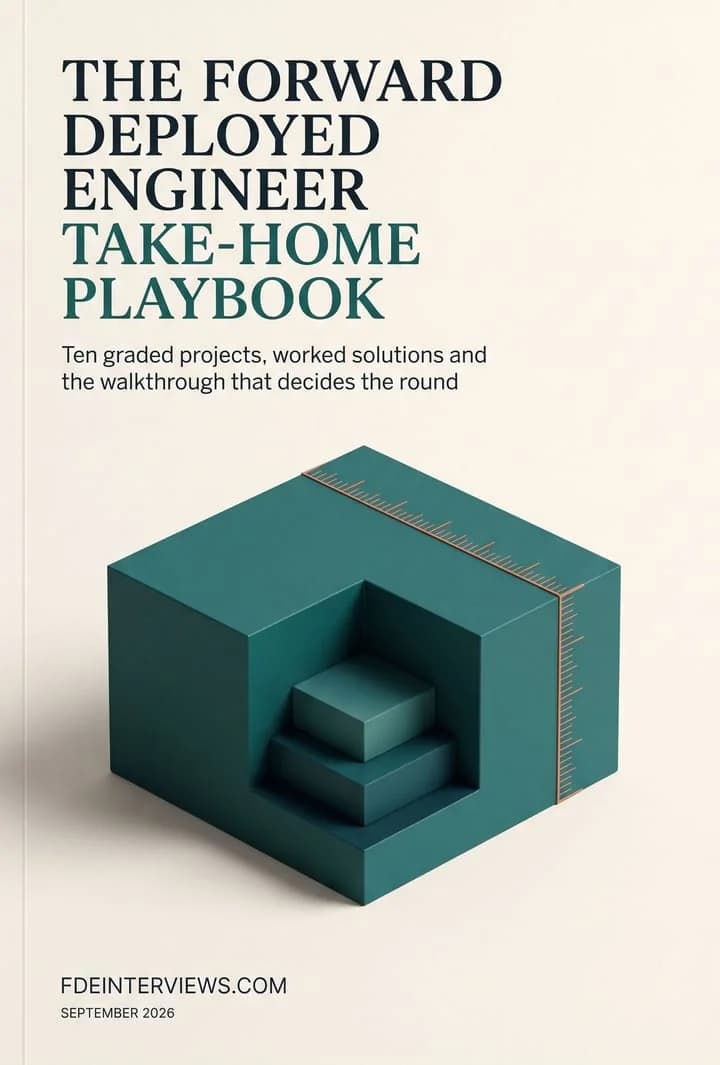
- pages
- 69
- graded projects
- 10
- solution and test files
- 22
- diagrams
- 11
What you will be able to do
Five habits, each with a project that proves it.
Written for two readers: the candidate with a take-home due this week, and the engineer who wants the job and has no interview yet.
- Scope an underspecified brief into a slice you can build, test and defend in the stated hours, and write down what you left out and why.
- Ship a submission that runs from a clean clone, with a fixture a stranger can change and tests that fail when the answer changes.
- Answer "how do you know it works?" with an evaluation that has a denominator, and "what happens when it breaks?" with a failure you demonstrated on purpose.
- Walk a reviewer through the result the way you would walk a customer through it, and hold up under thirty deep-dive questions.
- Treat the take-home as evidence of the job: the same habits are what forward deployed engineers are hired to do on site.
Look inside
Read a solution. Check the arithmetic.
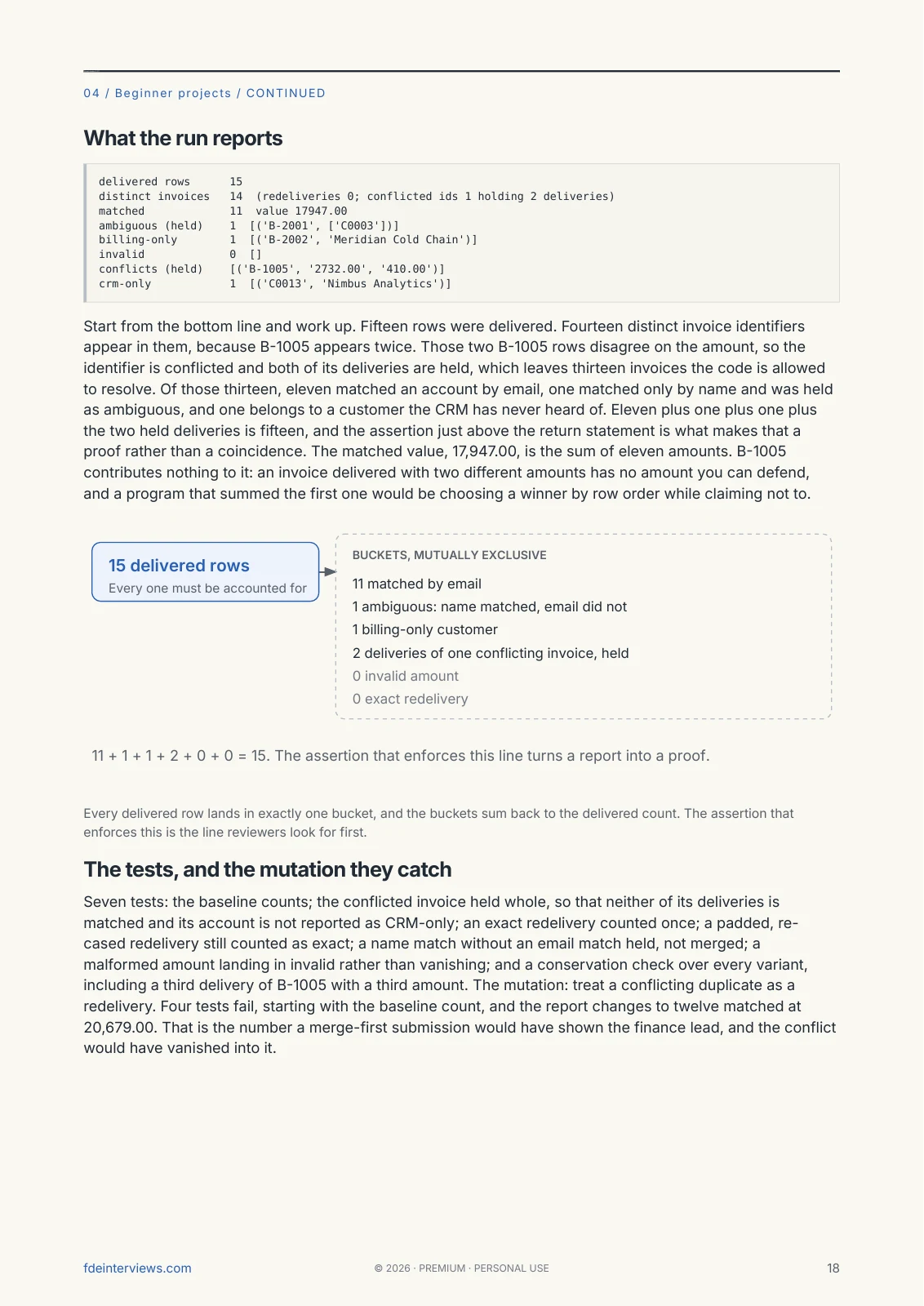
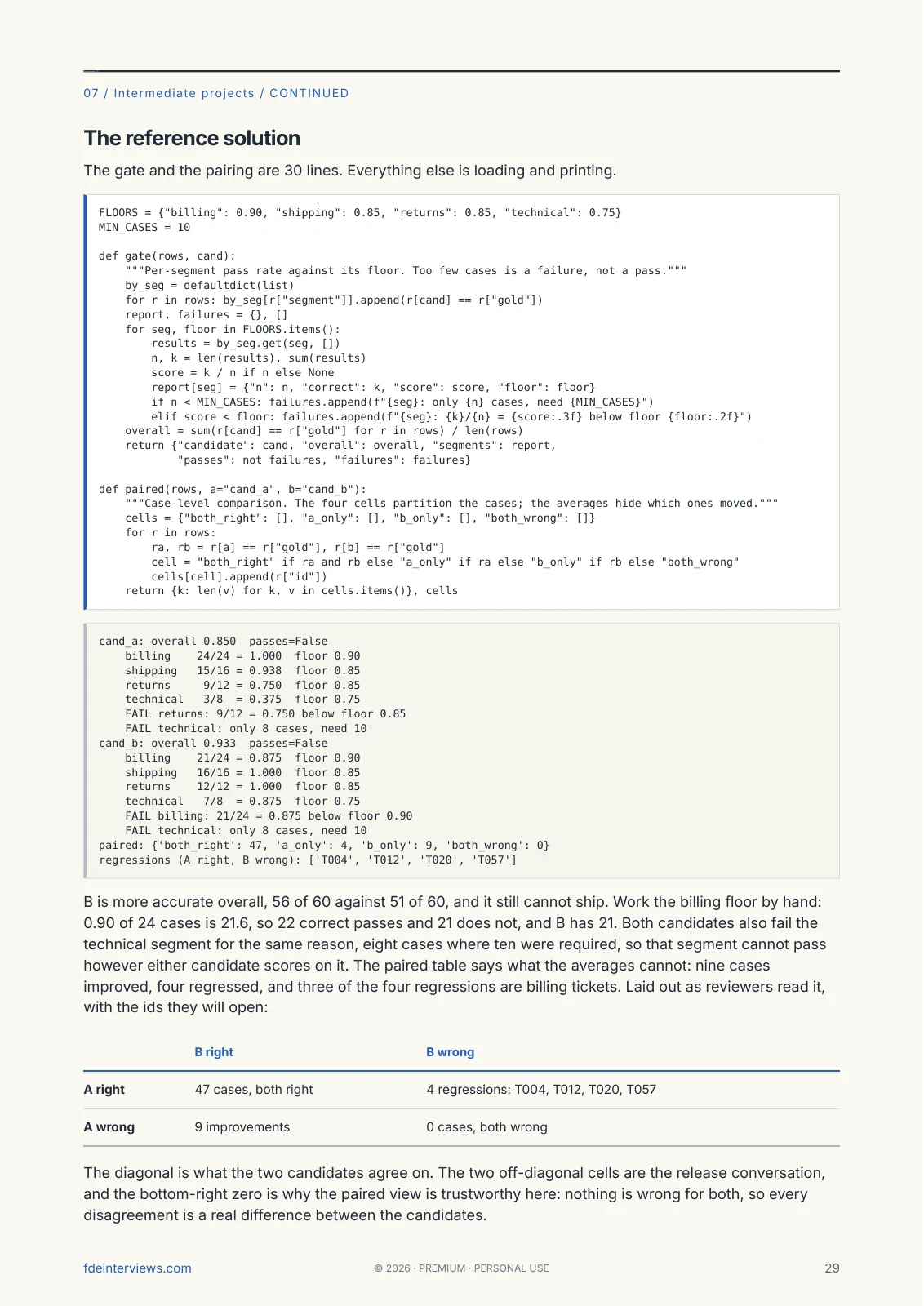
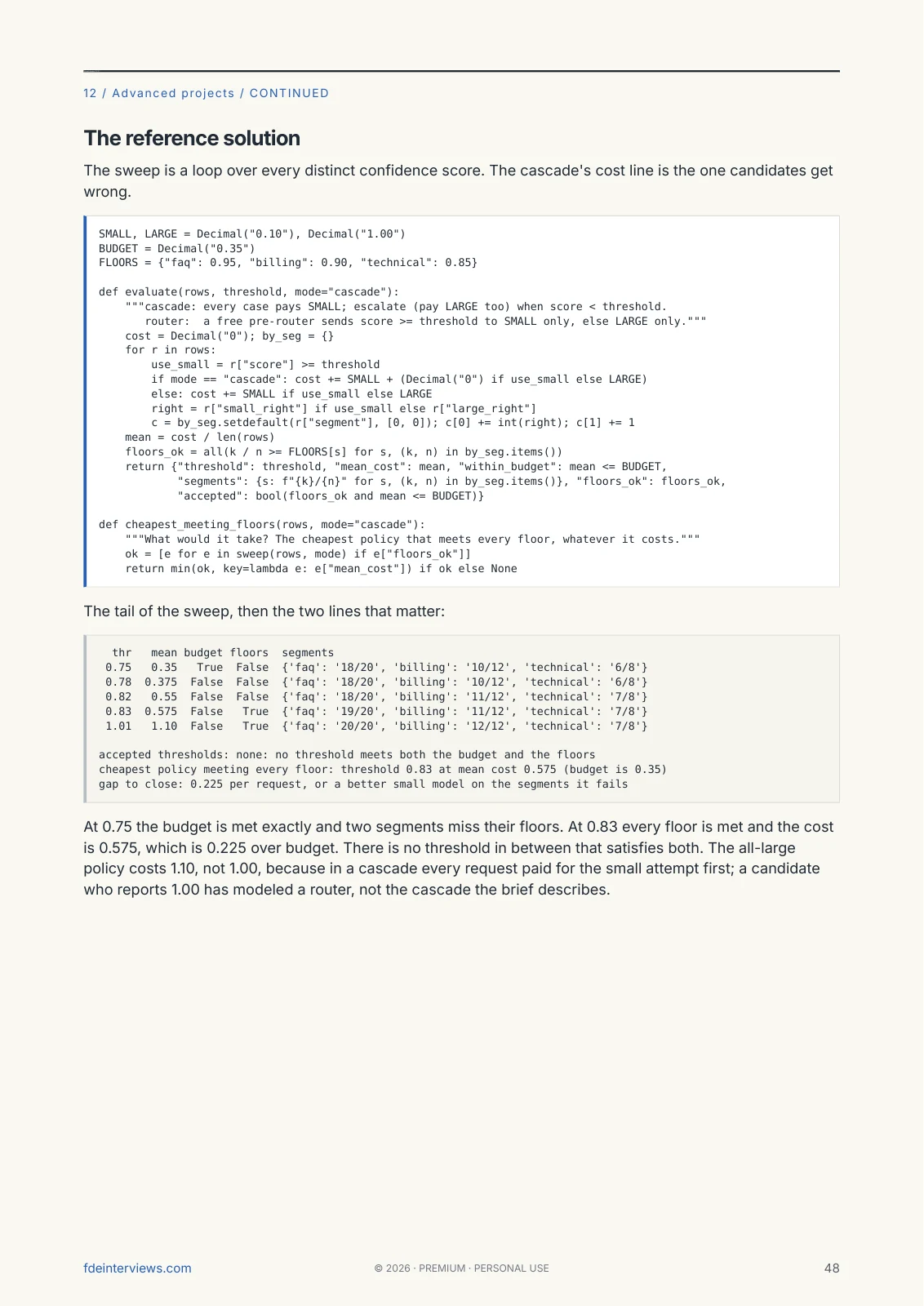
These are full pages from the PDF: a reconciliation whose buckets sum back to the delivered count, an evaluation that blocks a better-on-average candidate, and a routing sweep that finds no threshold meets both constraints. Open any page to read it at full size.
The projects
Ten briefs, three levels, one habit each.
- 01beginner · Data and integration · 3 h
Reconcile two exports of the same customers
Account for every row; hold what you cannot prove. Taught in depth: Parsing messy data.
- 02beginner · Deployment and integration · 3 h
Read an undocumented, paginated API without guessing
Turn every observation into a rule and every surprise into a stop. Taught in depth: Investigate undocumented behavior.
- 03beginner · Applied AI · 3 h
Answer a policy question only from what the requester may see
Permission before ranking; the revision in force on the claim date. Taught in depth: Permission-aware RAG.
- 04intermediate · Applied AI · 4 h
Build an evaluation that can block a release
Per-segment floors, a minimum case count, a paired comparison. Taught in depth: The eval harness comes first.
- 05intermediate · Applied AI and operations · 4 h
Build an action service an agent can retry
Idempotency by request key; an outcome that may be unknown. Taught in depth: Idempotency.
- 06intermediate · Data and integration · 4 h
Consume webhooks without losing, duplicating or rewinding an order
Bounded memory, a dead-letter table with reasons, a sequence rule. Taught in depth: Streaming and backpressure.
- 07intermediate · Data and integration · 4 h
Decompose 'the exceptions desk is drowning' into something that ships
Scope from the operator's decision; rules that name their rule. Taught in depth: The Palantir decomposition interview.
- 08advanced · Applied AI and security · 6 h
Prove that tenant A can never read tenant B
Three controls, each with a test that fails when it is removed. Taught in depth: Specify and test tenant isolation.
- 09advanced · Applied AI and economics · 5 h
Route between two models under a budget and a quality floor
A cascade that pays twice; the honest answer when no threshold works. Taught in depth: AI cost and unit economics.
- 10advanced · Deployment and operations · 5 h
Diagnose a failing deployment from exports alone
Timeline before hypothesis; unknowns kept unknown. Taught in depth: The first 48 hours.
Around the projects: what the round tests, the deliverable reviewers respect, an eight-dimension scoring card, a ten-minute walkthrough script, thirty reviewer questions with the shape of a strong answer, and a four-week practice plan.
Every solution was run
Then broken on purpose,
to prove the tests would notice.
Each project ships with its reference solution and test suite, on Python 3.12 with the standard library only. Every number printed in the book comes from running that code. Each chapter also names one deliberate mutation, a rule removed or an order swapped, and reports which tests failed when we made it.
That is the standard the book asks of your submission, because it is the standard a reviewer's first question applies: how do you know it works?
All briefs, fixtures and numbers are synthetic teaching material. None is an employer's assignment. The rubric is an editorial instrument, not a hiring scorecard.
The online companion
Do a project. Then study the habit in depth.
Each stage of the playbook points at the concepts and course lessons that teach its habit. Articles are public; questions, concepts and lessons follow their displayed access level.
01Chapters 1 to 3
Learn what the round tests and what a submission looks like
Score a past project of yours on the eight-dimension card before you build anything new.
02Projects 1 to 3
Build the beginner habits
Account for every row, stop when the contract is unclear, and filter before ranking.
03Projects 4 to 7
Make evidence and failure handling your strongest dimensions
Ship an evaluation with a denominator and demonstrate a partial failure on purpose.
04Projects 8 to 10
Take on the briefs where a correct program can still lose
Prove isolation with negative tests, report an infeasible constraint honestly, and build a timeline before a hypothesis.
05Chapters 14 to 16
Defend the submission
Record a ten-minute walkthrough of your own project and answer the thirty reviewer probes against it.
Before you download
What is The Forward Deployed Engineer Take-Home Playbook?
A 69-page practice book for the take-home round of FDE, FDSE and Forward Deployed AI Engineer interviews. It contains 10 graded projects (3 beginner, 4 intermediate, 3 advanced), each with a customer-style brief, a time budget, learning goals, a worked and executed solution, the questions a reviewer asks in the walkthrough and the failures that lose the round.
Are the solutions real code I can run?
Yes. Every reference solution and its test suite ship as a separate download beside the PDF. They run on Python 3.12 with the standard library only. Each project also names one deliberate mutation its tests must catch, and the book reports what happened when we made it.
Are these real companies' take-home assignments?
No. Every brief, fixture and number is original synthetic teaching material and is labeled as such. Chapter 1 describes the formats that recur in public reporting in general terms, and the sources page lists the primary references. The rubric is an editorial instrument, not an employer's scorecard.
Do I need Premium to download it?
Yes. The complete PDF and the solutions download require sign-in and active FDEInterviews.com Premium access. Three selected sample pages are public. There is no separate purchase.
How does the playbook connect to the courses?
Each project links to the concepts and course lessons that teach its habit in depth, and chapter 16 gives a four-week plan that maps the ten projects onto the Foundations, FDE Engagement and Hard Deployments courses.
Were AI tools used to create the playbook?
Yes. AI tools assisted research organization, drafting, editing and illustration. Every solution was executed, with its tests and its named mutation, before its output was printed. FDEInterviews.com confirms that the playbook was manually curated, compiled and reviewed by its human editorial team.
I am not interviewing yet. Is the playbook still useful?
Yes. The ten projects are practice for the job as much as for the round: scoping an underspecified brief, leaving evidence a stranger can rerun, handling failure on purpose and walking a customer through the result are what forward deployed engineers do on site. Chapter 16 shows how a finished project becomes a portfolio piece and an interview story, and the four-week plan works whether or not a take-home is on your calendar.
How is this different from the Field Guide?
The Field Guide is about making the move and doing the work of a customer engagement. The Take-Home Playbook is about one interview round: it is practice projects with solutions, a rubric and a walkthrough script. They are companions and both are included with Premium.
Your next take-home deserves a rehearsal.
© 2026 FDEInterviews.com. Personal study only, subject to our Terms of Service and applicable law. The complete playbook and its solutions require active Premium access; selected samples are public. AI-assisted, manually curated and reviewed by the FDEInterviews.com editorial team, as confirmed by the publisher. Independent educational material; no company affiliation or guarantee of interview or employment outcomes.