
Lost response / one intended purchase
The reply disappears
The supplier may have committed the order. Recover the original operation from authoritative evidence before allowing another attempt.
A practical agent integration guide / October 2026
Connect tools, agents and commerce with contracts you can test.
Follow one customer purchase across model tools, MCP, remote agents, approval and payment. Learn what each protocol promises, what the application must enforce and how to recover when a reply disappears.
Every answer, concept and course, every paper breakdown, all published video lessons, hands-on FDE Lab missions, Premium PDF guides and companion files, the full practice-test bank and work-sample downloads. Referral Premium excludes guide PDFs and their companion files.
Study alongside free video lessons.
Premium guide PDFs and companion files require active paid Premium or approved complimentary access. Referral Premium includes the rest of the site, but excludes these downloads.
105 pages · 32 chapters · PDF + code + worksheets

Contracts / authority / integration / recovery
An agent system crosses several boundaries: the model proposes a tool call, a host invokes a service, a remote agent owns a task, and a merchant or payment provider owns an external effect. Each boundary needs an explicit contract.
The guide explains the protocols at those boundaries and connects them through one coherent architecture. It separates discovery from trust, interface events from committed work, and a retried message from a safe business retry.
Three complete pages, free to read
See how operation identity, remote-task recovery and lost responses fit together. Each preview opens a real PDF page at full size.
Page 15 / Sample
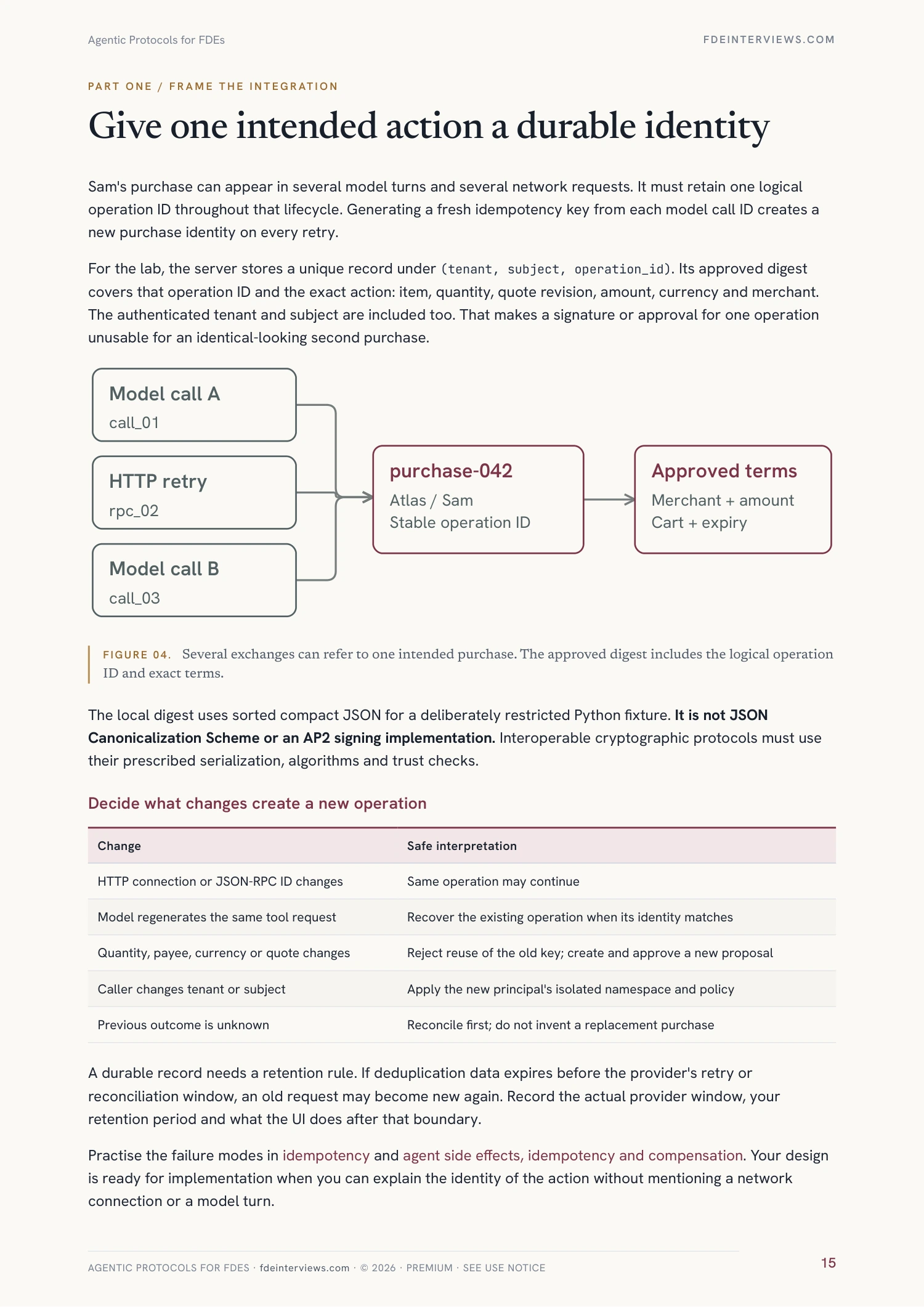
Separate exchange IDs from the durable identity that binds approval, dispatch and recovery.
Open the page at full size ↗
Page 34 / Sample
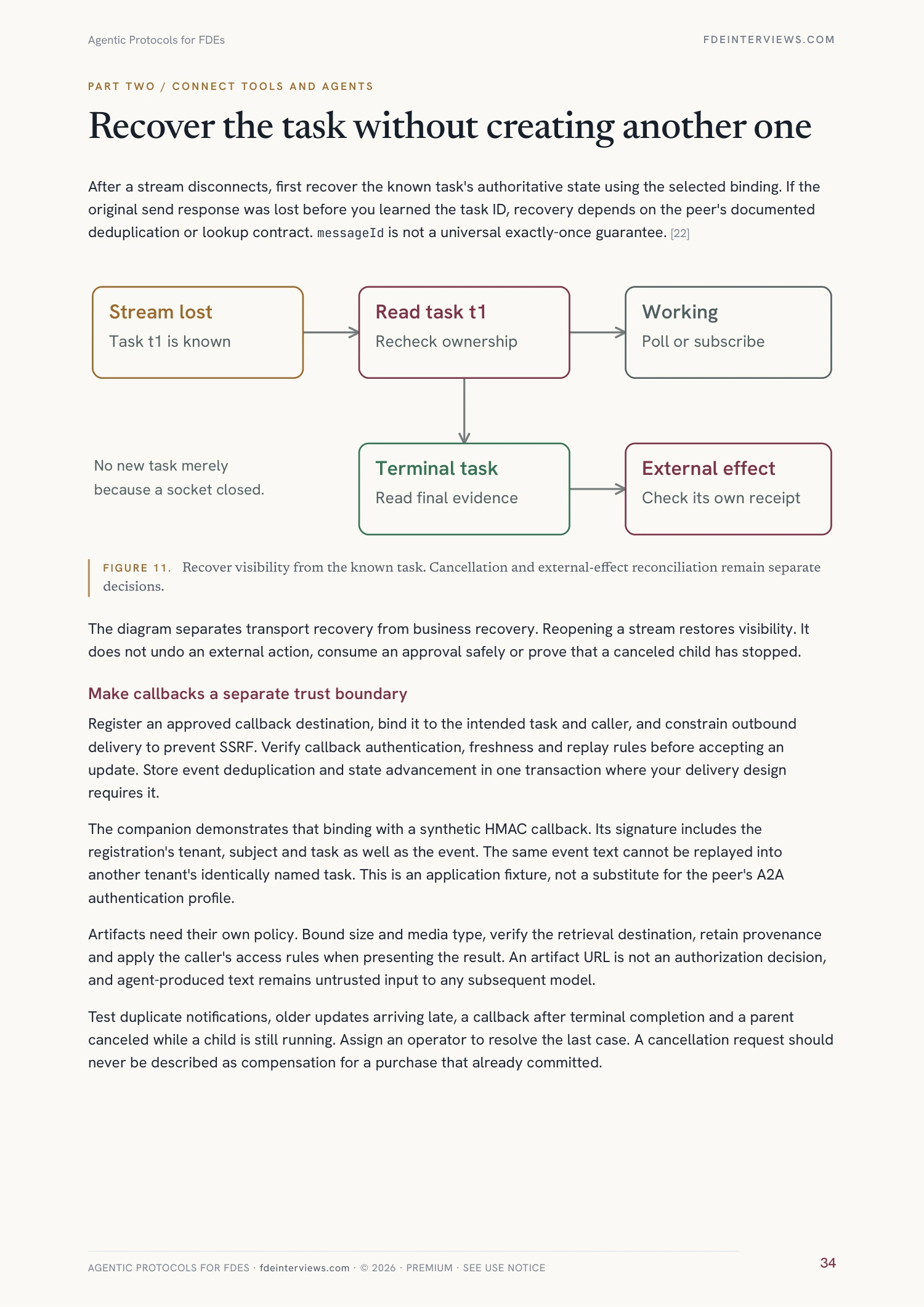
Treat callbacks as delivery evidence, then verify task state and preserve the business operation.
Open the page at full size ↗
Page 69 / Sample
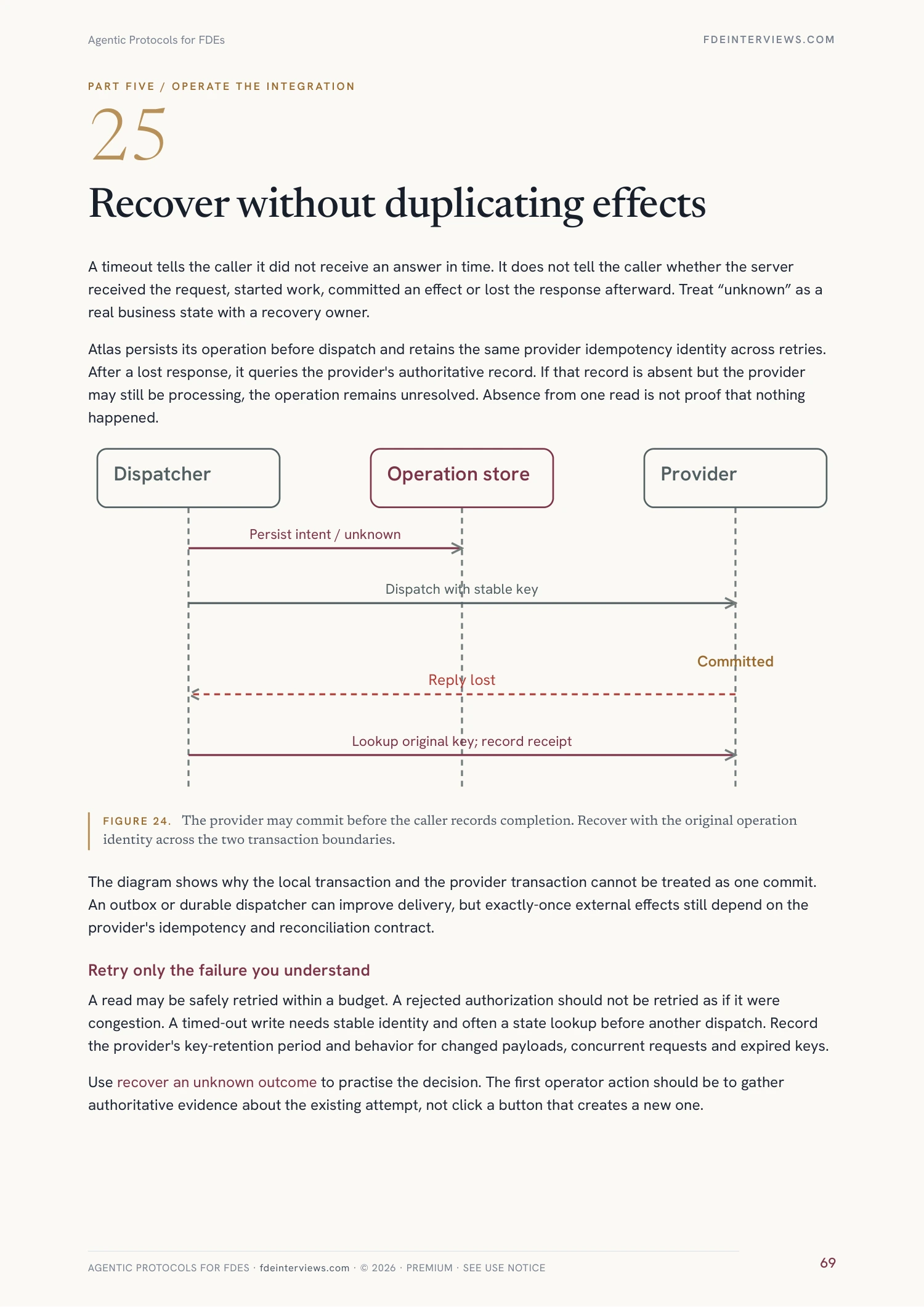
Follow the operation record through dispatch, uncertainty and authoritative reconciliation.
Open the page at full size ↗
32 chapters / six parts
Define the customer contract, separate protocol families, read the wire and keep business operation identity independent of model calls.
Implement July 2026 MCP, authorization and continuations; delegate through A2A; connect agent interfaces, coding agents and skills.
Carry user and workload identity across services, constrain delegation and bind approval to the exact operation.
Work through UCP, Agentic Commerce Protocol, AP2, x402 and MPP, then evaluate network services, Verifiable Intent and agent registries.
Choose the runtime, bound execution and WebMCP browser access, enforce gateway policy, recover uncertain effects and plan telemetry, security and deployment.
Run the contract lab and actual MCP SDK checks, investigate three incidents and work through ten design-review prompts before handover.
Three fictional incident reviews connect protocol behavior to customer outcomes. Each follows the available evidence, the repair and the regression checks needed to prevent recurrence.
Lost response / one intended purchase
The supplier may have committed the order. Recover the original operation from authoritative evidence before allowing another attempt.
Valid signature / wrong registration
Find why a signed event updated the wrong customer task. Bind callback verification to the tenant, subject and registered task.
Stale authority / changed amount
Reject the changed purchase, show the new terms and obtain approval that binds the actual merchant, amount and operation.
Included / executable companion
Run an approved synthetic purchase, interrupt its response, restart and reconcile it. Check tenant boundaries, changed approvals, signed callbacks and fragmented event streams. The archive passed 56 tests and 8 deliberate mutation checks.
The core track uses Python and SQLite without external packages or keys. The optional SDK track runs actual MCP discovery and tool calls, with separate versioned protocol-fixture checks. Setup instructions explain expected results, failure diagnosis and production limitations.
Teaching code and synthetic data. No hosted execution, production credentials or model account required for the local track.
These paths connect the guide to focused concepts, questions, course lessons and a work sample. The same links are clickable inside the PDF.
Chapters 1–5
Chapters 6–13
Chapters 14–21
Chapters 22–28
Chapters 29–32
They are contracts at the boundaries of an agent system: model-to-tool calls, access to tools and resources, delegated work between agents, user-interface events, identity, checkout and payment. The guide explains which boundary each protocol serves and how to preserve authority and recovery across them.
The guide covers MCP, A2A, AG-UI, A2UI, MCP Apps, Agent Client Protocol, UCP, Agentic Commerce Protocol, AP2, x402 and MPP. It also explains OAuth/OIDC, token exchange, DPoP, mTLS, workload identity, CIBA, PAR, Verifiable Credentials, HTTP Message Signatures, OpenTelemetry and CloudEvents. WebMCP, ANP, NLWeb, Agent Skills, AGENTS.md, ERC-8004 and provider payment services are placed in their proper context, with draft and product status distinguished from open protocol support.
MCP connects a host or client to capabilities such as tools, resources and prompts. A2A connects independently operated agents through discovery, messages, tasks and artifacts. Neither automatically grants permission to act for a user. The guide follows identity, approval and durable business state across both boundaries.
Both names appear in the ecosystem. Agentic Commerce Protocol defines a commerce boundary; Agent Client Protocol connects coding agents and editors. The earlier Agent Communication Protocol is another distinct project. The guide uses the full names and exact versions to avoid treating them as one protocol.
The companion contains a Python/SQLite contract lab with 56 tests, a loopback HTTP server, a lost-response demo, callback and stream exercises, and 8 worksheets. Its core needs Python 3.10 or later without packages, cloud credentials or model keys. A separate Python 3.12 track uses pinned SDKs for a real local MCP server/client and hash-verified official schemas for MCP and commerce ACP, plus A2A protobuf checks.
The purchase provider and identities are synthetic local fixtures. The optional MCP server performs a public synthetic read. There are no live purchases, wallets or production OAuth flows. Deployment chapters explain the additional identity, infrastructure, credential, payment and operating work required for a customer system.
The October 2026 edition uses 86 primary references and explicit version boundaries, including July MCP and A2A wire 1.0. The exact extracted companion passed 56 tests and detected 8 deliberately broken controls. The optional track passed five local MCP checks and 30 schema/selected-invariant checks. These checks establish their stated scope, not complete conformance across every peer or payment provider.
Forward deployed engineers and application engineers connecting agents to customer tools, services, interfaces or commerce systems. Basic Python, HTTP and JSON familiarity helps. The early chapters explain the vocabulary before the implementation and production exercises.
The complete PDF and companion ZIP are included with active paid Premium or approved complimentary guide access, with no separate purchase. Three complete sample pages are public. Referral-only online Premium does not include guide downloads. Keep a lawfully downloaded copy for study under the publication notice; do not redistribute the Premium files.
The PDF and learning paths link directly to Production AI Agents, Harness Engineering, Hard Deployments, FDE Engagement, concepts, interview questions and Repair the Streaming Assistant. Use a chapter to understand the integration, then practise the specific mechanism in the linked lesson or exercise. Each resource retains its displayed access level.
AI tools assisted research, writing, code and the original cover illustration. Technical figures are authored vector diagrams. Customer scenarios and numerical fixtures are synthetic teaching material. The edition is prepared for publisher review; automated checks and assistant review do not imply independent human editorial approval.