
Anduril Forward Deployed Engineer interview questions
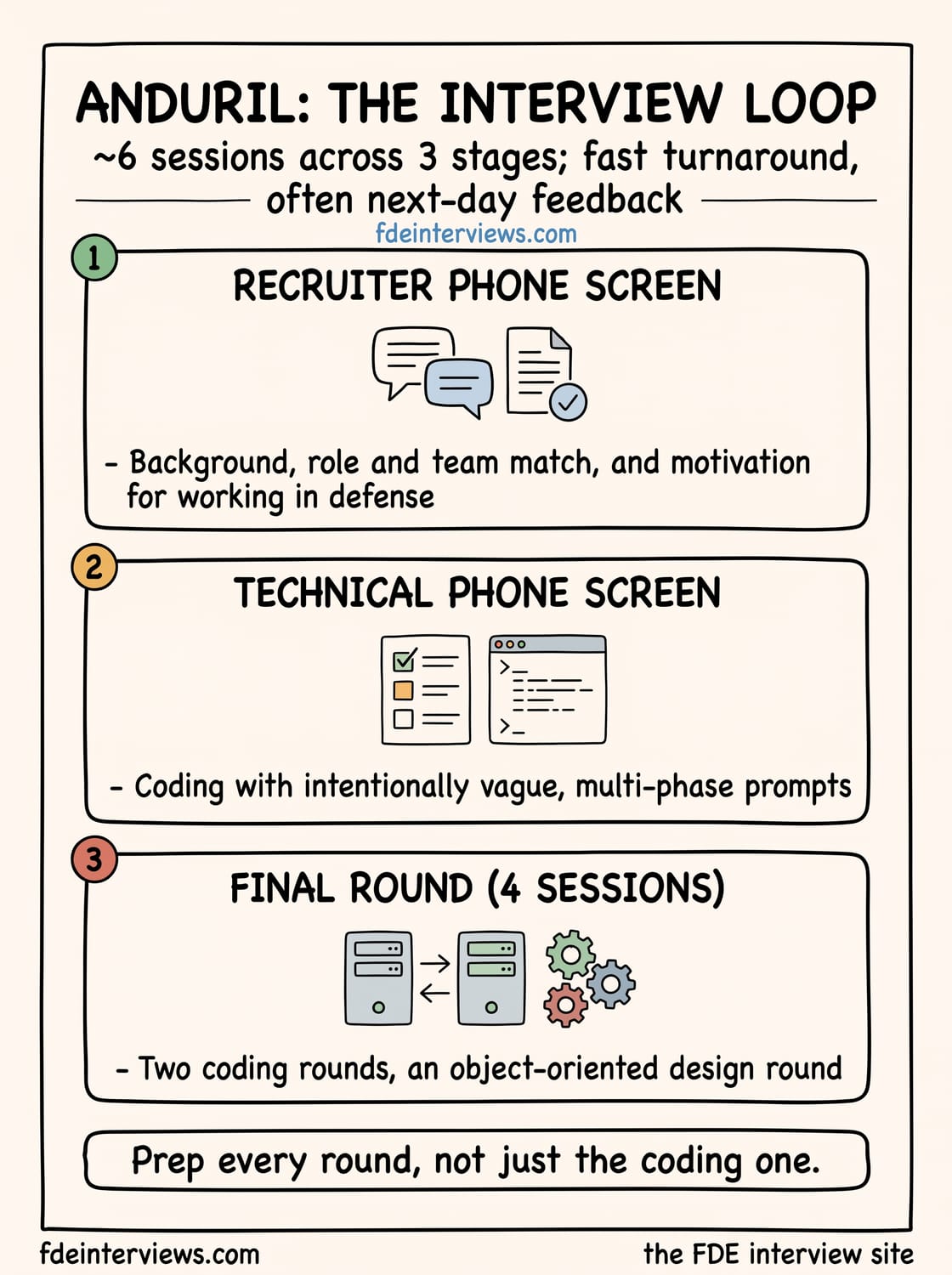
Anduril builds autonomous defense systems and runs a genuine Forward Deployed Engineer loop, embedding engineers with operators and customers to ship mission software in the field. The process is known for roughly six sessions across three stages and for weighting customer judgment as heavily as code: intentionally vague, multi-phase technical prompts, plus rounds that probe how you handle ambiguity, make tradeoffs under real constraints, and stay effective with a frustrated non-technical stakeholder. Experienced hires are matched to a specific team first, so some rounds go deep on domain skills such as C++, perception, or ML infrastructure.
The Anduril Forward Deployed Engineer interview process
DocumentedHow the Anduril Forward Deployed Engineer interview experience actually runs — the rounds, what each stage tests, and the signals candidates report. Last reviewed July 31, 2026.
- 1Recruiter phone screenBackground, role and team match, and motivation for working in defense.
- 2Technical phone screenCoding with intentionally vague, multi-phase prompts.
- 3Final round (4 sessions)Two coding rounds, an object-oriented design round, and a behavioral conversation with a senior or staff engineer; experienced hires may get domain-specific depth in C++, perception, or ML infrastructure.
- The loop scores five things at once: working software, working directly with a client, handling ambiguity, real tradeoff calls under constraint, and staying effective with a frustrated non-technical stakeholder
- Experienced-hire candidates are matched to a specific team before the loop, so some rounds test that team's domain
- Genuine, well-reasoned motivation for the defense mission is assessed across rounds
Compiled from public interview guides and candidate reports; loops vary by team and level, so confirm your exact rounds with your recruiter.
Compiled from our research and publicly available information (candidate reports and company interview guides). Interview loops change and are continuously iterated, and they vary by team, level, and region. Treat this as directional preparation, not an official spec, and confirm the exact rounds with your recruiter or hiring point of contact.
Anduril Forward Deployed Engineer salary
What we can trace, labelled by where it came from. We publish a band only where there is a source behind it, so some of this page is a gap rather than a number.
We have not found a compensation figure for this role at Anduril that we can trace to an employer posting or a public aggregator. Rather than publish an estimate, we are naming the gap. Their careers page is the authority, and postings in some jurisdictions are required to state a range.
A US defence or national-security employer. These roles routinely require US citizenship or an active security clearance, so for most India-based candidates this is not a hiring route regardless of what it pays.
We are naming the constraint rather than a number, because the number is not the thing standing in the way. Requirements differ per req, so confirm on the posting itself.
Full method, US bands by level, and the three India tiers side by side are in the FDE salary guide.

Questions modeled on Anduril loops
More from the tracks Anduril's loop tests
The highest-signal questions across Anduril's core tracks.
Go deeper on the topics Anduril's loop tests
The tracks that map to a Anduril Forward Deployed Engineer loop, ordered easy to hard.
The concepts Anduril's Forward Deployed Engineer loop assumes you know
The vocabulary and mental models behind Anduril's questions, from our curriculum. Start with the foundations free; the deeper, interview-defining ideas are part of premium.
CODING & ENGINEERING CRAFT
SYSTEM DESIGN FOR AI IN PRODUCTION
ML INFRASTRUCTURE & SERVING
THE CUSTOMER-FACING CRAFT
Where to apply, and official Anduril resources
Straight from Anduril: open roles and the company's own hiring guidance. Prep here, then apply there.
External links to Anduril's own pages. Roles and processes change; always confirm on the official site.
Forward Deployed Engineer / Software Engineer. Typical loop: ~6 sessions across 3 stages; fast turnaround, often next-day feedback. Stages: Recruiter phone screen → Technical phone screen → Final round (4 sessions). Key focus: The loop scores five things at once: working software, working directly with a client, handling ambiguity, real tradeoff calls under constraint, and staying effective with a frustrated non-technical stakeholder. Compiled from public reports; loops change over time, so confirm the exact rounds with your recruiter.
Walk into your Anduril Forward Deployed Engineer interview ready
Unlock every FDE interview answer, ordered easy to hard, plus the full concept curriculum, for 6 months. One payment, no auto-renewal. Free questions and concepts in each track, no card needed to start.
Or create a free account to unlock more free answers per topic.
Other Forward Deployed Engineer interviews to prep
Companies whose loops test the same tracks as Anduril's.
Independent and not affiliated with Anduril. All trademarks belong to their owners.