
Applied Intuition Forward Deployed Engineer interview questions
Applied Intuition builds the software that autonomy and vehicle programs run on, and it hires Forward Deployed Engineers to embed with customers and take that tooling into production. The loop pairs strong practical coding with the customer-facing judgment the role lives on. The round that filters most candidates is the customer scenario interview: scoping work live with a frustrated stakeholder, pushing back without damaging the relationship, and knowing when to say no.
The Applied Intuition Forward Deployed Engineer interview process
DocumentedHow the Applied Intuition Forward Deployed Engineer interview experience actually runs — the rounds, what each stage tests, and the signals candidates report. Last reviewed July 31, 2026.
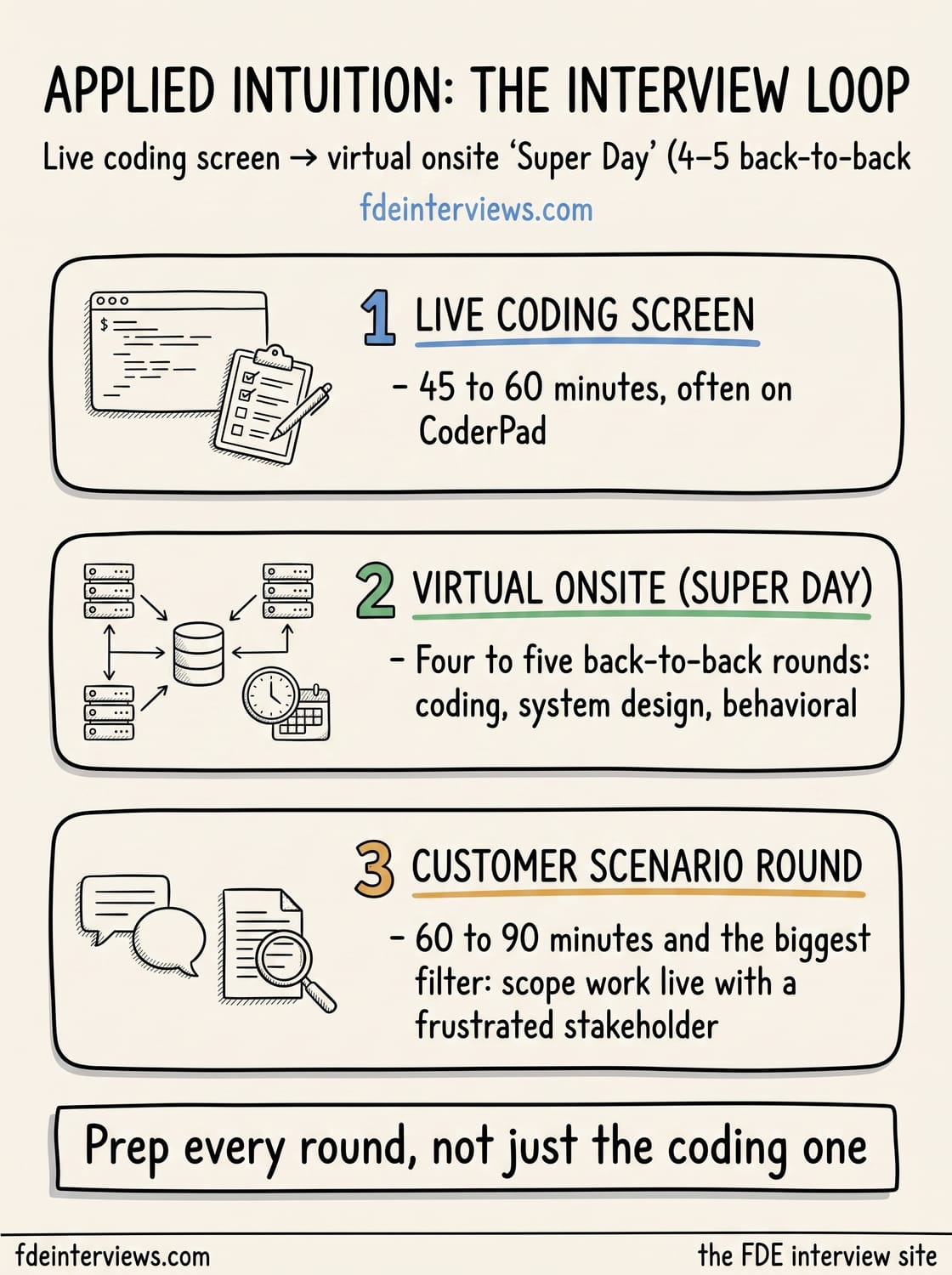
- 1Live coding screen45 to 60 minutes, often on CoderPad.
- 2Virtual onsite (Super Day)Four to five back-to-back rounds: coding, system design, behavioral, and a hiring-manager conversation.
- 3Customer scenario round60 to 90 minutes and the biggest filter: scope work live with a frustrated stakeholder, push back without damaging the relationship, and know when to say no.
- The customer scenario round filters the most candidates and is the one engineers most often under-prepare
- Strong practical coding paired with the customer-facing judgment the FDE role lives on
- Taking autonomy and vehicle tooling from demo to a production customer deployment
Compiled from public interview guides and candidate reports; loops vary by team and level, so confirm your exact rounds with your recruiter.
Compiled from our research and publicly available information (candidate reports and company interview guides). Interview loops change and are continuously iterated, and they vary by team, level, and region. Treat this as directional preparation, not an official spec, and confirm the exact rounds with your recruiter or hiring point of contact.
Applied Intuition Forward Deployed Engineer salary
What we can trace, labelled by where it came from. We publish a band only where there is a source behind it, so some of this page is a gap rather than a number.
We have not found a compensation figure for this role at Applied Intuition that we can trace to an employer posting or a public aggregator. Rather than publish an estimate, we are naming the gap. Their careers page is the authority, and postings in some jurisdictions are required to state a range.
A US or EU AI company with no large India engineering centre. An India-based hire here is usually a global-remote contract, often USD-denominated, which is the highest-paying route into the role from India and also the hardest to get.
| LEVEL | REPORTED FOR THIS EMPLOYER TYPE |
|---|---|
| Junior (0-2 yrs) | ₹35 LPA - ₹55 LPA |
| Mid (3-6 yrs) | ₹55 LPA - ₹90 LPA |
| Senior (7+ yrs) | ₹90 LPA - ₹1.5 Cr |
Reported range for this type of employer, not a figure reported for this company. Whether an India-based hire is possible at all depends on their entity and visa position, so check their careers page before you plan around it.
Full method, US bands by level, and the three India tiers side by side are in the FDE salary guide, including what actually moves your number between these tiers.

Representative Forward Deployed Engineer questions for Applied Intuition's loop
Applied Intuition's loop draws from these tracks. Here are the highest-signal questions in each, ordered by what candidates rate most useful.
Go deeper on the topics Applied Intuition's loop tests
The tracks that map to a Applied Intuition Forward Deployed Engineer loop, ordered easy to hard.
The concepts Applied Intuition's Forward Deployed Engineer loop assumes you know
The vocabulary and mental models behind Applied Intuition's questions, from our curriculum. Start with the foundations free; the deeper, interview-defining ideas are part of premium.
CODING & ENGINEERING CRAFT
SYSTEM DESIGN FOR AI IN PRODUCTION
THE CUSTOMER-FACING CRAFT
ML INFRASTRUCTURE & SERVING
Where to apply, and official Applied Intuition resources
Straight from Applied Intuition: open roles and the company's own hiring guidance. Prep here, then apply there.
External links to Applied Intuition's own pages. Roles and processes change; always confirm on the official site.
Forward Deployed Engineer. Typical loop: Live coding screen → virtual onsite 'Super Day' (4–5 back-to-back rounds). Stages: Live coding screen → Virtual onsite (Super Day) → Customer scenario round. Key focus: The customer scenario round filters the most candidates and is the one engineers most often under-prepare. Compiled from public reports; loops change over time, so confirm the exact rounds with your recruiter.
Walk into your Applied Intuition Forward Deployed Engineer interview ready
Unlock every FDE interview answer, ordered easy to hard, plus the full concept curriculum, for 6 months. One payment, no auto-renewal. Free questions and concepts in each track, no card needed to start.
Or create a free account to unlock more free answers per topic.
Other Forward Deployed Engineer interviews to prep
Companies whose loops test the same tracks as Applied Intuition's.
Independent and not affiliated with Applied Intuition. All trademarks belong to their owners.