FDEInterviews logo
FORWARD DEPLOYED ENGINEER PROGRAM

Mistral Forward Deployed Engineer interview questions

Mistral runs a forward deployed function, with roles titled Forward Deployed AI Engineer and Forward Deployed Machine Learning Engineer under its Applied AI team. They embed with enterprise and sovereign customers to ship fine-tuning, RAG, and agentic workflows on Mistral models, often in on-premise or data-sovereign environments. The loop goes deeper on model internals and deployment than most, reflecting that Mistral sells open-weight and on-prem options.

The Mistral Forward Deployed Engineer interview process

Documented

How the Mistral Forward Deployed Engineer interview experience actually runs — the rounds, what each stage tests, and the signals candidates report.

RoleCustomer Solutions Engineer / Applied AI
  1. 1
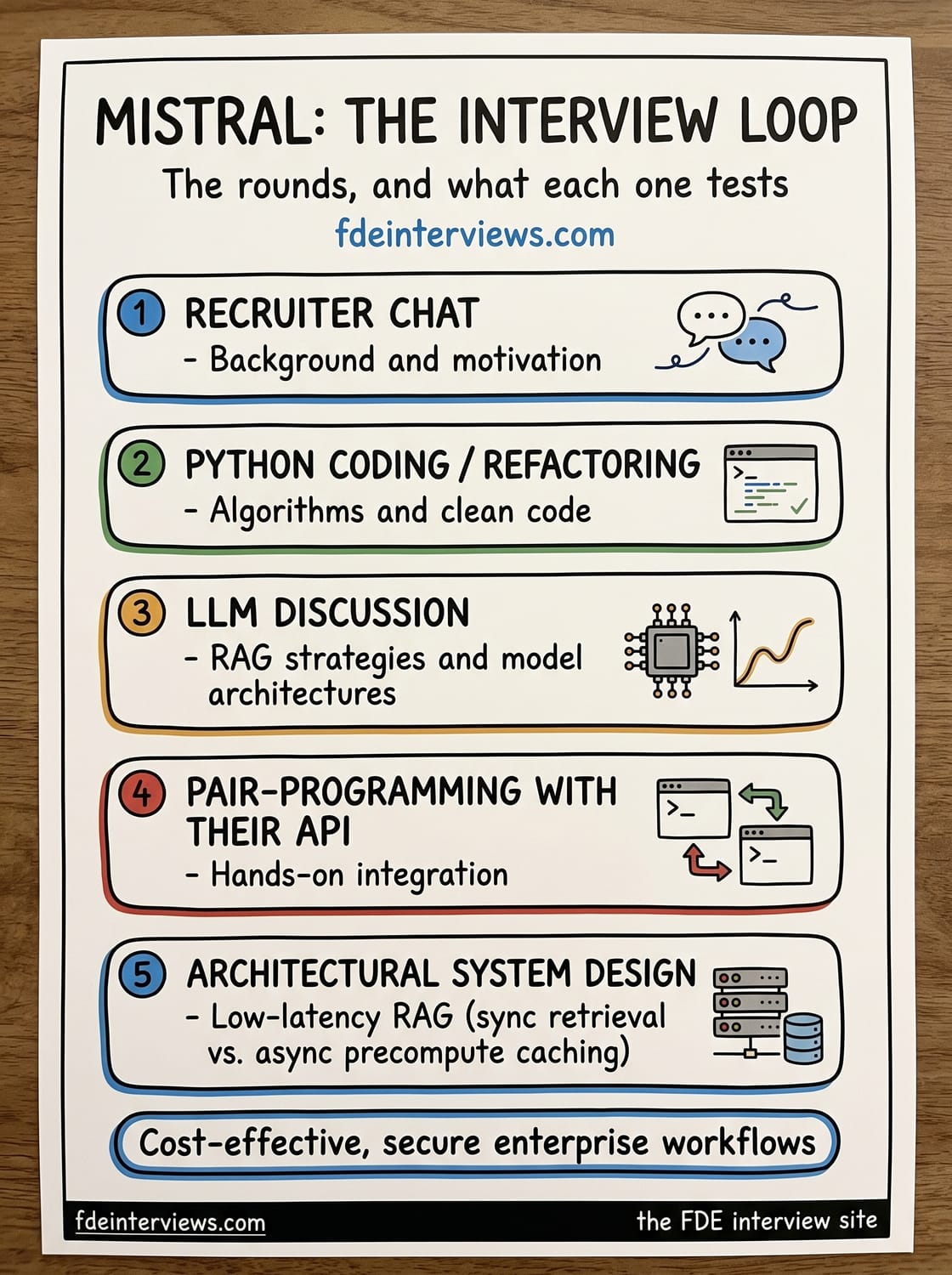
    Recruiter chatBackground and motivation.
  2. 2
    Python coding / refactoringAlgorithms and clean code.
  3. 3
    LLM discussionRAG strategies and model architectures.
  4. 4
    Pair-programming with their APIHands-on integration.
  5. 5
    Architectural system designLow-latency RAG (sync retrieval vs. async precompute caching), multi-tenant agentic authorization, and secure containerized tool execution.
WHAT THEY'RE EVALUATING
  • Cost-effective, secure enterprise workflows
  • Very selective (reported sub-30% pass rate)

Compiled from our research and publicly available information (candidate reports and company interview guides). Interview loops change and are continuously iterated, and they vary by team, level, and region. Treat this as directional preparation, not an official spec, and confirm the exact rounds with your recruiter or hiring point of contact.

Mistral Forward Deployed Engineer salary

What we can trace, labelled by where it came from. We publish a band only where there is a source behind it, so some of this page is a gap rather than a number.

NO TRACEABLE BAND

We have not found a compensation figure for this role at Mistral that we can trace to an employer posting or a public aggregator. Rather than publish an estimate, we are naming the gap. Their careers page is the authority, and postings in some jurisdictions are required to state a range.

HIRING FROM INDIA
Global AI lab, India-based hire

A US or EU AI company with no large India engineering centre. An India-based hire here is usually a global-remote contract, often USD-denominated, which is the highest-paying route into the role from India and also the hardest to get.

LEVELREPORTED FOR THIS EMPLOYER TYPE
Junior (0-2 yrs)₹35 LPA - ₹55 LPA
Mid (3-6 yrs)₹55 LPA - ₹90 LPA
Senior (7+ yrs)₹90 LPA - ₹1.5 Cr

Reported range for this type of employer, not a figure reported for this company. Whether an India-based hire is possible at all depends on their entity and visa position, so check their careers page before you plan around it.

Full method, US bands by level, and the three India tiers side by side are in the FDE salary guide, including what actually moves your number between these tiers.

THE ONE-PAGE VERSION
Infographic of the Mistral interview loop, round by round: Recruiter chat, Python coding / refactoring, LLM discussion, Pair-programming with their API, Architectural system design.
↧ DownloadShare on X ↗Share on LinkedIn ↗

Questions modeled on Mistral loops

10 questions · 2 unlocked for you

More from the tracks Mistral's loop tests

The highest-signal questions across Mistral's core tracks.

16 questions · 16 unlocked for you

Go deeper on the topics Mistral's loop tests

The tracks that map to a Mistral Forward Deployed Engineer loop, ordered easy to hard.

The concepts Mistral's Forward Deployed Engineer loop assumes you know

The vocabulary and mental models behind Mistral's questions, from our curriculum. Start with the foundations free; the deeper, interview-defining ideas are part of premium.

FOUNDATIONS OF LLMS & GENAI

Foundational
Tokenization & TokensA language model does not read characters or words. It reads tokens: sub-word chunks produced by a tokenizer, each mapped to an integer the model embeds. Tokens are the unit of the context window and of billing, and the way text splits into them explains a surprising number of model quirks, which is why almost every loop opens here.
Foundational
The Context WindowThe context window is the fixed number of tokens a language model can attend to at once, and input and output share that same budget. Understanding it is what separates engineers who can size a prompt, control cost and latency, and decide when to reach for RAG from those who just paste everything in and hope.
Foundational
Embeddings & Vector RepresentationsAn embedding turns a piece of text into a list of numbers positioned so that similar meanings land near each other in space, which lets you search by meaning instead of by keyword. Embeddings are the engine under RAG, semantic search, clustering, and deduplication, so FDE loops expect you to explain cosine similarity and the pitfalls that quietly break a vector index.
Advanced🔒 Premium
LoRA and Parameter-Efficient Fine-tuningFull fine-tuning updates every weight in a model, which is expensive to train and produces a full-size checkpoint per task. LoRA freezes the base model and trains small low-rank adapter matrices instead, giving tiny swappable checkpoints; QLoRA adds a quantized frozen base so the whole thing fits on a single GPU. FDE loops probe it because it is how you adapt a model on a customer's data without their budget or their hardware blowing up.

RETRIEVAL & AGENTS

Foundational
Retrieval-Augmented Generation (RAG)RAG grounds a language model in your own data by retrieving relevant passages at query time and putting them in the prompt, so the model answers from real sources instead of memory. It is the default pattern for almost every enterprise FDE deployment, which is why nearly every loop tests it.
Foundational
Vector DatabasesA vector database stores embeddings alongside metadata and answers nearest-neighbor queries fast using approximate indexes. The real interview question is not how they work but when you actually need one instead of a library or plain Postgres with pgvector.
CoreSign in
Hybrid Search (Lexical + Vector)Hybrid search runs a keyword retriever (BM25) and a dense vector retriever side by side, then merges their result lists, because each one misses cases the other catches. Vectors lose exact codes and rare jargon, BM25 loses paraphrase, and combining them with Reciprocal Rank Fusion usually beats either alone.
Advanced🔒 Premium
Agent MemoryAgent memory is how an agent carries state across turns and sessions. Short-term memory is the conversation and scratchpad living inside the context window, bounded and expensive. Long-term memory is an external store the agent writes to and retrieves from on demand, usually via RAG, so it can recall facts from last week without holding them in the prompt. FDE loops probe this because the hard parts, summarization, what to persist, and stale or contradictory memory, are where agents quietly break.

ML INFRASTRUCTURE & SERVING

CoreSign in
GPU Memory and VRAMVRAM is the budget that decides which models you can actually run. It is spent on three things: model weights, the KV cache, and activations. Knowing the back-of-envelope arithmetic (a 7B model at fp16 is roughly 14GB of weights) is what separates a candidate who has deployed an LLM from one who has only read about it.
CoreSign in
QuantizationQuantization stores model weights (and sometimes activations) in fewer bits, fp16 down to int8 or 4-bit, which cuts memory and speeds inference. The quality hit is usually small at int8 and larger at 4-bit. Knowing post-training quantization versus quantization-aware training, and when each is acceptable, is standard FDE interview ground.
CoreSign in
Knowledge DistillationDistillation trains a small student model to mimic a large teacher, learning from the teacher's full output distribution rather than just hard labels. The soft targets carry extra signal about how the teacher 'thinks', so the student keeps much of the quality at a fraction of the size and latency. Knowing when distillation beats quantization or pruning is standard FDE ground when you have a latency or cost budget to hit.
Advanced🔒 Premium
Continuous BatchingStatic batching runs a fixed group of requests to completion together, so a batch of one short reply and one long reply makes the GPU idle while it waits on the longest. Continuous batching adds and evicts sequences from the running batch every decode step, keeping the GPU saturated and multiplying throughput. It is the scheduling trick at the heart of vLLM and every modern LLM serving stack.

THE CUSTOMER-FACING CRAFT

Foundational
Requirements DiscoveryRequirements discovery is the work of finding the real problem hiding behind the customer's stated ask. The request they hand you ("build us a chatbot") is almost never the need; the FDE who surfaces who uses it, what success looks like, what data actually exists, and why the deadline is the deadline is the one who ships something people use.
Foundational
Scoping Ambiguous ProblemsScoping an open-ended prompt ("a city wants to reduce 911 response times") is a structured move, not a flash of inspiration: clarify inputs and constraints, state your assumptions out loud, carve out the smallest useful MVP, name the accuracy/cost/latency trade-offs you are choosing, and plan for what happens when it fails. Diving straight into a model or an architecture is the most common reason candidates get cut in the simulation round.
Foundational
Explaining Trade-offs to Non-EngineersAn exec does not care whether you chose RAG or fine-tuning; they care what it costs, when it ships, and what it might get wrong. Translating a technical trade-off means converting accuracy, cost, and latency into the decision the business is actually making, framing each option as a choice with a consequence in their terms, and answering the question they will all eventually ask: why does the AI give a different answer every time, and why is that not a bug.
CoreSign in
Stakeholder ManagementA deployment spans the analyst who will use the tool daily and the CTO who signed the check, and those people want different things. Stakeholder management is figuring out who actually decides, building enough trust to be believed when you deliver bad news, and managing expectations so reality never arrives as a surprise. The job is not shipping the system; it is getting people to adopt it, which is a different and harder thing.

Where to apply, and official Mistral resources

Straight from Mistral: open roles and the company's own hiring guidance. Prep here, then apply there.

External links to Mistral's own pages. Roles and processes change; always confirm on the official site.

ABOUT THE ROLE
MISTRAL INTERVIEW FAQ
What is the Mistral Forward Deployed Engineer interview process?

Customer Solutions Engineer / Applied AI. Stages: Recruiter chat → Python coding / refactoring → LLM discussion → Pair-programming with their API → Architectural system design. Key focus: Cost-effective, secure enterprise workflows. Compiled from public reports; loops change over time, so confirm the exact rounds with your recruiter.

Does Mistral hire Forward Deployed Engineers?
What does the Mistral Applied AI interview test?
What is the Mistral Forward Deployed Engineer salary?

Walk into your Mistral Forward Deployed Engineer interview ready

Unlock every FDE interview answer, ordered easy to hard, plus the full concept curriculum, for 6 months. One payment, no auto-renewal. Free questions and concepts in each track, no card needed to start.

Or create a free account to unlock more free answers per topic.

Other Forward Deployed Engineer interviews to prep

Companies whose loops test the same tracks as Mistral's.

Independent and not affiliated with Mistral. All trademarks belong to their owners.