
Atlas Service / fictional customer
Support and replacements
Retrieve the current warranty under the engineer's permissions, retain approved memory and recover a replacement after the shipping reply is lost.
A practical data architecture guide / October 2026
State, memory and governed data access for agents that do real work.
Build the data layer behind a customer chatbot or agent: decide what is authoritative, retrieve evidence under current permissions, remember with provenance and recover actions when a reply is lost. Follow the decisions from a small relational core to a measured production design.
Every answer, concept and course, every paper breakdown, all published video lessons, hands-on FDE Lab missions, Premium PDF guides and companion files, the full practice-test bank and work-sample downloads. Referral Premium excludes guide PDFs and their companion files.
Study alongside free video lessons.
Premium guide PDFs and companion files require active paid Premium or approved complimentary access. Referral Premium includes the rest of the site, but excludes these downloads.
107 pages · 32 chapters · PDF + code + worksheets
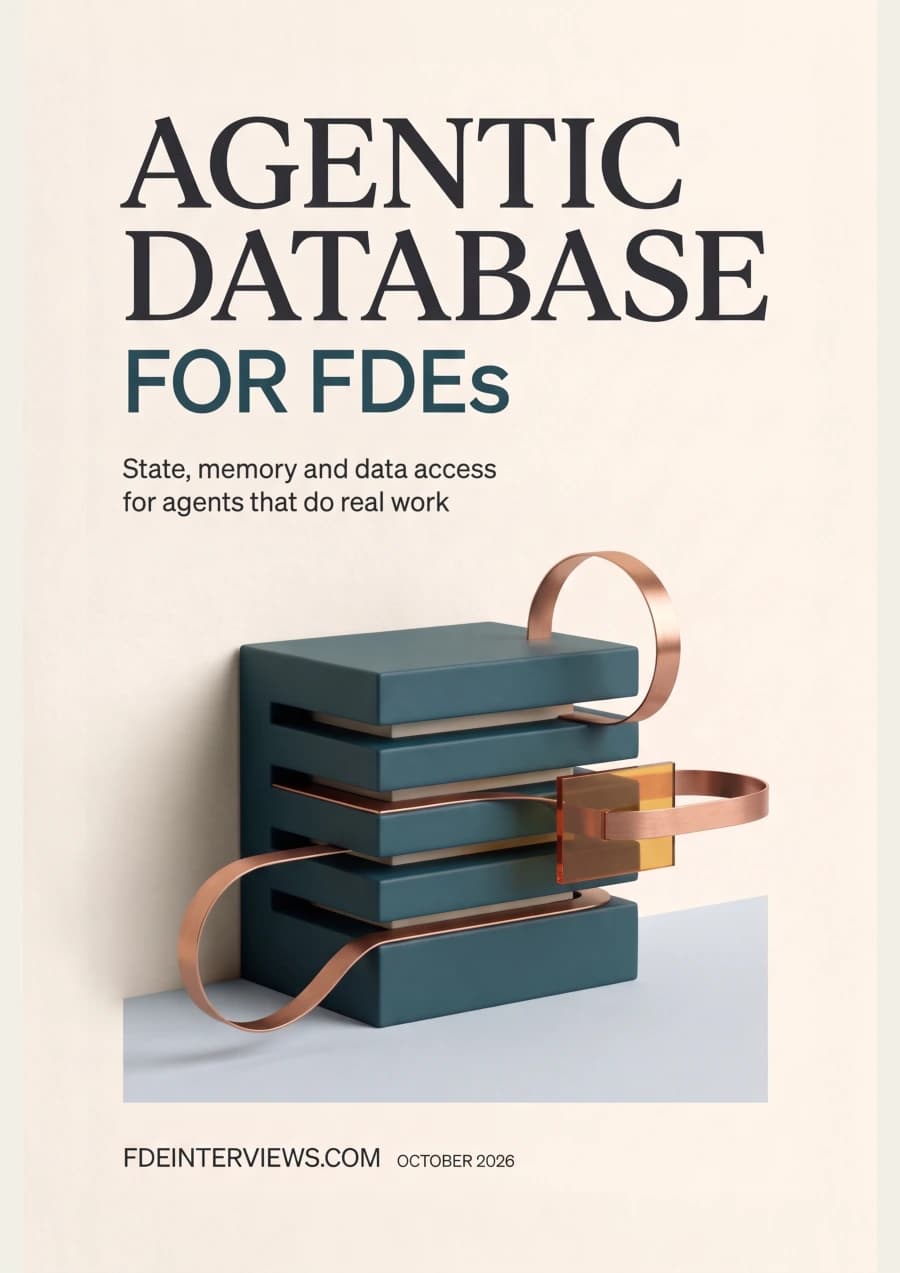
Authority / evidence / memory / recovery
It is the data architecture that lets an AI agent work with business records, searchable evidence, persistent task state and approved memory. One database can serve several of these roles; a larger system may separate them.
The guide helps you choose those boundaries. It distinguishes a vector index from an authority, a checkpoint from long-term memory, a protocol retry from a safe business retry, and an open-source core from a separately licensed service.
Three complete pages, free to read
See the tenant boundary, filtered retrieval and erasure through recovery. Each preview opens a real PDF page at full size.
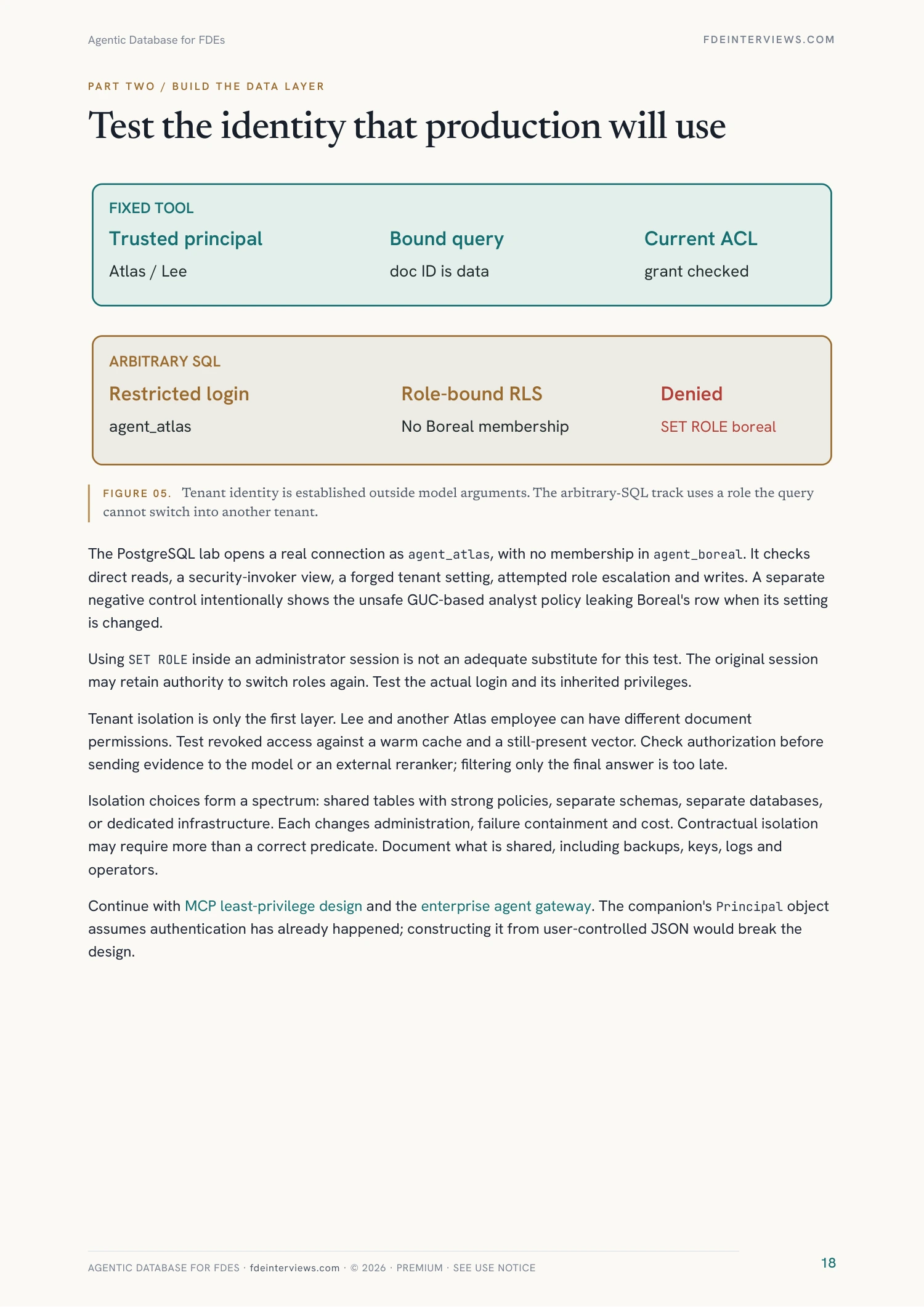
Page 18 / Sample
See how actual tenant logins, current permissions and a deliberately unsafe setting expose the trust boundary.
Open the page at full size ↗
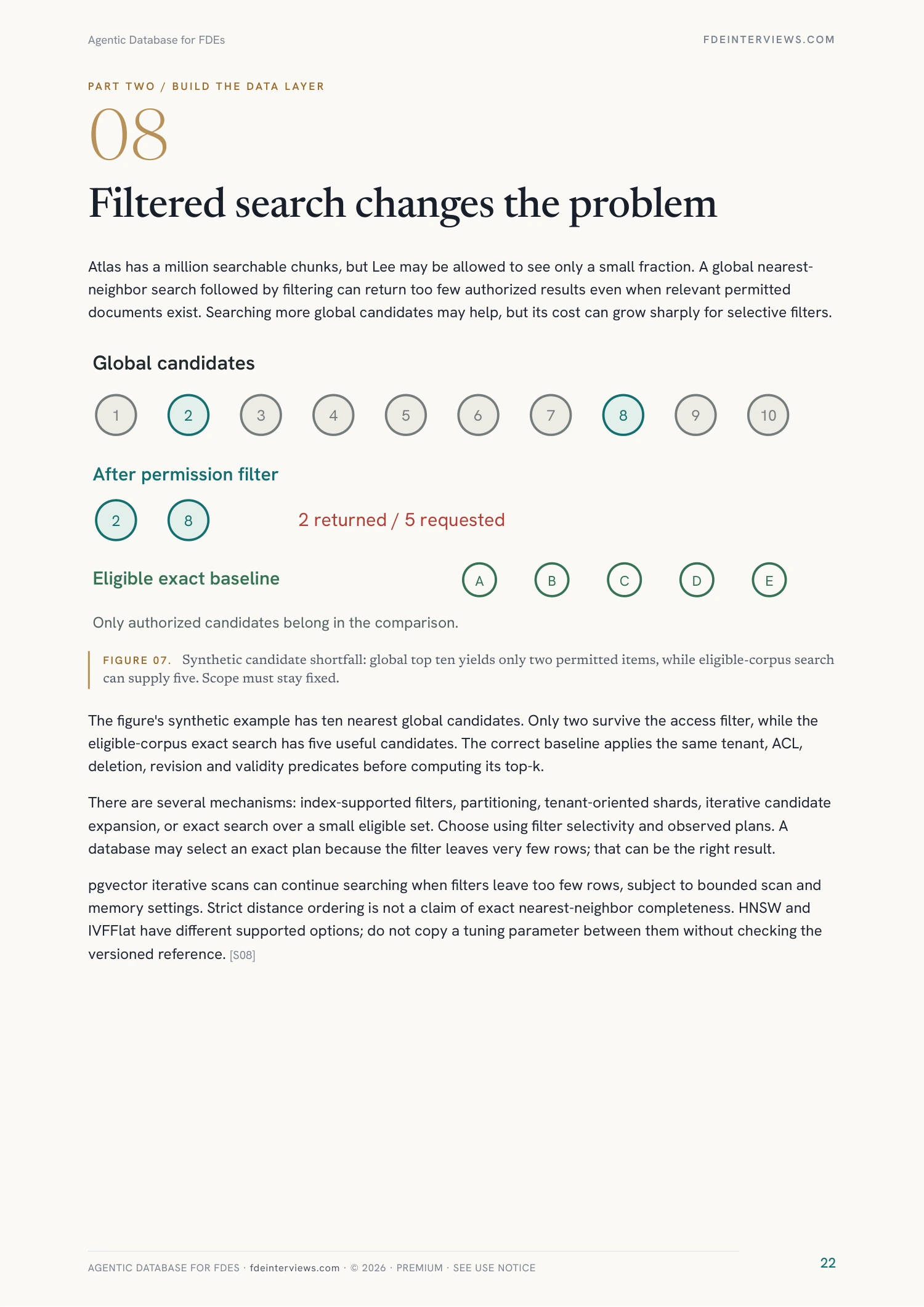
Page 22 / Sample
Compare global candidates with the eligible-corpus baseline and understand why a filter can cause shortfall.
Open the page at full size ↗
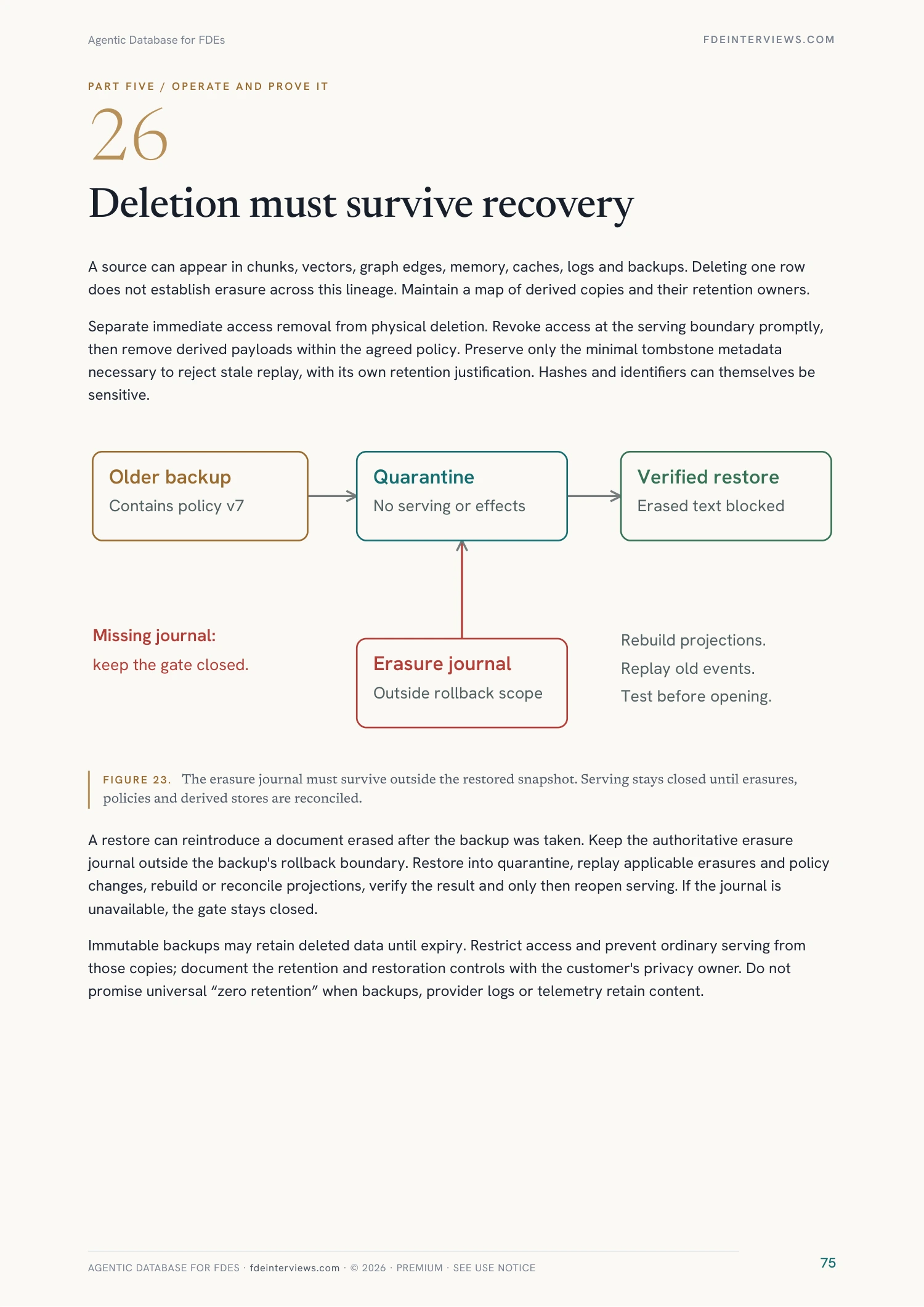
Page 75 / Sample
Follow the erasure journal through a quarantined restore so an older backup cannot reopen erased evidence.
Open the page at full size ↗
32 chapters / six parts
Translate a customer request into an authority map, database invariants and versioned data contracts.
Work through PostgreSQL, tenant isolation, vector and hybrid retrieval, ingestion, memory, graphs, ontologies, catalogs, feature stores, Open Knowledge Format and caching.
Understand October 2026 MCP, constrain tools and generated SQL, bind approvals and recover ambiguous actions.
Compare database roles, exact license boundaries, distributed guarantees, cloud services, branches and migrations.
Calculate capacity and cost, benchmark customer requests, write runbooks, plan backups and regional failover, and keep erased data erased after recovery.
Run the reference system, examine three deployment cases and practise ten design-review questions with worked answers.
Three fictional cases connect the architecture to customer decisions. The local code exercises the support mechanics and analyst fixture; the field case is a worked design, with its offline limitations stated.
Atlas Service / fictional customer
Retrieve the current warranty under the engineer's permissions, retain approved memory and recover a replacement after the shipping reply is lost.
Governed SQL / synthetic records
Resolve metric grain before querying. Catch a valid join that inflates the total, and contain query execution in an approved analytical snapshot.
Unreliable connectivity / explicit limits
Keep local task state and permitted evidence, define what may happen offline and reconcile permissions and queued proposals on reconnect.
Included / executable companion
Run time-correct feature retrieval, a bounded knowledge-bundle reader, scoped search, an atomic outbox, memory expiry, optimistic checkpoints, concurrent budgets, a lost-reply recovery, bounded analyst SQL and a restore that reapplies erasures. The archive passed 70 tests and 8 deliberate mutation checks.
The offline track uses Python and SQLite without external packages or keys. The Docker track exercises actual PostgreSQL and pgvector. Setup instructions explain expected results, failure diagnosis and the integrations still required for production.
Teaching code and synthetic data. No hosted execution, production credentials or model account required for the local track.
These paths connect the guide to focused concepts, questions, course lessons and a work sample. The same links are clickable inside the PDF.
Chapters 2–10
Chapters 11–16
Chapter 12
Chapters 17–18
Chapters 25–31
Chapter 12 follows one customer task through knowledge and context graphs, domain ontologies, ontology registries and upper ontologies, catalogs, semantic layers and feature stores. It explains Google’s Open Knowledge Format v0.2 and distinguishes it from RDF, OWL, SHACL, SPARQL, DCAT, OpenLineage and MCP. Worked examples and local tests cover late-arriving features and the trust boundary around imported knowledge.
In this guide, it means the data architecture behind an AI agent: authoritative business records, resumable task state, searchable evidence, approved memory and controlled database tools. It can use several ordinary databases. It does not require a database with an LLM built into it.
PostgreSQL and pgvector form the relational reference track. The selection chapters discuss SQLite, DuckDB, MySQL, TiDB, OpenSearch, Valkey, Redis, Qdrant, Milvus, Weaviate, Chroma, LanceDB, Neo4j, FalkorDB, Memgraph, MongoDB and CockroachDB, with AWS RDS/Aurora, Aurora DSQL, DynamoDB, Google Cloud SQL, AlloyDB, Firestore, Firebase SQL Connect, Realtime Database, Supabase, Cosmos DB, Pinecone, Spanner and Bigtable considered separately. The comparison distinguishes core licenses, enterprise components and cloud terms.
Basic Python and familiarity with short SQL statements are enough to start. The guide explains keys, transactions, isolation, vector distance and retrieval metrics before using them in design decisions. The examples follow one customer scenario, with an analyst and disconnected-field variant later.
The companion includes an offline Python/SQLite teaching system, 70 tests, a demo and calculation helpers. An optional Docker track executes actual PostgreSQL/pgvector checks, including restricted logins, row security, an HNSW plan and exact-search comparison. The core track needs Python 3.10 or later and no packages, network, cloud account or model key. Docker and an image download are needed for the PostgreSQL track.
No. The MCP module is an executable protocol-and-identity contract fixture, and the external action system is a durable simulator. The guide identifies the authentication, SDK server, embedding model, approval service, infrastructure and operational work needed for a production integration. It teaches and tests the boundaries rather than claiming a turnkey deployment.
This October 2026 edition uses 106 primary references, including the July 2026 MCP revision and version-specific licensing. The extracted companion passed 70 tests and caught 8 deliberate control-breaking mutations. The PostgreSQL track was executed separately. PDF layout, links and figures were checked. Product claims should still be rechecked against the exact version and plan you deploy.
The complete PDF and companion ZIP are included with active paid Premium or approved complimentary guide access, with no separate purchase. Three complete sample pages are public. Referral-only online Premium does not include guide downloads. Keep a lawfully downloaded copy for study under the publication notice; do not redistribute the Premium files.
The PDF and learning paths link to concepts, interview questions, Production AI Agents, Hard Deployments, FDE Engagement and work samples. Follow a chapter into a focused exercise, then return to the guide to place the mechanism in the complete data architecture. Each linked resource retains its displayed access level.
AI tools assisted research, writing, code and the original cover illustration. Technical figures are explicit vector diagrams. Customer names and numerical fixtures are synthetic teaching material. The edition is prepared for publisher review; automated checks and assistant review do not imply independent human editorial approval.