
Start with an easy example
Read the symbols in plain language, keep the units and check a case whose answer you already know.
The practical mathematics primer / October 2026
A practical primer for engineers who want the maths to make sense.
A retrieval score, a small evaluation and a memory estimate can all change a customer decision. Learn what those numbers mean, work through the arithmetic and show the result clearly.
Every answer, concept and course, all published video lessons, hands-on FDE Lab missions, Premium PDF guides and companion files, the full practice-test bank and work-sample downloads. Referral Premium excludes guide PDFs and their companion files.
Study alongside free video lessons.
Premium guide PDFs and companion files require active paid Premium or approved complimentary access. Referral Premium includes the rest of the site, but excludes these downloads.
66 pages · 15 core lessons · PDF + calculation companion
Quantities / evidence / computation / charts
Read the symbols in plain language, keep the units and check a case whose answer you already know.
Judge model evidence, explain retrieval, budget memory and examine the queue behind a review threshold.
Choose a chart that answers the question, preserve its denominator and show the limits of the evidence.
Open the book
Read three complete pages from the PDF. Open a preview at full size to inspect the worked example and its figure.
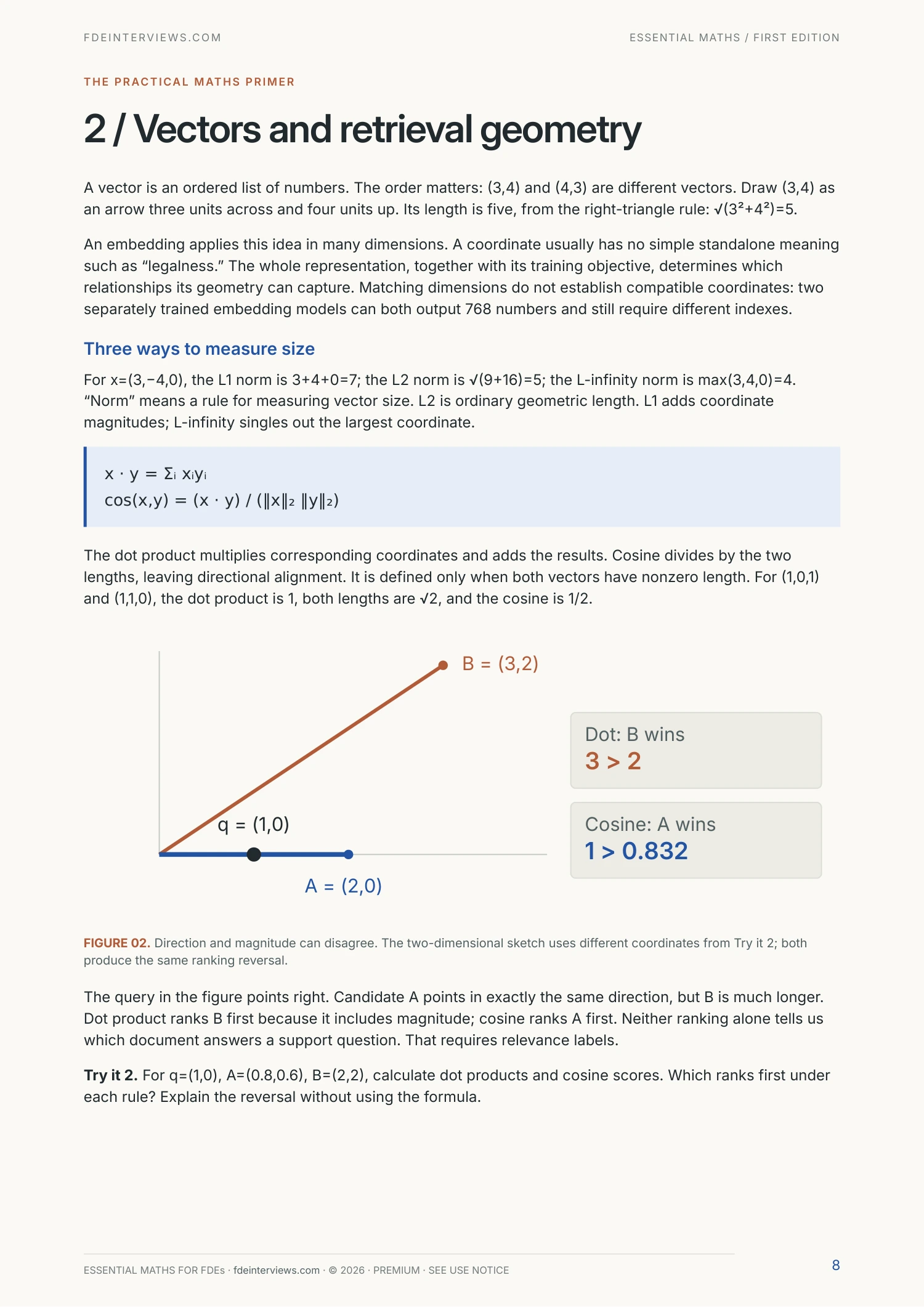
Page 8 / Sample
See why dot product and cosine can rank the same candidates differently.
Open the page at full size ↗
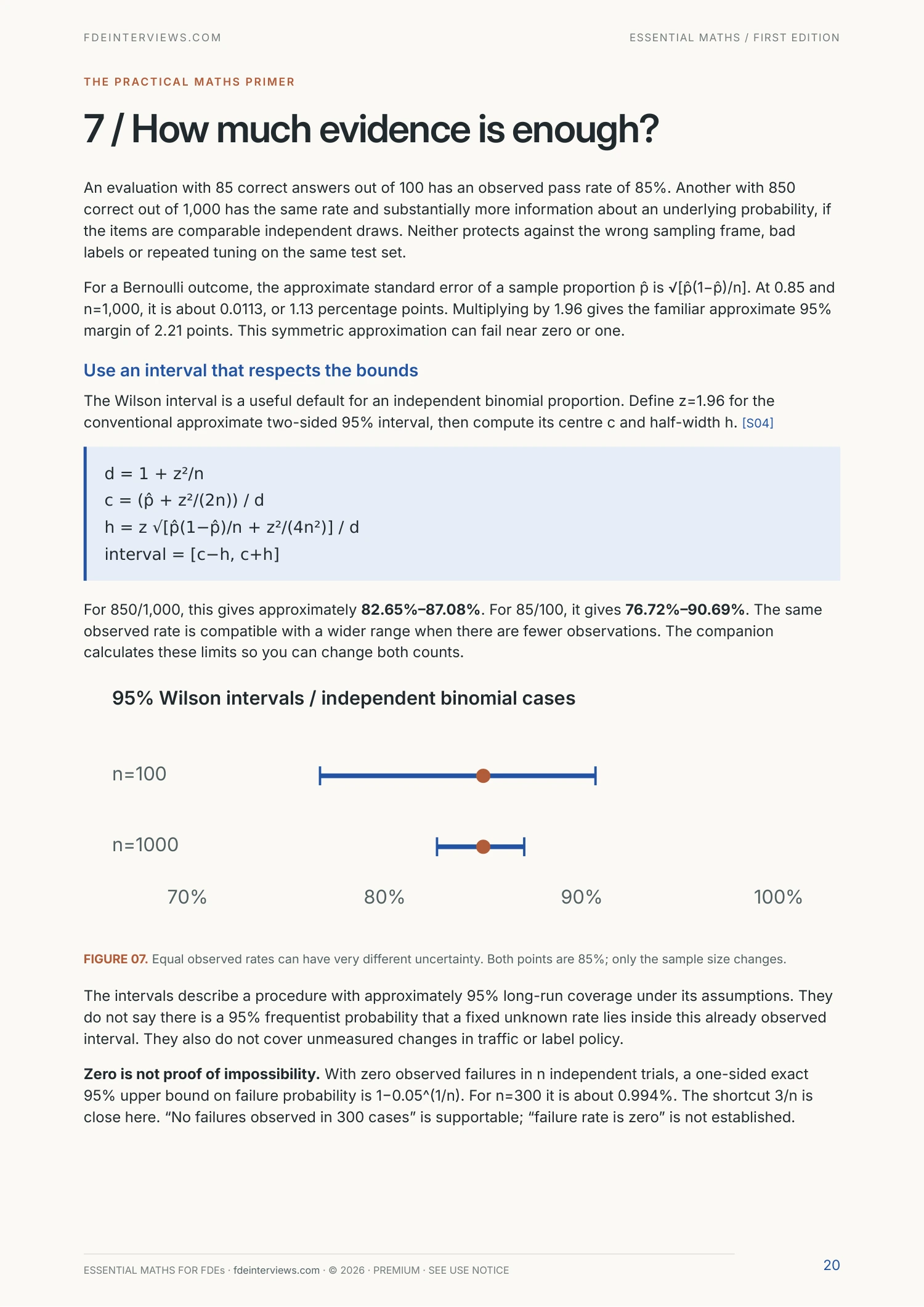
Page 20 / Sample
Compare equal pass rates at different sample sizes, and interpret zero observed failures.
Open the page at full size ↗
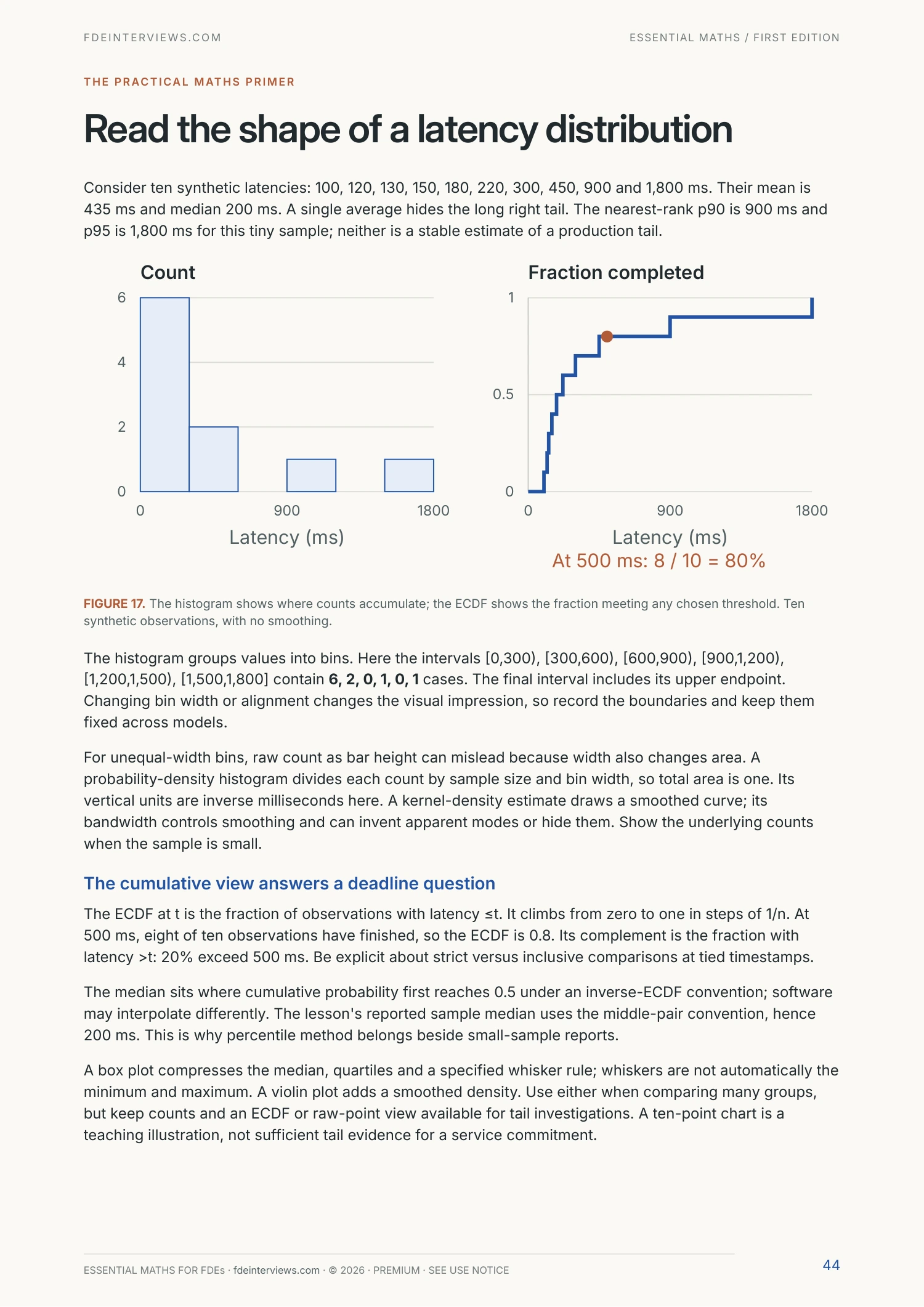
Page 44 / Sample
Use a histogram and cumulative curve to explain latency and deadlines.
Open the page at full size ↗
A connected learning sequence
Work with units, percentages, vectors and matrix shapes. Understand what compression preserves.
Use probability, distributions, intervals and error costs to judge a model and its decisions.
Follow gradients, attention, floating point, cache budgets, queues and graph growth.
Choose a chart, work through a release review, check your answers and return to the desk reference.
The optional specialist pages introduce priors, constrained optimisation, vision shapes, Fourier transforms and curved geometry. Follow those routes when your application needs them. The book includes 25 selected primary references.
Included / calculation companion
Run transparent calculators for cosine, evaluation intervals, paired comparisons, stable probabilities, quantisation, memory and queues. Recreate the worked charts from their synthetic data, and keep assumptions beside the result in an editable calculation note.
Python 3.10 or later, with no extra packages or paid APIs. The exact distributed archive passes 21 test groups and detects five deliberate defects. These are teaching tools with stated limits; review them before operational use.
A candidate assistant improves on an evaluation and requests a longer context window. Inspect the paired evidence, cache budget, human-review capacity and cost per accepted task before recommending a release.
The supplied packet and worked response are fictional. The exercise teaches how to combine constraints without mistaking a promising score for a complete operating decision.
The PDF links directly to relevant concepts, questions and courses. Each linked resource retains its displayed access level.
Lessons 2–4
Lessons 5–9 and 15
Lessons 10–14
Worked review and reference
You need ordinary arithmetic, curiosity and a calculator. The guide introduces notation, units and percentages before vectors or calculus. Each core lesson works through a small example and explains what the result means in engineering work.
The 66-page PDF contains 15 core lessons, 20 original vector figures, 14 exercises with worked answers, a release-review case, reference sheets and optional specialist material. A separate ZIP contains standard-library Python calculators, checks, synthetic chart data and a calculation-note template.
Yes. A dedicated lesson covers chart selection, bar and dot comparisons, time series, histograms, cumulative curves, scatterplots, heatmaps, log scales, uncertainty, ROC and precision–recall curves. Worked figures show how the denominator, sample size and display choices change the interpretation.
Use it to explain a retrieval ranking, judge an evaluation, choose a review threshold, estimate model and cache memory, investigate numerical failures, plan capacity or present data to a customer. The worked review brings quality, memory, review capacity and cost into one decision.
No. All configurations, workloads, costs and outcomes are synthetic teaching inputs. The guide states formula assumptions and links selected primary technical references. It does not promise a particular model's accuracy, performance or deployment outcome.
The full PDF and companion are included with active paid Premium or approved complimentary guide access. No separate purchase is needed. Three complete sample pages are public. Referral-only online Premium does not include guide downloads.
Yes, for your own internal work under the guide's publication notice and site terms. The companion runs on Python 3.10 or later without extra packages or paid APIs. Review the assumptions before using it operationally. Public redistribution or resale requires permission except where allowed by law.
Coverage was reconciled against the supplied research and a later topic audit. The distributed companion passes 21 test groups and detects five deliberate defects. Checks also cover arithmetic, source and study links, PDF structure and rendered layout. AI assisted drafting, illustration and verification. Automated checks and assistant review do not imply independent human editorial approval.