FDEInterviews logo
APPLIED AI & SOLUTIONS ENGINEERING

Cohere Forward Deployed Engineer interview questions

Cohere hires AI engineers who apply its language models to real customer problems such as search, summarization, and generation, and who help integrate and optimize them in production. The loop centers on practical LLM work rather than pure algorithms, covering transformer fundamentals, deployment, and ML systems with MLOps and data pipelines. Expect strong emphasis on clear communication and collaborative problem-solving.

The Cohere Forward Deployed Engineer interview process

Documented

How the Cohere Forward Deployed Engineer interview experience actually runs — the rounds, what each stage tests, and the signals candidates report.

RoleCustomer Engineer / Applied AILoop~3–4 weeks
  1. 1
    Recruiter / HR screenResume, projects, behavior.
  2. 2
    Online coding (60 min)Three medium-difficulty data-structures problems.
  3. 3
    Take-home case studyOne or two prompts with a ~2-day turnaround.
  4. 4
    Virtual onsiteCoding, ML/LLM system design (model serving, retrieval, ingestion), a research-paper discussion, and a hiring-manager behavioral round.
WHAT THEY'RE EVALUATING
  • Heavy LLM / transformer and NLP-deployment fluency
  • Enterprise MLOps considerations

Compiled from our research and publicly available information (candidate reports and company interview guides). Interview loops change and are continuously iterated, and they vary by team, level, and region. Treat this as directional preparation, not an official spec, and confirm the exact rounds with your recruiter or hiring point of contact.

Cohere Forward Deployed Engineer salary

What we can trace, labelled by where it came from. We publish a band only where there is a source behind it, so some of this page is a gap rather than a number.

NO TRACEABLE BAND

We have not found a compensation figure for this role at Cohere that we can trace to an employer posting or a public aggregator. Rather than publish an estimate, we are naming the gap. Their careers page is the authority, and postings in some jurisdictions are required to state a range.

HIRING FROM INDIA
Global AI lab, India-based hire

A US or EU AI company with no large India engineering centre. An India-based hire here is usually a global-remote contract, often USD-denominated, which is the highest-paying route into the role from India and also the hardest to get.

LEVELREPORTED FOR THIS EMPLOYER TYPE
Junior (0-2 yrs)₹35 LPA - ₹55 LPA
Mid (3-6 yrs)₹55 LPA - ₹90 LPA
Senior (7+ yrs)₹90 LPA - ₹1.5 Cr

Reported range for this type of employer, not a figure reported for this company. Whether an India-based hire is possible at all depends on their entity and visa position, so check their careers page before you plan around it.

Full method, US bands by level, and the three India tiers side by side are in the FDE salary guide, including what actually moves your number between these tiers.

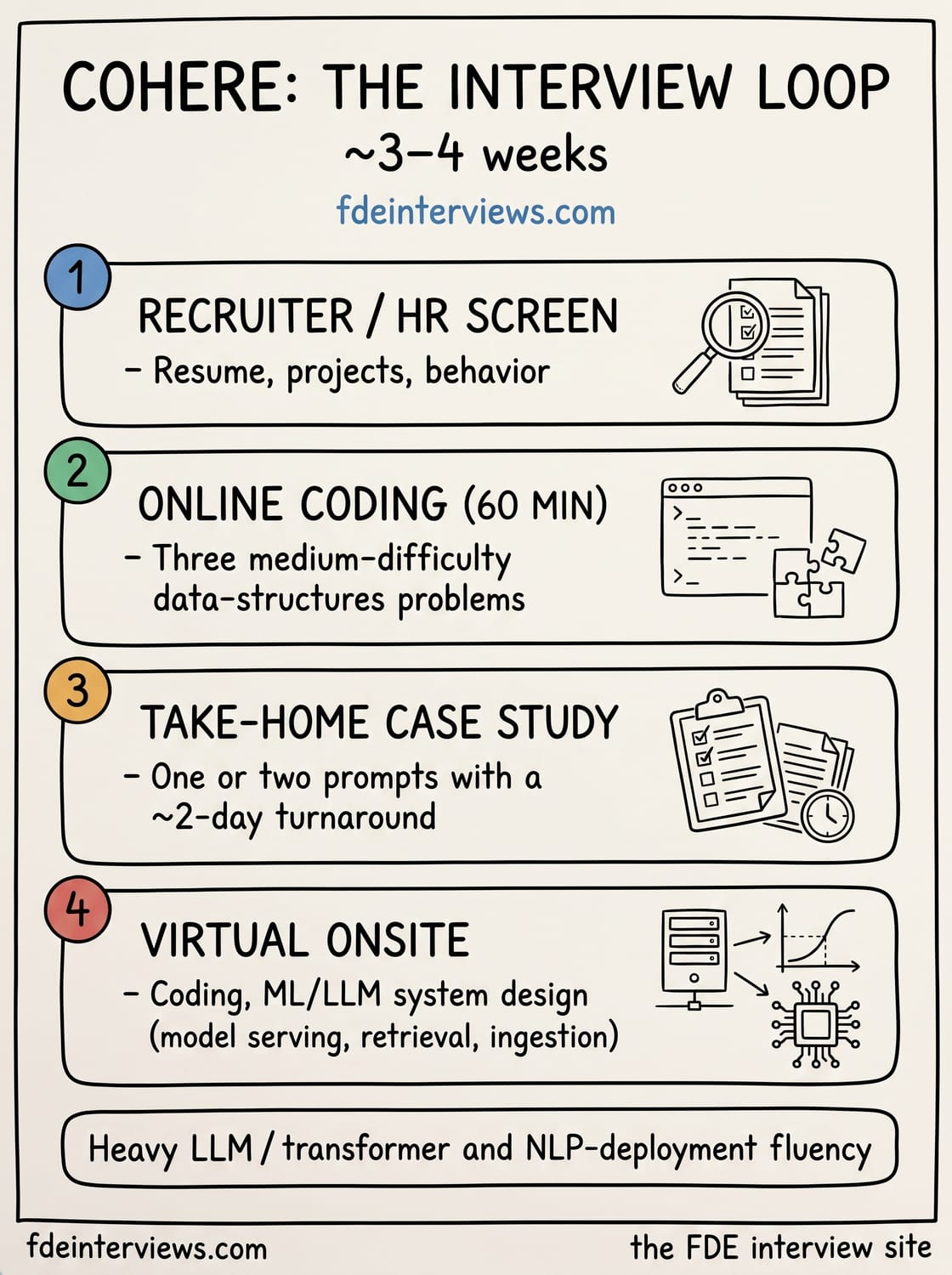
THE ONE-PAGE VERSION
Infographic of the Cohere interview loop, round by round: Recruiter / HR screen, Online coding (60 min), Take-home case study, Virtual onsite.
↧ DownloadShare on X ↗Share on LinkedIn ↗

Questions modeled on Cohere loops

36 questions · 10 unlocked for you

More from the tracks Cohere's loop tests

The highest-signal questions across Cohere's core tracks.

8 questions · 8 unlocked for you

Go deeper on the topics Cohere's loop tests

The tracks that map to a Cohere Forward Deployed Engineer loop, ordered easy to hard.

The concepts Cohere's Forward Deployed Engineer loop assumes you know

The vocabulary and mental models behind Cohere's questions, from our curriculum. Start with the foundations free; the deeper, interview-defining ideas are part of premium.

FOUNDATIONS OF LLMS & GENAI

Foundational
Tokenization & TokensA language model does not read characters or words. It reads tokens: sub-word chunks produced by a tokenizer, each mapped to an integer the model embeds. Tokens are the unit of the context window and of billing, and the way text splits into them explains a surprising number of model quirks, which is why almost every loop opens here.
Foundational
The Context WindowThe context window is the fixed number of tokens a language model can attend to at once, and input and output share that same budget. Understanding it is what separates engineers who can size a prompt, control cost and latency, and decide when to reach for RAG from those who just paste everything in and hope.
Foundational
Embeddings & Vector RepresentationsAn embedding turns a piece of text into a list of numbers positioned so that similar meanings land near each other in space, which lets you search by meaning instead of by keyword. Embeddings are the engine under RAG, semantic search, clustering, and deduplication, so FDE loops expect you to explain cosine similarity and the pitfalls that quietly break a vector index.
Advanced🔒 Premium
LoRA and Parameter-Efficient Fine-tuningFull fine-tuning updates every weight in a model, which is expensive to train and produces a full-size checkpoint per task. LoRA freezes the base model and trains small low-rank adapter matrices instead, giving tiny swappable checkpoints; QLoRA adds a quantized frozen base so the whole thing fits on a single GPU. FDE loops probe it because it is how you adapt a model on a customer's data without their budget or their hardware blowing up.

RETRIEVAL & AGENTS

Foundational
Retrieval-Augmented Generation (RAG)RAG grounds a language model in your own data by retrieving relevant passages at query time and putting them in the prompt, so the model answers from real sources instead of memory. It is the default pattern for almost every enterprise FDE deployment, which is why nearly every loop tests it.
Foundational
Vector DatabasesA vector database stores embeddings alongside metadata and answers nearest-neighbor queries fast using approximate indexes. The real interview question is not how they work but when you actually need one instead of a library or plain Postgres with pgvector.
CoreSign in
Hybrid Search (Lexical + Vector)Hybrid search runs a keyword retriever (BM25) and a dense vector retriever side by side, then merges their result lists, because each one misses cases the other catches. Vectors lose exact codes and rare jargon, BM25 loses paraphrase, and combining them with Reciprocal Rank Fusion usually beats either alone.
Advanced🔒 Premium
Agent MemoryAgent memory is how an agent carries state across turns and sessions. Short-term memory is the conversation and scratchpad living inside the context window, bounded and expensive. Long-term memory is an external store the agent writes to and retrieves from on demand, usually via RAG, so it can recall facts from last week without holding them in the prompt. FDE loops probe this because the hard parts, summarization, what to persist, and stale or contradictory memory, are where agents quietly break.

MLOPS & LIFECYCLE

EVALUATION & ML FOUNDATIONS

CoreSign in
Information Theory for ML: Entropy, Cross-Entropy, KL and PerplexityFour quantities from information theory keep showing up in ML: entropy measures the average surprise in a distribution, cross-entropy is the loss that trains classifiers and language models, KL divergence measures how far one distribution sits from another, and perplexity is the intuitive branching-factor view of a language model's loss. Knowing where each appears separates people who tuned a loss function from people who only imported one.
Foundational
Precision, Recall and F1Precision asks how many of your positive predictions were right; recall asks how many of the real positives you caught. They trade off against each other, F1 is their harmonic mean, and accuracy lies to you the moment the classes are imbalanced.
Foundational
Gradient Descent & Learning RateGradient descent is how almost every model learns: compute the slope of the loss with respect to the weights, then step the weights a little in the downhill direction. The learning rate sets the step size, and it is the single most consequential knob. Too small and training crawls; too large and it overshoots and diverges.
Advanced🔒 Premium
Offline vs Online EvaluationOffline evaluation scores a change against a fixed golden set: fast, cheap, repeatable, and runnable in CI before anything ships. Online evaluation measures the change on real traffic and real users, usually via A/B, and is the only true read on impact. The two are not interchangeable: offline gains routinely fail to hold online because of distribution shift and metric gaming. The discipline FDE loops test is using offline to gate and online to confirm.

Where to apply, and official Cohere resources

Straight from Cohere: open roles and the company's own hiring guidance. Prep here, then apply there.

External links to Cohere's own pages. Roles and processes change; always confirm on the official site.

ABOUT THE ROLE
COHERE INTERVIEW FAQ
What is the Cohere Forward Deployed Engineer interview process?

Customer Engineer / Applied AI. Typical loop: ~3–4 weeks. Stages: Recruiter / HR screen → Online coding (60 min) → Take-home case study → Virtual onsite. Key focus: Heavy LLM / transformer and NLP-deployment fluency. Compiled from public reports; loops change over time, so confirm the exact rounds with your recruiter.

Does Cohere hire Forward Deployed Engineers?
What does the Cohere AI engineer interview test?
What is the Cohere AI engineer salary?

Walk into your Cohere Forward Deployed Engineer interview ready

Unlock every FDE interview answer, ordered easy to hard, plus the full concept curriculum, for 6 months. One payment, no auto-renewal. Free questions and concepts in each track, no card needed to start.

Or create a free account to unlock more free answers per topic.

Other Forward Deployed Engineer interviews to prep

Companies whose loops test the same tracks as Cohere's.

Independent and not affiliated with Cohere. All trademarks belong to their owners.