FDEInterviews logo
FORWARD DEPLOYED ENGINEER PROGRAM

Sierra Forward Deployed Engineer interview questions

Sierra builds enterprise conversational AI agents and runs a customer-facing Agent Engineer function that ships agents into production for clients. The loop typically includes a paid take-home work sample, a pairing round, a system design round, a past-project deep dive, and behavioral, plus a distinctive TypeScript and React debugging round. Expect a blend of technical skill, product sense, and front-end fluency.

The Sierra Forward Deployed Engineer interview process

Documented

How the Sierra Forward Deployed Engineer interview experience actually runs — the rounds, what each stage tests, and the signals candidates report.

RoleAgent Engineer / Forward DeployedAI toolsAI-native: you bring and use any AI coding tools during the Build phase.
  1. 1
    Recruiter screenBackground and role fit.
  2. 2
    Practical technical screen (60 min)e.g. spreadsheet dependency parsing and cycle detection.
  3. 3
    React / TypeScript debugging (60 min)Front-end debugging without AI tools.
  4. 4
    Agent-building take-homeGiven an API key, build a custom agent.
  5. 5
    AI-native onsite (Plan → Build → Review)Define a product domain, then a 2-hr self-directed agent build with any AI tools, then a structured demo and code review of data models, abstractions, and production readiness.
WHAT THEY'RE EVALUATING
  • Product agency and pragmatic scoping over LeetCode memorization
  • How you handle failing AI outputs: adapt vs. paralyze

Compiled from our research and publicly available information (candidate reports and company interview guides). Interview loops change and are continuously iterated, and they vary by team, level, and region. Treat this as directional preparation, not an official spec, and confirm the exact rounds with your recruiter or hiring point of contact.

Sierra Forward Deployed Engineer salary

What we can trace, labelled by where it came from. We publish a band only where there is a source behind it, so some of this page is a gap rather than a number.

NO TRACEABLE BAND

We have not found a compensation figure for this role at Sierra that we can trace to an employer posting or a public aggregator. Rather than publish an estimate, we are naming the gap. Their careers page is the authority, and postings in some jurisdictions are required to state a range.

HIRING FROM INDIA
Global AI lab, India-based hire

A US or EU AI company with no large India engineering centre. An India-based hire here is usually a global-remote contract, often USD-denominated, which is the highest-paying route into the role from India and also the hardest to get.

LEVELREPORTED FOR THIS EMPLOYER TYPE
Junior (0-2 yrs)₹35 LPA - ₹55 LPA
Mid (3-6 yrs)₹55 LPA - ₹90 LPA
Senior (7+ yrs)₹90 LPA - ₹1.5 Cr

Reported range for this type of employer, not a figure reported for this company. Whether an India-based hire is possible at all depends on their entity and visa position, so check their careers page before you plan around it.

Full method, US bands by level, and the three India tiers side by side are in the FDE salary guide, including what actually moves your number between these tiers.

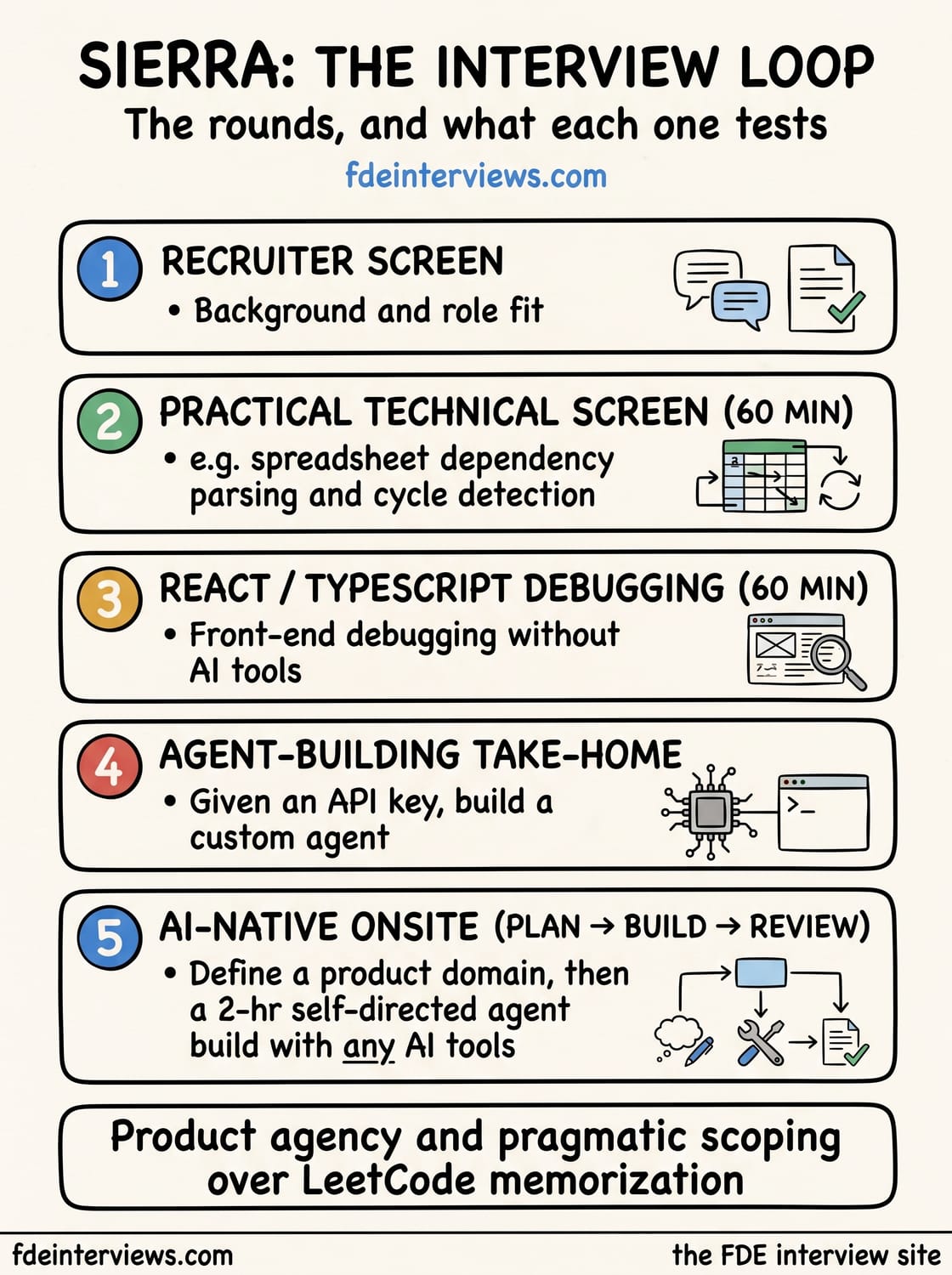
THE ONE-PAGE VERSION
Infographic of the Sierra interview loop, round by round: Recruiter screen, Practical technical screen (60 min), React / TypeScript debugging (60 min), Agent-building take-home, AI-native onsite (Plan → Build → Review).
↧ DownloadShare on X ↗Share on LinkedIn ↗

Questions modeled on Sierra loops

46 questions · 3 unlocked for you

More from the tracks Sierra's loop tests

The highest-signal questions across Sierra's core tracks.

8 questions · 8 unlocked for you

Go deeper on the topics Sierra's loop tests

The tracks that map to a Sierra Forward Deployed Engineer loop, ordered easy to hard.

The concepts Sierra's Forward Deployed Engineer loop assumes you know

The vocabulary and mental models behind Sierra's questions, from our curriculum. Start with the foundations free; the deeper, interview-defining ideas are part of premium.

RETRIEVAL & AGENTS

Foundational
Retrieval-Augmented Generation (RAG)RAG grounds a language model in your own data by retrieving relevant passages at query time and putting them in the prompt, so the model answers from real sources instead of memory. It is the default pattern for almost every enterprise FDE deployment, which is why nearly every loop tests it.
Foundational
Vector DatabasesA vector database stores embeddings alongside metadata and answers nearest-neighbor queries fast using approximate indexes. The real interview question is not how they work but when you actually need one instead of a library or plain Postgres with pgvector.
CoreSign in
Hybrid Search (Lexical + Vector)Hybrid search runs a keyword retriever (BM25) and a dense vector retriever side by side, then merges their result lists, because each one misses cases the other catches. Vectors lose exact codes and rare jargon, BM25 loses paraphrase, and combining them with Reciprocal Rank Fusion usually beats either alone.
Advanced🔒 Premium
Agent MemoryAgent memory is how an agent carries state across turns and sessions. Short-term memory is the conversation and scratchpad living inside the context window, bounded and expensive. Long-term memory is an external store the agent writes to and retrieves from on demand, usually via RAG, so it can recall facts from last week without holding them in the prompt. FDE loops probe this because the hard parts, summarization, what to persist, and stale or contradictory memory, are where agents quietly break.

CODING & ENGINEERING CRAFT

Foundational
Parsing Messy, Real-World DataCustomer files are dirty: inconsistent quoting, missing headers, junk rows, encodings that lie. The job is to parse defensively, skip and log bad rows instead of aborting the whole batch, and keep parsing pure and separate from business logic so it stays testable and deterministic. This is most of what early FDE data-ingestion work actually is.
Foundational
Big-O That Actually MattersOn a deployment, Big-O is not a whiteboard puzzle; it is the one calculation that tells you whether the customer's data fits in the approach you picked. The skill is spotting the term that dominates at their scale, knowing when brute force dies and you need an index or ANN, and recognizing when constant factors and memory decide the outcome instead of the exponent.
CoreSign in
Testability and Dependency InjectionCode that reaches out to the clock, the network, the filesystem, or a random generator cannot be tested deterministically, because its output depends on the world. The fix is to separate pure logic from side effects and inject the things that touch the world (the clock, I/O, randomness) so a test can pass fakes. When you inherit untestable code, pin its current behavior with a characterization test first, then refactor under that net.
CoreSign in
Streaming and BackpressureStreaming processes data one chunk at a time so memory stays flat no matter how big the input is. The moment a producer outruns its consumer, you need backpressure: a bounded buffer that makes the producer wait instead of piling unbounded work into memory. In Python this is generators and chunked reads for the streaming half, and a bounded queue (or a blocking put) for the backpressure half. Get it wrong and a 50 GB file or a fast upstream OOMs the box.

SYSTEM DESIGN FOR AI IN PRODUCTION

THE CUSTOMER-FACING CRAFT

Foundational
Requirements DiscoveryRequirements discovery is the work of finding the real problem hiding behind the customer's stated ask. The request they hand you ("build us a chatbot") is almost never the need; the FDE who surfaces who uses it, what success looks like, what data actually exists, and why the deadline is the deadline is the one who ships something people use.
Foundational
Scoping Ambiguous ProblemsScoping an open-ended prompt ("a city wants to reduce 911 response times") is a structured move, not a flash of inspiration: clarify inputs and constraints, state your assumptions out loud, carve out the smallest useful MVP, name the accuracy/cost/latency trade-offs you are choosing, and plan for what happens when it fails. Diving straight into a model or an architecture is the most common reason candidates get cut in the simulation round.
Foundational
Explaining Trade-offs to Non-EngineersAn exec does not care whether you chose RAG or fine-tuning; they care what it costs, when it ships, and what it might get wrong. Translating a technical trade-off means converting accuracy, cost, and latency into the decision the business is actually making, framing each option as a choice with a consequence in their terms, and answering the question they will all eventually ask: why does the AI give a different answer every time, and why is that not a bug.
CoreSign in
Stakeholder ManagementA deployment spans the analyst who will use the tool daily and the CTO who signed the check, and those people want different things. Stakeholder management is figuring out who actually decides, building enough trust to be believed when you deliver bad news, and managing expectations so reality never arrives as a surprise. The job is not shipping the system; it is getting people to adopt it, which is a different and harder thing.

Where to apply, and official Sierra resources

Straight from Sierra: open roles and the company's own hiring guidance. Prep here, then apply there.

External links to Sierra's own pages. Roles and processes change; always confirm on the official site.

ABOUT THE ROLE
SIERRA INTERVIEW FAQ
What is the Sierra Forward Deployed Engineer interview process?

Agent Engineer / Forward Deployed. Stages: Recruiter screen → Practical technical screen (60 min) → React / TypeScript debugging (60 min) → Agent-building take-home → AI-native onsite (Plan → Build → Review). Key focus: Product agency and pragmatic scoping over LeetCode memorization. Compiled from public reports; loops change over time, so confirm the exact rounds with your recruiter.

Does Sierra hire Forward Deployed Engineers?
What does the Sierra Agent Engineer interview test?
What is the Sierra Agent Engineer salary?
What does Sierra's final Agent Engineer round focus on?

Walk into your Sierra Forward Deployed Engineer interview ready

Unlock every FDE interview answer, ordered easy to hard, plus the full concept curriculum, for 6 months. One payment, no auto-renewal. Free questions and concepts in each track, no card needed to start.

Or create a free account to unlock more free answers per topic.

Other Forward Deployed Engineer interviews to prep

Companies whose loops test the same tracks as Sierra's.

Independent and not affiliated with Sierra. All trademarks belong to their owners.