FDEInterviews logo
APPLIED AI & SOLUTIONS ENGINEERING

Snowflake Forward Deployed Engineer interview questions

Snowflake hires AI and ML solutions architects who work with customers to design data and AI systems on its platform. The loop includes a recruiter screen, a hiring-manager scenario round, a technical architecture deep dive with a design exercise, and a stakeholder role play where you present a past architecture to business stakeholders. This is solutions architecture rather than a classic forward deployed org.

The Snowflake Forward Deployed Engineer interview process

Documented

How the Snowflake Forward Deployed Engineer interview experience actually runs — the rounds, what each stage tests, and the signals candidates report.

RoleSolutions Architect / Applied AILoopScreening rounds + a 3-round onsiteAI toolsStrict ban on AI coding assistants in live rounds; at least one in-person coding round.
  1. 1
    Coding & algorithms45–60 min.
  2. 2
    SQL & data modelingDeep SQL proficiency.
  3. 3
    ML fundamentals + statisticsTraining vs. inference latency, feature engineering.
  4. 4
    Take-home (3–5 hrs)Build an end-to-end data pipeline or model deployment.
  5. 5
    Onsite: design, behavioral, bar-raiserData-warehouse / vector-DB system design, behavioral, and a bar-raiser.
WHAT THEY'RE EVALUATING
  • Deep SQL, vector databases, embeddings, and warehouse optimization
  • Presentation / demo skills matter

Compiled from our research and publicly available information (candidate reports and company interview guides). Interview loops change and are continuously iterated, and they vary by team, level, and region. Treat this as directional preparation, not an official spec, and confirm the exact rounds with your recruiter or hiring point of contact.

Snowflake Forward Deployed Engineer salary

What we can trace, labelled by where it came from. We publish a band only where there is a source behind it, so some of this page is a gap rather than a number.

NO TRACEABLE BAND

We have not found a compensation figure for this role at Snowflake that we can trace to an employer posting or a public aggregator. Rather than publish an estimate, we are naming the gap. Their careers page is the authority, and postings in some jurisdictions are required to state a range.

HIRING FROM INDIA
Multinational with an India engineering centre

An established India presence, usually Bengaluru, Hyderabad or Pune, hiring on a local band rather than a global-remote one. Lower than the global-remote route and far more attainable, with the usual multinational benefits and stability.

LEVELREPORTED FOR THIS EMPLOYER TYPE
Junior (0-2 yrs)₹22 LPA - ₹35 LPA
Mid (3-6 yrs)₹35 LPA - ₹55 LPA
Senior (7+ yrs)₹55 LPA - ₹80 LPA

Reported range for this type of employer, not a figure reported for this company. Bands vary widely by internal level, and the equity component at a listed company behaves very differently from startup equity.

Full method, US bands by level, and the three India tiers side by side are in the FDE salary guide, including what actually moves your number between these tiers.

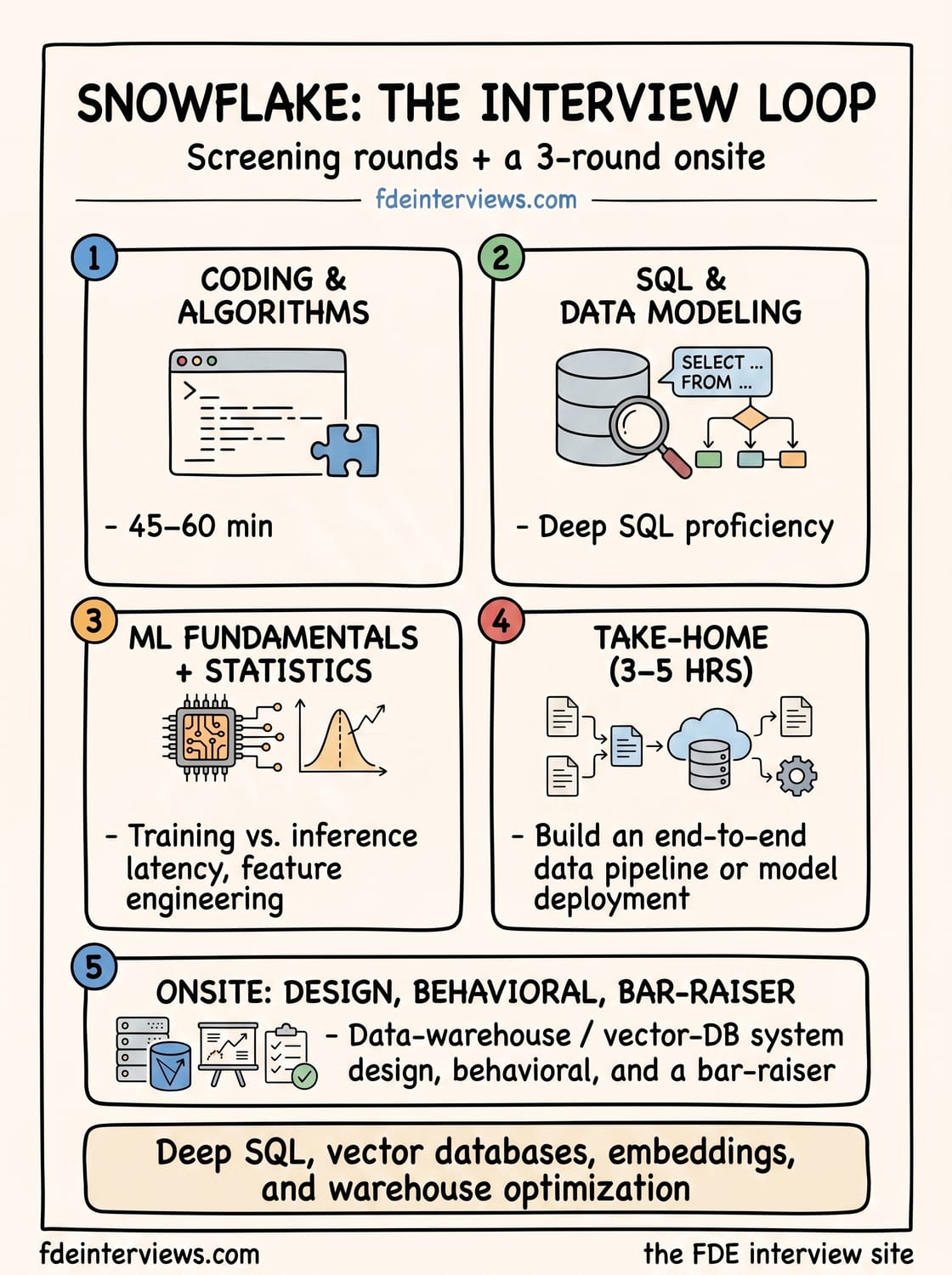
THE ONE-PAGE VERSION
Infographic of the Snowflake interview loop, round by round: Coding & algorithms, SQL & data modeling, ML fundamentals + statistics, Take-home (3–5 hrs), Onsite: design, behavioral, bar-raiser.
↧ DownloadShare on X ↗Share on LinkedIn ↗

Questions modeled on Snowflake loops

71 questions · 10 unlocked for you

More from the tracks Snowflake's loop tests

The highest-signal questions across Snowflake's core tracks.

8 questions · 8 unlocked for you

Go deeper on the topics Snowflake's loop tests

The tracks that map to a Snowflake Forward Deployed Engineer loop, ordered easy to hard.

The concepts Snowflake's Forward Deployed Engineer loop assumes you know

The vocabulary and mental models behind Snowflake's questions, from our curriculum. Start with the foundations free; the deeper, interview-defining ideas are part of premium.

DATA & SQL ENGINEERING

Foundational
SQL Window FunctionsWindow functions compute a value across a set of rows related to the current row without collapsing them, so you can rank, compare to a neighbor, or run a cumulative total while keeping every row. They are how analysts answer 'compared to what?' questions in pure SQL, and most interviewers use them to tell people who know SQL from people who know GROUP BY.
CoreSign in
Idempotent Data PipelinesPipelines retry, get re-run, and get backfilled, and every one of those re-runs must produce the same result as running once. Idempotency is the property that makes that true: write by key with upsert or partition overwrite, never blind append, so a retry cannot double-count. It is the single property that makes a pipeline safe to operate, because the alternative is a 2 a.m. page where you cannot tell if it is safe to run the job again.
CoreSign in
Data Quality and ValidationA deployment lives or dies on the customer's data, and that data is worse than their sample suggested. The job is to build automated quality gates (schema, null, range, uniqueness, freshness) at the boundary, quarantine bad records instead of failing the whole batch, and alert on the rate so a Tuesday-shaped degradation surfaces before a dashboard goes wrong. This is the difference between a pipeline that fails loudly and one that lies quietly.
Advanced🔒 Premium
Gaps and IslandsGaps and islands is the SQL pattern for collapsing a sequence of rows into the contiguous runs (islands) and the breaks between them (gaps). The trick is a difference of two row numbers that stays constant inside a run, giving every row in the same island an identical group key you can then aggregate. It powers sessionization, login streaks, and contiguous date-range queries, and interviewers love it because the naive self-join answer is both slow and wrong on ties.

SYSTEM DESIGN FOR AI IN PRODUCTION

EVALUATION & ML FOUNDATIONS

CoreSign in
Information Theory for ML: Entropy, Cross-Entropy, KL and PerplexityFour quantities from information theory keep showing up in ML: entropy measures the average surprise in a distribution, cross-entropy is the loss that trains classifiers and language models, KL divergence measures how far one distribution sits from another, and perplexity is the intuitive branching-factor view of a language model's loss. Knowing where each appears separates people who tuned a loss function from people who only imported one.
Foundational
Precision, Recall and F1Precision asks how many of your positive predictions were right; recall asks how many of the real positives you caught. They trade off against each other, F1 is their harmonic mean, and accuracy lies to you the moment the classes are imbalanced.
Foundational
Gradient Descent & Learning RateGradient descent is how almost every model learns: compute the slope of the loss with respect to the weights, then step the weights a little in the downhill direction. The learning rate sets the step size, and it is the single most consequential knob. Too small and training crawls; too large and it overshoots and diverges.
Advanced🔒 Premium
Offline vs Online EvaluationOffline evaluation scores a change against a fixed golden set: fast, cheap, repeatable, and runnable in CI before anything ships. Online evaluation measures the change on real traffic and real users, usually via A/B, and is the only true read on impact. The two are not interchangeable: offline gains routinely fail to hold online because of distribution shift and metric gaming. The discipline FDE loops test is using offline to gate and online to confirm.

THE CUSTOMER-FACING CRAFT

Foundational
Requirements DiscoveryRequirements discovery is the work of finding the real problem hiding behind the customer's stated ask. The request they hand you ("build us a chatbot") is almost never the need; the FDE who surfaces who uses it, what success looks like, what data actually exists, and why the deadline is the deadline is the one who ships something people use.
Foundational
Scoping Ambiguous ProblemsScoping an open-ended prompt ("a city wants to reduce 911 response times") is a structured move, not a flash of inspiration: clarify inputs and constraints, state your assumptions out loud, carve out the smallest useful MVP, name the accuracy/cost/latency trade-offs you are choosing, and plan for what happens when it fails. Diving straight into a model or an architecture is the most common reason candidates get cut in the simulation round.
Foundational
Explaining Trade-offs to Non-EngineersAn exec does not care whether you chose RAG or fine-tuning; they care what it costs, when it ships, and what it might get wrong. Translating a technical trade-off means converting accuracy, cost, and latency into the decision the business is actually making, framing each option as a choice with a consequence in their terms, and answering the question they will all eventually ask: why does the AI give a different answer every time, and why is that not a bug.
CoreSign in
Stakeholder ManagementA deployment spans the analyst who will use the tool daily and the CTO who signed the check, and those people want different things. Stakeholder management is figuring out who actually decides, building enough trust to be believed when you deliver bad news, and managing expectations so reality never arrives as a surprise. The job is not shipping the system; it is getting people to adopt it, which is a different and harder thing.

Where to apply, and official Snowflake resources

Straight from Snowflake: open roles and the company's own hiring guidance. Prep here, then apply there.

External links to Snowflake's own pages. Roles and processes change; always confirm on the official site.

ABOUT THE ROLE
SNOWFLAKE INTERVIEW FAQ
What is the Snowflake Forward Deployed Engineer interview process?

Solutions Architect / Applied AI. Typical loop: Screening rounds + a 3-round onsite. Stages: Coding & algorithms → SQL & data modeling → ML fundamentals + statistics → Take-home (3–5 hrs) → Onsite: design, behavioral, bar-raiser. Key focus: Deep SQL, vector databases, embeddings, and warehouse optimization. Compiled from public reports; loops change over time, so confirm the exact rounds with your recruiter.

Does Snowflake hire Forward Deployed Engineers?
What does the Snowflake AI/ML solutions architect interview test?
What is the Snowflake solutions architect salary?

Walk into your Snowflake Forward Deployed Engineer interview ready

Unlock every FDE interview answer, ordered easy to hard, plus the full concept curriculum, for 6 months. One payment, no auto-renewal. Free questions and concepts in each track, no card needed to start.

Or create a free account to unlock more free answers per topic.

Other Forward Deployed Engineer interviews to prep

Companies whose loops test the same tracks as Snowflake's.

Independent and not affiliated with Snowflake. All trademarks belong to their owners.