Companies / Databricks APPLIED AI & SOLUTIONS ENGINEERING
Databricks Forward Deployed Engineer interview questions Databricks now posts explicit Forward Deployed Engineer roles, verticalized by industry such as Healthcare and Life Sciences and Manufacturing, alongside the solutions architects and field engineers who have long worked directly with customers to design and productionize data and AI systems on its platform. The loop covers data architecture, a coding assignment, a design and architecture round, and a customer-facing presentation where you scope a scenario and pitch a solution.
The Databricks Forward Deployed Engineer interview process Documented How the Databricks Forward Deployed Engineer interview experience actually runs — the rounds, what each stage tests, and the signals candidates report.
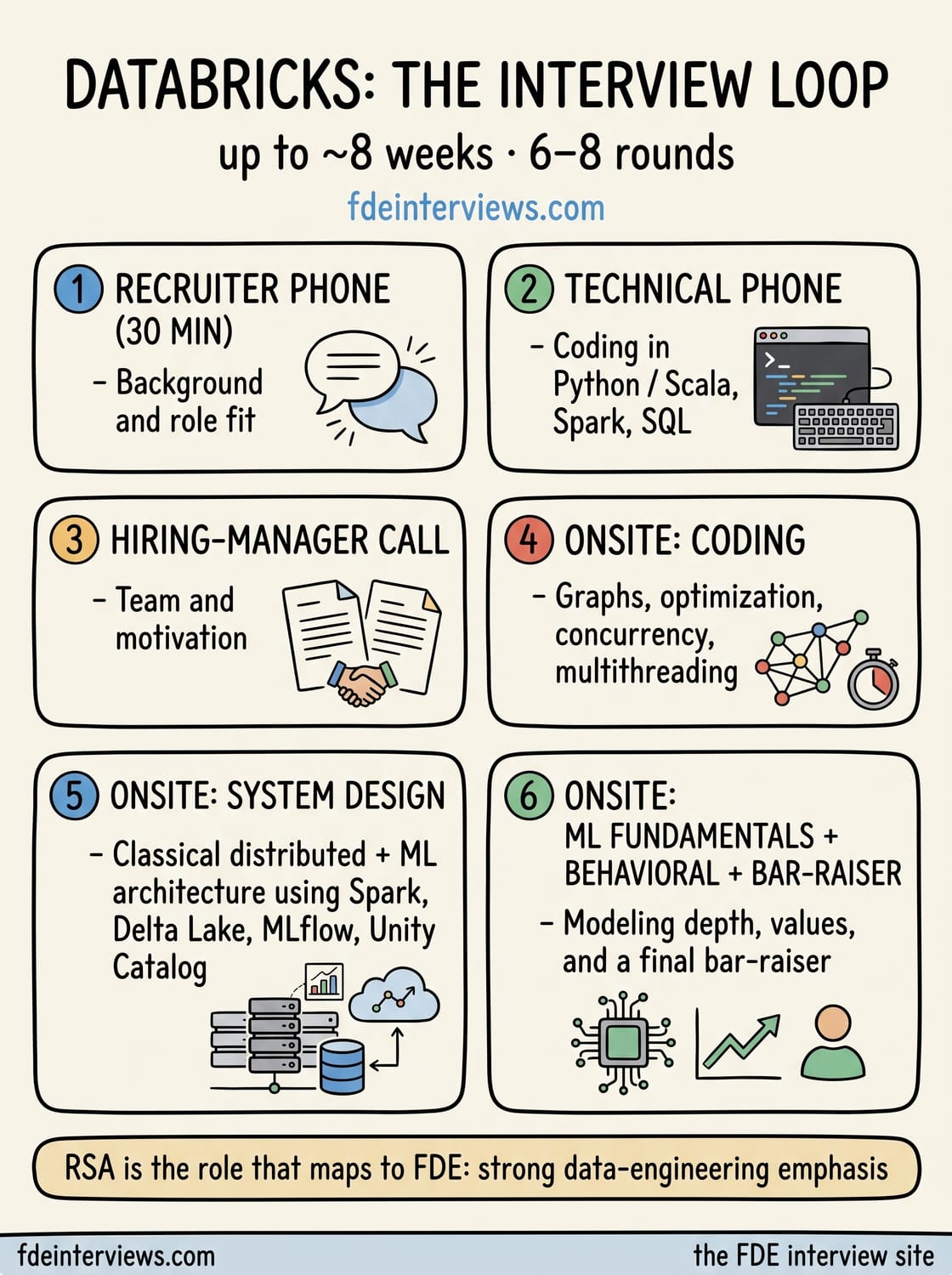
Role Resident Solutions Architect (RSA), the FDE-equivalent role Loop up to ~8 weeks · 6–8 rounds AI tools Favors simple, thread-safe correctness over lock-free cleverness.
1 Recruiter phone (30 min) Background and role fit.
2 Technical phone Coding in Python / Scala, Spark, SQL.
3 Hiring-manager call Team and motivation.
4 Onsite: coding Graphs, optimization, concurrency, multithreading.
5 Onsite: system design Classical distributed + ML architecture using Spark, Delta Lake, MLflow, Unity Catalog.
6 Onsite: ML fundamentals + behavioral + bar-raiser Modeling depth, values, and a final bar-raiser.
WHAT THEY'RE EVALUATING
› RSA is the role that maps to FDE: strong data-engineering emphasis› Spark / distributed systems and applied MLCompiled from our research and publicly available information (candidate reports and company interview guides). Interview loops change and are continuously iterated, and they vary by team, level, and region. Treat this as directional preparation, not an official spec, and confirm the exact rounds with your recruiter or hiring point of contact.
THE ONE-PAGE VERSION
↧ Download Share on X ↗ Share on LinkedIn ↗ Questions modeled on Databricks loops 170 questions · 24 unlocked for you
30
LoRA vs full fine-tuning, and when does running a 4-bit quantized model on-prem make sense? ▼ hard Mistral Cohere Databricks 1 replies ◆ premium
Adapter math, the VRAM arithmetic that makes 4-bit a 4x unlock, and the honest decision rule for on-prem deployments. The deep-internals question Mistral and Cohere loops use to find real practitioners.
31
A customer wants to self-host open weights instead of paying API fees. How do you model the real costs and decide? ▼ hard ★ Essential Mistral Databricks Microsoft 1 replies ◆ premium
The GPU-utilization math that decides this argument, the hidden line items (ops headcount, quality gap, model churn), and the hybrid recommendation that wins both the analysis and the customer.
39
You have a fixed latency and cost budget at scale. Walk me through quantization vs distillation to hit it. ▼ hard ★ Essential Mistral Databricks Together 1 replies ◆ premium
Two compression levers with very different bills. The arithmetic that decides between them, when to stack both, and the eval discipline that keeps a 'cheaper' model from quietly tanking your hardest 10% of queries.
41
At millions of calls a day, do you guarantee structured output with constrained decoding or validate-and-retry? Defend the economics. ▼ hard OpenAI Together Databricks 1 replies ◆ premium
The escalation ladder is settled; the at-scale tradeoff is not. Why retries quietly multiply your bill and tail latency, why constrained decoding has its own taxes, and the hybrid that most high-volume pipelines actually run.
42
Design a multi-model router or cascade that cuts cost without dropping below a quality floor. ▼ hard Anthropic OpenAI Databricks 1 replies ◆ premium
Sending every request to the frontier model is the lazy bill. The patterns that route by difficulty, the verifier that enforces a hard quality floor, and the failure mode that turns a cost-saving cascade into a worse, slower system.
56
Classify 100M product descriptions with an LLM when the budget covers a fraction. Design the pipeline. ▼ hard Scale AI Cohere Databricks 2 replies ◆ premium
Budget covers maybe 5M of 100M LLM calls. Run a cheap first stage on everything, route only low-confidence items to the LLM, and use those LLM labels to distill a student that absorbs most of the volume. The cost-vs-coverage math that decides where the threshold goes.
09
Retrieval fails on the customer's internal jargon. Fine-tune embeddings, add a reranker, or rewrite queries? ▼ medium Glean Cohere Databricks 1 replies unlocked
Three plausible fixes, one decision framework. Interviewers grade the ordering (cheapest-reversible first) and whether you can say what each option costs in data, time, and operational burden.
15
Design text-to-SQL for executives, where a wrong-but-plausible query must never mislead anyone ▼ medium Databricks Snowflake OpenAI 1 replies ○ sign in
Text-to-SQL's nightmare isn't syntax errors, it's the query that runs, returns a confident number, and is silently wrong. The defense is a semantic layer plus transparency UX. Here's the full design.
17
Run an LLM over 10 million records nightly, within budget. Design the batch pipeline. ▼ medium Databricks Scale Anthropic 1 replies ○ sign in
The unglamorous design question that exposes who has run LLMs in production. Batch APIs at 50% off, idempotency keys, poison records, spend kill-switches: the full checklist interviewers listen for.
18
Ingest 40 enterprise sources (SharePoint, Confluence, Jira, drives) with incremental sync and deletion handling ▼ medium Glean Databricks Microsoft 1 replies ○ sign in
A Glean-signature design question where deletions, not ingestion, are the trap. Covers the connector framework, change detection per source class, tombstones, and the freshness SLO customers actually sign.
24
Design multi-tenant isolation for an agent platform: prompts, vector stores, caches, and evals ▼ hard Sierra Decagon Databricks 1 replies ◆ premium
Serving 50 enterprise customers off one platform means four leak surfaces most designs miss, including the semantic cache and the eval set. A tier-by-tier isolation model with the noisy-neighbor math.
26
Take a RAG POC from 50 docs in a notebook to 5M docs, 2k QPS, and a 99.9% SLA ▼ hard OpenAI Databricks Glean 1 replies ◆ premium
The POC-to-production gap is the FDE's home turf. What actually breaks at each order of magnitude (index, ingestion, latency, cost) and the dependency math that makes 99.9% harder than it sounds.
30
Your agent is live. Design the improvement flywheel: logging, eval mining, prompt versioning, canary rollout ▼ hard OpenAI Anthropic Sierra 1 replies ◆ premium
Launch is the starting line. The staff-level capstone: how production traffic becomes eval cases, prompts ship like code, and a model deprecation becomes a Tuesday instead of an incident.
37
An agent fleet has executed thousands of real side effects, then a bad deploy corrupts state. Design the recovery. ▼ hard Sierra Anthropic Stripe 1 replies ◆ premium
The staff-level reliability question for agent platforms. Refunds went out, emails sent, tickets closed, and now you have to triage at fleet scale without double-refunding. The recovery model interviewers actually score.
42
Your agent platform calls each customer's Salesforce, Slack, and email on their behalf. Design credential isolation. ▼ hard Sierra Decagon Databricks 1 replies ◆ premium
The data-isolation answer everyone gives misses the harder surface: live OAuth tokens and API keys the agent uses to act in third-party systems. The model that keeps one tenant's credentials out of another's agent loop, and out of the LLM context entirely.
48
Build a DSPy email-triage pipeline and use a compiler to auto-tune its prompts and few-shot examples. ▼ hard Databricks Scale AI JetBlue 1 replies ◆ premium
DSPy's pitch is to stop hand-writing prompts and instead declare what the pipeline does, define a metric, and let a compiler search for the prompts and examples. The catch is that the compiler is only as good as the metric, and an LLM-judge metric drags its own biases in.
56
The customer's corpus grew from one million documents to ten million and retrieval p99 tripled. Your code did not change. Find out why. ▼ hard New Glean Databricks OpenAI 4 replies ◆ premium
Everyone reaches for a bigger machine. The two mechanisms that actually cause this both scale with corpus size, both hit the tail before the median, and one of them is the permission filter your security review insisted on.
57
You upgraded the embedding model and re-embedded the corpus. Nothing errored, no alert fired, and answer quality fell. Find out why. ▼ hard New Glean Databricks OpenAI 4 replies ◆ premium
Vectors from two versions of an embedding model are not comparable, and nothing in the stack will tell you so. The cosine between the same document's old and new vector is roughly zero, which is why a half-finished migration returns confident nonsense at full speed.
59
The agent works in the pilot and falls apart somewhere between ten and fifty concurrent runs. Diagnose it before you add capacity. ▼ hard New OpenAI Anthropic Databricks 4 replies ◆ premium
Everyone sizes the pool on average run length, and average is the one statistic an agent fleet does not have. Simulated, the p99 sat at 160 seconds whether the system was half loaded or nearly saturated, which means capacity was never the problem.
60
The search index has to be rebuilt weekly, the rebuild takes ninety minutes, and users must not see stale results. Design it. ▼ hard New Glean Databricks Snowflake 4 replies ◆ premium
Everyone computes the stale fraction as a share of the corpus, gets 0.03%, and moves on. Weighted by queries rather than documents it is 1.4%, roughly fifty times larger, because the documents that changed during the rebuild are the ones people are asking about.
61
One tenant started sending 100,000-token documents and everyone else's latency doubled. The rate limiter says nobody is over quota. ▼ hard New OpenAI Anthropic Databricks 4 replies ◆ premium
The rate limiter is working correctly and that is the problem. It counts requests, and one hundred-thousand-token request occupies the KV cache of fifty short ones, so admitting both tenants equally hands one of them eighty percent of the machine.
62
Finance says one in five numbers from your text-to-SQL feature is wrong. Find which, and why, before they stop trusting all of them. ▼ hard New Databricks Snowflake Glean 3 replies ◆ premium
A query that errors is a bug. A query that runs and returns a plausible wrong number is a product teaching a finance team, one figure at a time, not to trust it. The diagnosis is a classification exercise, and the fix is almost never a better prompt.
66
Build the eval for a text-to-SQL feature over a customer's warehouse: what is in the golden set, what is the metric, how many cases? ▼ hard New Databricks Snowflake Glean 2 replies ◆ premium
Three correct queries scored 0 of 3 on exact match and 3 of 3 on execution. The golden set is question, reference SQL and result set, stratified by the ways queries go wrong, with abstention as its own column. A hundred cases gives plus or minus eight points; four hundred gives four.
69
After an index rebuild, a set of documents stopped appearing in any search result. Nothing errored and the count is right. Find them. ▼ hard New Glean Databricks Snowflake 2 replies ◆ premium
The document count matches, nothing threw, and a specific set of documents is now unreachable by any query. That combination narrows the cause fast, and the two survivors are an approximate-search parameter that a rebuild reset and a metadata filter applied in the wrong order.
47
Build a tiny query planner: choose index vs full scan, push down predicates, estimate cost ▼ hard Palantir Databricks Snowflake 1 replies ◆ premium
Executing a query is the easy half; deciding HOW to execute it is the staff-level half. The interesting failure is choosing an index that returns 90% of the table, where a full scan is faster, and a planner that knows that beats one that always uses the index.
67
Find near-duplicate documents in a 1TB corpus without comparing every pair. ▼ hard Scale AI Palantir Databricks 1 replies ◆ premium
All-pairs comparison is O(n^2) and dies long before 1TB. The senior move is MinHash plus LSH: hash documents so only likely-similar pairs ever land in the same bucket, then verify just those.
03
Explain the bias-variance tradeoff, and how it shows up in a real customer deployment. ▼ easy ★ Essential Google Microsoft Databricks 1 replies unlocked
The textbook answer gets a polite nod. The version that names which side of the tradeoff a 6-week customer pilot usually dies on gets the hire signal, here's that version.
04
How do you detect overfitting, and walk me through the tools you'd use to fix it. ▼ easy ★ Essential Google Databricks Microsoft 1 replies unlocked
"Use regularization" is the answer everyone gives. The ordered toolbox, and which tool to reach for first when a customer's pilot model collapses in week two, is what actually gets scored.
06
Your model scored 95% in the pilot and 70% in production. What happened? ▼ medium ★ Essential Google Databricks Scale 1 replies unlocked
This exact gap kills more customer pilots than any modeling choice. There's a ranked list of culprits, and one of them hides inside innocent-looking feature pipelines at almost every enterprise.
07
Explain k-fold cross-validation, and when would you refuse to use it? ▼ easy Google Databricks Microsoft 1 replies unlocked
Everyone can describe the five folds. The question is really about the second half, the two data shapes, both everywhere in enterprise data, where standard k-fold quietly lies to you.
08
A customer says 'we want the model to be accurate.' How do you turn that into the metric you'll optimize? ▼ medium Google Databricks Snowflake 2 replies unlocked
This is a discovery question wearing an ML costume. The strongest candidates run a four-step translation from business pain to loss function, and put a number on each error before choosing anything.
10
Tree ensembles vs linear models vs neural networks, how do you choose for a customer's tabular problem? ▼ medium ★ Essential Databricks Google Snowflake 2 replies unlocked
The empirical answer for tabular data hasn't changed in a decade, but interviewers want the why, and the two situations where the default is wrong. A decision table you can defend under panel Q&A.
11
The customer wants to try a fancier model. You think the win is in feature engineering. Make your case, with examples. ▼ medium Databricks Snowflake Google 1 replies ○ sign in
On enterprise data, the feature pipeline routinely buys 2-5x the lift of a model swap. Here's the worked churn example, and the leakage rule every engineered feature must pass, that makes the argument stick.
12
What does cosine similarity actually measure, and why is it the default for comparing embeddings? ▼ easy Google Databricks Scale 1 replies ○ sign in
Every RAG deployment runs on this math, and most candidates can't say why cosine beats Euclidean, or when the two are secretly identical. The 90-second version with a worked example.
14
When does classical ML beat an LLM, and when is the LLM the right call? A customer wants 'AI' for everything. ▼ hard ★ Essential Google Databricks Scale 1 replies ○ sign in
The 2026 FDE differentiator: customers ask for LLMs by name, and the engineer who knows when a $0 logistic regression beats a $40k/month LLM pipeline, with the cost math, wins the room.
15
A regulated customer asks: 'Why did the model deny this application?' Explain SHAP and how you'd deploy explainability. ▼ medium Google Microsoft Databricks 2 replies ○ sign in
Explainability is where ML deals in banking, insurance and healthcare live or die. What SHAP actually computes, the per-decision worked example reviewers expect, and the trap of reading it as causality.
16
A customer wants to forecast weekly demand. What's different about time-series ML, and how do you avoid embarrassing yourself? ▼ medium Databricks Google Snowflake 1 replies ○ sign in
Time-series is where standard ML habits, random splits, fancy models first, single-number forecasts, fail loudest in front of customers. The baseline discipline and backtesting setup that keep you credible.
19
Design an A/B test for a customer's new recommendation model. How long do you run it, and on how many users? ▼ medium ★ Essential Meta Google Databricks 1 replies ○ sign in
"Run it two weeks and see" fails this question. Strong answers work the power calculation backwards from a minimum detectable effect, and know the duration rules that protect against lying-by-novelty.
21
The customer can't randomize, every user must get the new model. How do you measure whether it worked? ▼ hard Google Databricks Microsoft 1 replies ◆ premium
Enterprise reality: legal, fairness or ops constraints kill the A/B test, but the exec still demands proof of impact. The quasi-experimental toolkit, and the honest caveats, that let you answer anyway.
22
Six months after deployment, the CFO asks: 'What has this model actually earned us?' How do you answer? ▼ medium Databricks Google Snowflake 1 replies ◆ premium
Accuracy metrics don't survive contact with a CFO. The holdout pattern that turns a model into a permanent revenue receipt, and what to do when nobody set one up six months ago.
23
Your model is live at a customer. What do you monitor, and how do you catch drift before the customer does? ▼ medium Databricks Google Microsoft 1 replies ◆ premium
Models don't crash, they decay quietly while dashboards stay green. The four-layer monitoring stack, data vs concept drift with PSI numbers, and the label-lag problem that makes naive accuracy monitoring useless.
24
Offline the model scores 0.86 AUC. Served live, it's effectively random. Walk me through training/serving skew. ▼ hard ★ Essential Google Databricks Microsoft 1 replies ◆ premium
The most expensive bug class in production ML: two implementations of 'the same' feature that quietly disagree. The diagnostic that finds it in an afternoon, and the architecture that makes it impossible.
25
The customer's platform team wants to buy a feature store. What problem does it solve, and when would you tell them not to? ▼ medium Databricks Google Snowflake 1 replies ◆ premium
Half the value of this question is the second clause. Feature stores solve three specific problems, and FDEs earn trust by naming the team sizes and model counts below which they're expensive overkill.
26
The customer calls: 'The model got worse and we changed nothing.' Walk me through your first two hours. ▼ hard Google Databricks Scale 1 replies ◆ premium
The signature production-ML incident, and a pure FDE test: a ranked differential diagnosis run live on a call, because 'nothing changed' is always false, and one hypothesis explains half of all cases.
27
How often should the customer retrain their model, and what has to be true before you automate it? ▼ medium Databricks Google Microsoft 2 replies ◆ premium
"It depends" is correct and unhelpful. The decay-curve method that replaces guesswork with measurement, trigger-based vs scheduled retraining, and the safety rails without which auto-retraining is an outage generator.
28
You're replacing a customer's live scoring model with a better one. Design the rollout so nothing blows up. ▼ medium Google Databricks Microsoft 3 replies ◆ premium
Offline wins don't justify big-bang swaps, models fail in ways staging never shows. The shadow → canary → ramp playbook, what to compare at each stage, and the rollback discipline that keeps customer trust.
29
Offline metrics improved, but the online A/B shows no business lift. How do you explain the gap, and what do you do? ▼ hard Meta Google Databricks 3 replies ◆ premium
The maturity exam of production ML: a model that's better on paper and worthless in production. Five distinct causes, the funnel diagnostic that separates them, and when the right call is don't ship.
30
Design the path from a notebook pilot to a production ML system at a customer, end to end. ▼ hard Databricks Google Microsoft 1 replies ◆ premium
The capstone panel question that ties the whole track together. The spine, data, training, deployment, monitoring, operating model, plus the maturity-staging judgment that separates architects from slide-readers.
33
How do you measure whether a RAG pipeline is actually working? Walk me through the metrics. ▼ hard Databricks Goldman Sachs OpenAI 2 replies ◆ premium
The 2026 successor to 'explain precision and recall', interviewers now test whether your classical ML evaluation discipline survives contact with GenAI. The decomposition, the RAGAS dimensions, and the judge-calibration step everyone skips.
34
A customer wants to auto-decide on a high-stakes classifier. How do you make the probabilities safe to act on? ▼ hard Google Scale Databricks 2 replies ◆ premium
When a model auto-approves loans or routes patients, the probability is the product, not a dashboard number. The calibration-plus-abstention design that lets a customer trust an automated decision, and the subgroup trap that gets it pulled in audit.
35
Offline AUC is 0.91 and falling apart live. You suspect the feature store's point-in-time join. Find the bug. ▼ hard Databricks Google Snowflake 2 replies ◆ premium
The most expensive leakage bug in feature-store ML: training joins that grab feature values from after the label event. The timeline that exposes it, the one query that proves it, and the fix that survives audit.
36
The customer needs this classifier under a 150ms p99 and a $20k/month budget at 50M calls/day. LLM or not? ▼ hard OpenAI Databricks Google 1 replies ◆ premium
A budget-constrained design problem, not an ideology question. The per-call math that rules an LLM in or out, the cascade that keeps quality while cutting cost 90%, and the SLO arithmetic that decides where the LLM is even allowed to sit.
37
The customer's marketplace has network effects, so a user-level A/B test is biased. How do you measure the model's impact? ▼ hard Meta Google Databricks 1 replies ◆ premium
When treatment leaks between units, a clean A/B lies in both directions. The interference taxonomy, when to reach for switchback vs cluster vs geo designs, and the analysis trap that makes naive standard errors useless.
38
The model aced every offline eval and the customer says it's useless. The labels look fine. What now? ▼ hard Scale Google Databricks 1 replies ◆ premium
Not leakage, not skew, not drift: the model learned exactly what you asked, and you asked for the wrong thing. The proxy-label mismatch that passes every test, the audit that catches it, and why this is the failure no metric can see.
39
The customer wants to test five model variants without losing money on the bad ones. A/B test or a bandit? ▼ hard Meta Google Databricks 1 replies ◆ premium
Bandits sound strictly better and usually are not. The regret-vs-inference tradeoff, the three conditions that actually favor a bandit, and the production failure that makes adaptive allocation a debugging nightmare.
40
Walk me through SGD vs mini-batch vs Adam, learning-rate schedules, and what vanishing or exploding gradients look like in practice. ▼ medium Google Databricks Scale 1 replies ◆ premium
Most candidates recite the Adam update equation and stop. The interviewer wants the decision: when plain SGD with momentum still wins, why Adam is the safe default for new architectures, and how you diagnose a training run that is silently dying from a gradient that shrank to zero.
42
Why did attention and transformers replace RNNs for sequence modeling? Explain it conceptually. ▼ medium Google Scale Meta 1 replies ◆ premium
The answer is not just 'transformers are better.' It is two specific wins: every position can attend to every other in one step (long-range dependencies) and the whole sequence trains in parallel instead of one token at a time. Plus the cost that buys, and where RNNs still make sense.
44
Gradient boosting vs random forests: how does each build trees, the bias-variance behavior, and when to pick which? ▼ hard Databricks Google Snowflake 1 replies ◆ premium
Both are tree ensembles, but one averages independent deep trees to kill variance and the other adds shallow trees in sequence to kill bias. That single difference dictates the failure modes, the tuning burden, and which one you hand a customer who will retrain it after you leave.
45
Explain SVMs and the kernel trick: what is the margin, when do kernels actually help, and why did SVMs fade for large datasets? ▼ medium Google Databricks Scale 1 replies ◆ premium
The margin idea is elegant and worth understanding, and the kernel trick is a clever move. But the question that separates levels is why a model that dominated the 2000s is now a niche pick. The scaling math that killed it for big data, and where it still wins.
46
Walk me through Bayes' theorem on a real diagnostic problem: why can a 99%-accurate test still be wrong most of the time it fires? ▼ medium Google Databricks Scale 2 replies ◆ premium
The base-rate trap is the classic, and it is not academic: it is exactly how a high-accuracy fraud or disease classifier drowns ops in false alarms. The worked numbers, the tree you draw on the whiteboard, and the two levers that actually fix it in production.
47
MLE vs MAP: what exactly does the prior buy you, and when does it matter in an applied model? ▼ medium Google Databricks Scale 1 replies ◆ premium
MAP is MLE plus a prior, and that prior is not academic decoration: it is the same thing as regularization, and it is what stops a model from making confident nonsense out of three data points. The connection that makes this an applied answer, not a stats-class recitation.
48
How do you choose and interpret a distribution for a quantity? When is it Bernoulli vs Poisson vs Normal? ▼ medium Google Databricks Scale 1 replies ◆ premium
Picking the wrong distribution silently breaks your model: counts are not Gaussian, and treating them that way predicts negative events and underestimates the variance of busy periods. The decision tree by data type, the variance gotcha, and what each choice implies for the model you reach for.
50
What are Type I and Type II errors? Use an enterprise spam filter to make it concrete and tie each to a business cost. ▼ easy Google Microsoft Databricks 1 replies ◆ premium
A Type I error blocks a real invoice; a Type II error delivers the phishing email. Which one costs the customer more decides where you set the threshold. The spam-filter framing, the precision/recall mapping, and the asymmetric-cost call interviewers want.
51
Handed a messy new customer dataset: your first exploratory steps, and how do you handle missing values? ▼ medium Databricks Scale Palantir 1 replies ◆ premium
Profile before you model: shape, types, target balance, leakage check. Then the part most candidates botch, that a missing value is often the most predictive feature in the table, so you flag it before you fill it. The first-hour playbook and the imputation decisions that survive production.
53
L1 vs L2 regularization: what does each do to the weights, why does L1 induce sparsity, and when would you prefer L1? ▼ medium Google Databricks Scale 1 replies ◆ premium
L2 shrinks every weight smoothly toward zero; L1 drives many weights to exactly zero, which is automatic feature selection. The geometric reason L1 hits the corners is the part interviewers actually want, plus the call on when sparsity beats smooth shrinkage.
55
What is a validation set for, and how do you use it during training without overfitting to it? ▼ easy Google Databricks Microsoft 1 replies ◆ premium
The validation set is the one you tune and select on; the test set is the one you only look at once. Confusing them, or tuning so hard you overfit the validation set, is how a model that aced offline metrics dies in production.
56
Explain gradient descent intuitively, and how do you decide when to stop training? ▼ medium Google Databricks OpenAI 1 replies ◆ premium
Gradient descent is walking downhill on the loss surface, one step proportional to the slope. Knowing when to stop is the part that separates people who have trained models from people who have read about them: it is the validation curve, not the training curve, that tells you.
57
Build a 10M-sample instruction-tuning dataset from 100B web docs. Design the pipeline. ▼ expert OpenAI Scale AI Databricks 2 replies ◆ premium
The naive pipeline gives you 10 million 'summarize this paragraph' pairs and a model that can only summarize paragraphs. The hard part is diversity and quality control at 100-billion-document scale, not the generation call.
59
Route each request to a cheap 7B or expensive 70B model to maximize satisfaction minus cost. Design the online router. ▼ hard Cohere Databricks Martian 1 replies ◆ premium
A static threshold on prompt length leaves money on the table both ways. The router that learns is a contextual bandit, and the interview lives in the reward function and the cold-start handling, not the algorithm name.
66
How do you tune hyperparameters efficiently? ▼ medium Google Amazon Databricks 1 replies ◆ premium
Grid search is the answer that signals you have never paid for compute. The efficient answer is random or Bayesian over a small set of parameters that actually move the metric, with Hyperband killing bad runs early, on a validation set you never let leak.
69
A bank wants one fraud model across three systems it acquired. Each one labeled fraud differently. Scope the first 90 days. ▼ hard New Palantir Scale Databricks 2 replies ◆ premium
Everyone spots that the customer records need resolving. The failure that actually sinks this project is quieter: the word fraud means three different things in the three datasets, so the union of their labels trains a model that is confidently wrong.
70
Two annotators labeled 500 support tickets and disagree on 30%. The customer wants to train on these labels next week. What do you do? ▼ medium New Scale Palantir Databricks 2 replies ◆ premium
Thirty percent disagreement is not a fact about the annotators. It is a fact about the task definition, and on a skewed label set it can mean the labels are worse than chance. The week is spent on the guideline and the gold set, not on the model, because no model trains past the noise in its labels.
03
Write SQL for the top 3 products by revenue in each region, per month. ▼ medium ★ Essential Snowflake Databricks Palantir 2 replies unlocked
The single most-reported live-SQL question in data-platform FDE screens. The pattern is standard, the points are in tie handling, the QUALIFY shortcut, and one aggregation trap most candidates miss.
06
Find users who logged in on 3 or more consecutive days (gaps-and-islands). ▼ medium ★ Essential Meta Palantir Databricks 2 replies unlocked
The hardest 'standard' SQL interview pattern, asked everywhere from Meta to Palantir. There's a three-line trick that turns consecutive runs into a GROUP BY key, once you've seen it, you can't unsee it.
07
Sessionize a raw event stream in SQL: a gap of more than 30 minutes starts a new session. ▼ medium Databricks Meta Snowflake 1 replies unlocked
Sessionization is gaps-and-islands with a twist, and it shows up in both SQL screens and Spark rounds at Databricks. The LAG-plus-running-SUM pattern here solves a whole family of interview questions.
09
Build a cohort retention matrix in SQL: % of each monthly signup cohort still active N months later. ▼ medium Meta Databricks Snowflake 1 replies unlocked
The triangle-shaped retention table every PM asks for, and a two-join SQL pattern interviewers love because it exposes grain mistakes instantly. Includes the right-censoring caveat that separates analysts from engineers.
12
You're handed raw JSON events in a Snowflake VARIANT column. How do you query and model them? ▼ medium Snowflake Databricks Palantir 1 replies ○ sign in
Snowflake's signature semi-structured question. Dot-notation, LATERAL FLATTEN for nested arrays, the casting traps, and the schema-on-read vs flattened-model judgment call interviewers really want to hear.
13
A customer's query on a 2-billion-row table takes 40 minutes. Walk me through your diagnosis. ▼ hard ★ Essential Databricks Snowflake Palantir 1 replies ○ sign in
The Databricks signature triage question. Strong candidates don't list optimizations, they run a diagnostic decision tree: plan first, then scan, shuffle, join strategy, files. Here's the tree.
15
Why is Parquet the default for analytics? What does columnar storage actually buy you over CSV? ▼ easy Databricks Snowflake Palantir 1 replies ○ sign in
A warm-up that quietly reveals whether you understand why analytical engines are fast at all. Compression, projection, predicate pushdown, and the one workload where columnar is the wrong choice.
17
Spark: what's the difference between wide and narrow transformations, and why are shuffles expensive? ▼ medium Databricks Palantir Microsoft 1 replies ○ sign in
The Databricks screen opener that decides whether the rest of the interview goes deep or stays remedial. Definitions are table stakes, the points are in explaining what a shuffle physically does and how to see one in the Spark UI.
18
Your Spark join is skewed, 199 tasks finish in seconds, one runs for an hour. Fix it. ▼ hard Databricks Palantir Microsoft 2 replies ○ sign in
The Databricks signature deep-dive. Everyone says 'salting', almost nobody can write the salt correctly or explain why AQE might make hand-salting unnecessary. The full playbook, in the order a senior engineer actually tries it.
19
A customer's Delta table has 4 million small files and every query crawls. What happened, and how do you fix it? ▼ medium Databricks Palantir Snowflake 1 replies ○ sign in
The small-files problem is the #1 self-inflicted lakehouse wound FDEs find in the field. The causes are always the same three things, and the fix has a prevention half most candidates forget.
20
Design a star schema for a ride-sharing company's analytics. ▼ medium Databricks Snowflake Palantir 1 replies ○ sign in
The dimensional-modeling staple. The trip fact table is the easy part, interviewers score grain declaration, the surrogate-key rationale, and how you handle the rider who changes cities. Here's the full shape.
21
Implement Slowly Changing Dimension Type 2, keep full history when a customer's attributes change. ▼ hard Snowflake Databricks Microsoft 2 replies ◆ premium
Everyone can define SCD2; very few can write the MERGE that maintains it correctly. The expire-and-insert dance, the one-statement trick, and the late-arriving-change trap that breaks naive implementations.
22
Lakehouse vs data warehouse, and what does ACID on a data lake actually buy you? ▼ medium ★ Essential Databricks Snowflake Microsoft 1 replies ◆ premium
The architecture question both Databricks and Snowflake ask, for opposite reasons. A vendor-neutral framework, what the Delta transaction log really does, and the honest convergence story that scores with both panels.
23
A customer says they need 'real-time dashboards.' How do you respond, batch or streaming? ▼ medium Databricks Snowflake Retool 1 replies ◆ premium
A requirements-interrogation question disguised as an architecture question. The first move isn't Kafka, it's a freshness-SLA conversation that usually deletes 90% of the cost. Here's the script strong FDEs run.
25
Design a daily pipeline that survives reruns, late-arriving data, and a 3-year backfill, without double-counting. ▼ hard ★ Essential Databricks Palantir Snowflake 2 replies ◆ premium
The pipeline-design question that exposes whether you've ever been paged. One property, idempotency, solves reruns, late data, and backfills at once, and there are exactly three patterns that deliver it.
26
You must ingest from a customer source that ships nulls, duplicates, and surprise schema changes. Design defensive ingestion. ▼ medium Palantir Databricks Retool 1 replies ◆ premium
Pure FDE territory: the customer's data is always dirtier than scoped. The layered defense, contracts, quarantine, drift handling, and the alert-severity matrix that keeps you from crying wolf.
27
Two customer lists, millions of rows, no shared key, names and emails almost match. Dedupe and merge them. ▼ hard Palantir Retool Databricks 1 replies ◆ premium
Palantir's home turf: entity resolution disguised as a dedupe task. The naive O(n²) comparison is the trap, blocking, match scoring, transitive closure, and the golden-record question are where the interview actually happens.
28
Design CDC from a customer's Oracle ERP into the lakehouse, including deletes and schema evolution. ▼ hard Databricks Palantir Snowflake 2 replies ◆ premium
The integration question that decides data-platform FDE offers. Log-based vs query-based capture, why deletes break naive designs, the apply-merge that keeps order, and the snapshot step everyone forgets.
29
Design the data model for AI-agent conversation logs, for product analytics AND eval mining. ▼ medium Databricks Snowflake Retool 1 replies ◆ premium
The question where data engineering meets the AI-native FDE job. Conversations, turns, LLM calls and tool calls each have their own grain, model them wrong and neither the cost dashboard nor the eval set can be built.
30
The nightly job that took 1 hour now takes 9, since a new source was onboarded. Triage it live. ▼ hard Databricks Snowflake Palantir 1 replies ◆ premium
The capstone triage scenario data-platform FDEs get role-played through. A 9x blowup with an obvious-looking suspect, the scoring is on your diagnostic order, the questions you ask, and not stopping at the first plausible cause.
31
From user activity logs, find the top 3 most active users for each day, handling ties appropriately. ▼ medium Databricks 1 replies ◆ premium
A reported Databricks Solutions Architect screen question where the phrase 'handling ties appropriately' is the actual test. The SQL is six lines; the points are in interrogating 'appropriately' and the PySpark follow-up.
32
Write a query for the top 5 product pairs bought together by the same user in the same transaction. ▼ medium Databricks 1 replies ◆ premium
The Databricks Data Engineer self-join classic. One inequality predicate does all the work, get it wrong and you double-count every pair and match products with themselves. Here's the clean version and the fan-out trap.
33
Write PySpark to read a directory of JSON files, flatten the nested schema, and write a Delta table partitioned by date. ▼ medium Databricks 1 replies ◆ premium
The reported Databricks Solutions Architect live-coding staple. Working code is table stakes, the differentiators are explicit schemas, corrupt-record handling, idempotent re-runs, and knowing when explode_outer beats explode.
38
A nightly job drifted from 30 minutes to 5 hours over six weeks with no code change. Find the cause. ▼ hard Databricks Snowflake Palantir 1 replies ◆ premium
The regression with no smoking gun, no deploy to blame, no single bad night. Staff-level triage is about reading the trend, not the last run, and the four slow-burn causes that a one-night comparison can't see.
39
Design a backfill for an aggregate table that takes late and out-of-order events without double-counting or holes. ▼ hard Databricks Snowflake Palantir 1 replies ◆ premium
The aggregate-restatement problem that breaks naive backfills: events arrive days late and out of order, so any partition you already published may be wrong. The staff answer is event-time partitioning plus bounded restatement, not a bigger watermark.
40
Model a dimension bitemporally so you can answer 'what did we believe the customer's plan was, as of last Tuesday?' ▼ hard Palantir Snowflake Databricks 1 replies ◆ premium
SCD2 tracks when an attribute was true; bitemporal also tracks when you knew it. The question separates engineers who can audit a number from those who quietly overwrite history when a correction arrives.
41
Join two petabyte fact tables where both are skewed on the same key. Neither fits in memory. Make it finish. ▼ hard Databricks Palantir Snowflake 1 replies ◆ premium
Basic salting assumes one side is a small dimension you can explode. When both sides are huge and skewed, exploding either one blows up the cluster. The staff move is to split hot keys out and handle them on a different plan entirely.
42
Your CDC stream replays a batch and a customer issues a GDPR deletion mid-stream. Keep the silver mirror exactly-once and compliant. ▼ hard Databricks Snowflake Palantir 1 replies ◆ premium
CDC design questions usually stop at the happy-path MERGE. This one stress-tests it: an at-least-once stream that double-delivers, hard deletes, soft deletes for audit, and a GDPR erasure that must physically purge even the bronze change log. The guarantees have to compose.
43
Build a streaming aggregation with exactly-once output, bounded state, and a defined policy for events that arrive an hour late. ▼ hard Databricks Snowflake Palantir 1 replies ◆ premium
Streaming interviews separate people who have run a job at 3am from people who have read the docs. The hard parts are not the windowed aggregate, they are bounding state so the job does not die, and choosing what a late event does to an already-emitted result.
44
The customer says the synced orders table 'does not match' their ERP. Show me the queries you run. ▼ hard New Palantir Databricks Scale 2 replies ◆ premium
The most common escalation in any data deployment, and the one that quietly ends trust in the platform. Four causes produce it, one of them means nobody is wrong, and you cannot tell them apart without running the ladder in order.
45
Find the users who were active in January but not in February. ▼ medium ★ Essential New Palantir Databricks Scale 2 replies ◆ premium
Four lines of SQL, and one of the three obvious ways to write it returns an empty result set instead of an answer. Not wrong rows. Zero rows, silently, on production data that looks fine.
46
Find the customers whose return rate exceeded 30% last quarter. ▼ medium New Palantir Databricks Scale 2 replies ◆ premium
Everyone writes the join and the ratio. Then the result comes back dominated by people who bought one thing and sent it back, and the list is useless to the person who asked for it.
47
Sync a customer's on-prem Postgres to your cloud at 10,000 updates/sec. You may not install anything on the DB server. ▼ hard New Scale Palantir Databricks 2 replies ◆ premium
The constraint is the question. It rules out the two approaches most candidates reach for, and the approach that survives has one failure mode that can take the customer's production database down.
01
What's the difference between at-least-once and exactly-once delivery, and why should an FDE care? ▼ easy OpenAI Retool Databricks 1 replies unlocked
Every queue, webhook, and retry loop you'll ever deploy at a customer hides this distinction. Interviewers use it to separate people who've shipped from people who've read about shipping.
04
What is a dead-letter queue, and how do you handle a poison message in production? ▼ easy Retool Microsoft Databricks 2 replies unlocked
One malformed message can silently wedge an entire pipeline, and it happens at every customer eventually. The DLQ answer interviewers want covers what most candidates forget: what happens *after* the message lands there.
06
Estimate the capacity and cost of an app with 50k DAU making 10 LLM calls each. What do you provision for? ▼ medium ★ Essential OpenAI Anthropic Microsoft 2 replies unlocked
A Fermi estimate with a paycheck attached. The interviewers' favorite filter: candidates who jump to a dollar figure miss the two numbers that actually break deployments, peak QPS and tokens-per-minute limits.
09
A Python service starts double-processing messages under load. Why does this happen, and how do you fix it? ▼ medium ★ Essential OpenAI Retool Databricks 2 replies unlocked
The bug only appears under load, the code 'hasn't changed,' and the customer just got charged twice. There's one root-cause pattern behind almost every version of this incident, and a fix with a subtle race most candidates miss.
11
Design observability for an LLM application. What do you log, trace, and alert on, and how is it different from normal services? ▼ medium OpenAI Anthropic Glean 1 replies ○ sign in
Standard observability tells you the request returned 200 in 800ms. It cannot tell you the answer was wrong. The strong answer names the new failure plane LLMs introduce, and takes a real position on the prompts-and-PII question.
16
Decompose: design a system to detect credit-card fraud. ▼ hard Palantir Databricks Microsoft 1 replies ○ sign in
The classic Palantir decomposition prompt. The winning answer hinges on one asymmetry candidates rarely surface unprompted, and on starting with something embarrassingly simpler than an ML model.
18
Decompose: merge patient records across a network of hospitals. ▼ hard Palantir Databricks Microsoft 2 replies ○ sign in
The purest data-modeling prompt Palantir asks, the whole interview lives in the entity-resolution edge cases. Twins, maiden names, shared insurance IDs... and one architectural decision about merging that candidates get fatally wrong.
19
Decompose: design a system to route a fleet of delivery trucks. ▼ hard Palantir Microsoft Databricks 1 replies ○ sign in
Looks like an algorithms question; it's actually an operations question wearing one. The candidates who fail reach for 'solve VRP'; the ones who pass design for the 2pm reality that invalidates every morning plan.
20
Decompose: predict flight delays, and survive the interviewer changing the rules every five minutes. ▼ hard Palantir OpenAI Databricks 1 replies ○ sign in
The decomposition prompt we use to teach the skill that actually decides these interviews: graceful iteration under perturbation. Your score isn't your design; it's the delta when the design gets punched.
24
Your demo runs on a laptop. Now deploy it in the customer's VPC with no internet egress. What breaks? ▼ hard ★ Essential Palantir Anthropic Microsoft 1 replies ◆ premium
The defining Palantir-style deployment question. Everything your laptop did silently (package pulls, API calls, telemetry, auth callbacks, clock sync you never thought about) becomes a named workstream. Strong answers produce the checklist by category, not by anecdote.
25
Run a schema migration on a customer's live production database, zero downtime. Walk me through it. ▼ medium Palantir Retool Databricks 1 replies ◆ premium
The pattern is expand-contract; the interview is everything around it: the backfill that locks the table, the rollback nobody rehearsed, and the fact that it's the customer's database, not yours. One named technique carries the whole answer.
26
A customer wants to self-host open-weights models instead of paying API fees. Model the real costs and make a recommendation. ▼ hard ★ Essential Anthropic Databricks Microsoft 1 replies ◆ premium
The CFO sees API invoices; nobody sees the cost of the inference team they're about to hire. The strong answer models utilization, the variable that decides this question, and names the break-even honestly enough to be trusted.
29
Your product runs in 30 customer environments you can't SSH into. Design how you monitor, debug, and upgrade the fleet. ▼ hard Palantir Retool Databricks 1 replies ◆ premium
The question that defines forward-deployed engineering as a discipline: production you're responsible for but can't touch. The answer is a system (version skew, telemetry tiers, diagnostic bundles, release trains), not a collection of favors from customer IT.
30
Your pilot wowed the customer. Take it to production: 99.9% SLA, real users, their security team watching. Design the path. ▼ hard ★ Essential Palantir OpenAI Anthropic 2 replies ◆ premium
The capstone FDE question, where every topic in this category shows up as one workstream. The rubric isn't the target architecture; it's whether you can sequence the gap-closing while the customer keeps using the pilot.
36
Design multi-region active-active for a stateful agent platform. Where does the state model bite you? ▼ hard OpenAI Anthropic Microsoft 1 replies ◆ premium
Active-active is easy until two regions write the same agent's memory at once. The strong answer picks a write model on purpose, names what conflicts and what cannot, and refuses to pretend a long-running agent run survives a regional failover for free.
37
Deploy into a customer's air-gapped, continuously-audited environment (FedRAMP/IL5-style). Design for the audit, not just the gap. ▼ hard Palantir Anthropic Microsoft 1 replies ◆ premium
No egress is the easy half. The hard half is that an auditor will read your logs, your access trail, and your model-update process for the next three years. The strong answer designs the evidence the audit consumes as a first-class output.
38
Hit a hard p99 SLA on an LLM product without blowing a fixed monthly spend ceiling. Model it. ▼ hard OpenAI Anthropic Databricks 1 replies ◆ premium
Latency, cost, and quality are one budget with three claims on it. The strong answer treats the p99 SLA and the spend ceiling as a joint constraint, finds where they fight (batching), and names the lever it pulls when traffic exceeds what the ceiling can buy at SLA.
42
A customer's data lives in an eventually-consistent store. How do you reason about what consistency your AI workflow actually needs? ▼ hard Palantir Anthropic Databricks 1 replies ◆ premium
CAP is a trap if you recite it. The interviewer wants to see you map a customer's real datastore to a real failure mode, then decide where stale reads are free and where they corrupt an agent's decision.
44
A service you deployed at a customer corrupts a record intermittently under concurrency. How do you find it and fix it? ▼ hard Databricks Stripe Palantir 3 replies ◆ premium
It reproduces once in a thousand runs, never on your laptop, and the customer's data is wrong. This question separates engineers who name the race and reach for the right lock from those who sprinkle mutexes and pray.
54
Design an embedding-keyed semantic cache for LLM responses that hits on similar prompts without serving wrong answers. ▼ hard Cohere Glean Databricks 1 replies ◆ premium
Cache hits on similar prompts cut cost and latency, but one false hit serves a stranger's answer to your question. Picking the threshold and handling user-specific data is the whole game.
60
40 customers, 4 cells, one of them hot and one customer locked to the EU. How do you decide where a new tenant goes? ▼ hard Databricks Snowflake Glean ◆ premium
Modulo hashing reshuffles everyone the day you add a cell. Consistent hashing fixes that and then loses to the two constraints that actually decide placement in an enterprise deployment: jurisdiction and who must not share a blast radius with whom.
61
The customer signs a hardware order on Friday and asks how many GPUs. You have no access to their environment. What number do you give? ▼ hard NVIDIA Databricks Scale AI ◆ premium
A back-of-the-envelope round where the envelope has a purchase order attached. The arithmetic is the easy half. The scoring is in which assumptions you write down, which way you round, and what you say about the number being wrong.
62
Their order system goes down for four hours a week and cannot be changed. Design the queue that sits between it and your pipeline. ▼ hard Palantir Databricks C3 AI ◆ premium
Every integration lesson assumes a queue and nobody designs one. Ordering per entity rather than globally, a dead letter path somebody actually reads, and what your pipeline does when the consumer is slower than the producer for four hours.
63
Forty deployments, and the platform median looks fine while three customers are having their worst week. Design the metrics pipeline. ▼ hard Databricks Snowflake NVIDIA ◆ premium
Aggregate metrics hide exactly the customer who is about to churn. Adding a tenant label to everything is the obvious fix and it is also how you get a cardinality explosion that takes down the monitoring before it takes down the platform.
66
Decompose: design a data platform for an enterprise with 500 disparate data sources. ▼ hard New Palantir Databricks 2 replies ◆ premium
The number 500 is the trap. Candidates hear it as a scaling problem and design a pipeline factory, when the interviewer is watching to see whether you refuse to ingest 500 things at all.
69
A customer runs 50 notebooks by hand every morning and wants it automated. IT will not approve any new cloud service. ▼ medium New Palantir Databricks 2 replies ◆ premium
The obvious engineering answer is to rewrite the notebooks properly and schedule them. Do that and you will have built something correct that the people who own the work can no longer maintain.
71
A service you deployed on-premise grows memory over 72 hours. You have no shell access to the box. Diagnose it and say when it falls over. ▼ hard New Palantir Databricks Snowflake 4 replies ◆ premium
Three different causes produce the same rising line, and resident memory alone cannot tell them apart: a leak climbed 25.2 MB an hour and fragmentation climbed 22.8. The gauge that separates them costs nothing and has to have been shipped before the incident.
72
An urgent fix has to reach a live customer instance that has no CI/CD and a strict zero-downtime change-control policy. Ship it. ▼ hard New Palantir Databricks Snowflake 4 replies ◆ premium
Every instinct says move fast. The arithmetic says otherwise: eight hours of preparation reached a fixed system 26% sooner than shipping immediately, because each failed attempt costs a two-day approval cycle and you only get one shot per cycle.
02
Why customer-facing instead of pure engineering? Convince me you won't quit in a year. ▼ easy ★ Essential Palantir OpenAI Databricks 1 replies unlocked
This is a flight-risk filter, not small talk, FDE teams lose hires back to pure SWE roles constantly. The answer that passes is built on evidence, not enthusiasm. Here's what it sounds like.
03
This role is 50–75% travel, sometimes living at customer sites for weeks. Honestly, how will you handle that? ▼ easy Palantir Databricks Snowflake 1 replies unlocked
There's no trick here, except that interviewers are listening for one specific word: a plan. The candidates who fail give enthusiasm; the ones who pass give logistics.
07
Tell me about a time you said 'no' to a customer, and they thanked you for it later. ▼ easy ★ Essential Databricks Snowflake Sierra 3 replies unlocked
The 'thanked you later' clause is the trap, it rules out both the pushover story and the stubborn-engineer story. What's left is a specific skill, and interviewers know exactly what it sounds like.
10
Tell me about turning a skeptical stakeholder into a champion. ▼ medium ★ Essential Databricks Microsoft Palantir 1 replies unlocked
Every deployment has a skeptic, and 'I showed them data and they came around' is the answer everyone gives. The scored version starts with why they were right to be skeptical.
15
Your customer says the pilot 'should just be good.' Define success metrics with them, live. ▼ medium ★ Essential OpenAI Scale AI Databricks 1 replies ○ sign in
Undefined success is how pilots die in 'one more month' purgatory. Here's the facilitation script that converts 'it should just be good' into numbers, baselines, and a decision date the customer owns.
17
Here's an engineer's status update full of jargon. Rewrite it as the steering-committee email. ▼ easy Palantir Microsoft Databricks 1 replies ○ sign in
A live translation test of the FDE's core skill: same facts, different altitude. There's a four-line formula execs actually read, and one translation error that destroys trust.
19
The customer insists on fine-tuning when RAG clearly fits. They won't budge. Trusted advisor or vendor, what do you do? ▼ medium OpenAI Cohere Databricks 1 replies ○ sign in
The defining trusted-advisor dilemma, and both pure compliance and pure stubbornness fail it. The strong move is a sequence: diagnose, recommend in writing, then a test that lets the evidence decide.
21
The pilot succeeded, but the customer says it's 'too expensive to roll out.' Save the deployment without killing the economics. ▼ hard Databricks OpenAI Snowflake 2 replies ◆ premium
'Too expensive' after a winning pilot is a solvable engineering problem wearing a procurement costume. Here's the diagnose-then-optimize playbook, including the 10x cost levers, that turns it around.
22
Mid-deployment, the data is far dirtier than scoped and the timeline is now impossible. Draft the conversation with the exec sponsor. ▼ hard Palantir Databricks Scale AI 1 replies ◆ premium
Every enterprise AI deployment hits this wall, interviewers want to know if you deliver the bad news early, with options, or sit on it hoping. Here's the conversation script, beat by beat.
23
Present your architecture to a mock customer panel, who will interrupt, object, and try to rattle you. ▼ hard Databricks Snowflake Google 1 replies ◆ premium
The Databricks/Snowflake signature round: the interruptions ARE the interview. Here's how to structure for derailment, the objection-handling loop that scores, and why finishing your deck doesn't matter.
24
A customer engineer is blocking your integration access, your product threatens his job. Handle it. ▼ hard Palantir Databricks Microsoft 1 replies ◆ premium
The Palantir classic. He's not irrational, your product might really make his role redundant, and escalating over him is the losing move. Here's the playbook that converts the blocker.
39
Role-play: a customer panel where the eng lead has decided he wants you replaced. Win the room, or at least the next meeting. ▼ hard Palantir Databricks OpenAI 1 replies ◆ premium
The eng lead isn't testing your architecture, he's already decided you should go and is performing it for the room. Trying to win the technical argument is the trap. Here's how to split his audience from his position and leave with a next meeting.
40
The pilot quietly missed its success metric and the go/no-go is in ten days. Salvage it honestly, or recommend killing it. ▼ hard OpenAI Databricks Palantir 1 replies ◆ premium
You hit 71% against an 85% bar nobody wants to say out loud, and the easy moves (quietly redefine the metric, ask for 'one more month') are how pilots rot in purgatory. Here's the honest salvage path, and how to recommend a kill without losing the account.
41
Scope grew, the timeline slipped, and the customer's CEO has called an escalation meeting tomorrow. Walk in and run it. ▼ hard Palantir Databricks Snowflake 3 replies ◆ premium
Both dials broke at once and now the most senior person in the building wants answers. The instinct to lead with explanation is how you lose the room in the first minute. Here's the structure that turns an execution interrogation into a decision meeting you control.
44
Your AE promised the customer a capability that doesn't exist, the contract is signed, and the customer is holding you to it. Handle it. ▼ hard Databricks Salesforce Snowflake 1 replies ◆ premium
The capability isn't real, the ink is dry, and the customer found out from you, not your AE. Throwing sales under the bus and quietly building vaporware both fail. Here's how to reset the expectation without breaking the account or the internal relationship.
46
Walk me through your first 30, 60, and 90 days in a new customer-facing engineering role. ▼ easy OpenAI Palantir Anthropic 1 replies ◆ premium
The graded shape is specific: learn and ship something small by day 30, own a deployment by day 60, drive a cross-customer improvement by day 90. Vague answers about 'meeting stakeholders and ramping up' fail. Here is the staged plan with what good looks like at each gate.
47
Tell me about a time you persuaded a resistant team to adopt an engineering practice you believed in. ▼ medium Palantir OpenAI Databricks 1 replies ◆ premium
A research team that owns its own way of working does not adopt your process because you're right. The candidates who win this question don't argue, they run a small proof that makes the practice obviously cheaper than the status quo, then let the team claim it.
48
You're the first FDE at a traditional software shop. How do you pick the first AI project, show value in 30 days, and win over skeptics? ▼ hard OpenAI Palantir Google 1 replies ◆ premium
Around 95% of enterprise AI pilots produce no measurable impact, almost always from deployment, not the model. As the first FDE in a skeptical SWE shop, your month-one job is to not be pilot 95: pick a project that can win, prove it in 30 days, and turn the engineers who roll their eyes into the ones who vouch for you.
67
Ninety days in, adoption is 12% and the customer blames the product. What do you do? ▼ hard ★ Essential New Palantir OpenAI Databricks 2 replies ◆ premium
The deployment worked. The software runs, the data flows, the demo landed. Nobody is using it. Two of the three research sets we vetted surfaced this from different angles, and it is the failure mode that ends renewals.
68
Eight months into a multi-year deployment, the executive who sponsored the whole thing resigns. What now? ▼ hard New Palantir Databricks OpenAI 2 replies ◆ premium
Nothing about the software changed. The single person whose belief the contract rested on is gone, and the replacement has more to gain from cancelling your project than from finishing it.
69
Your customer urgently needs a feature. Your own product team has looked at it and said no. Resolve it. ▼ hard New Palantir OpenAI Databricks 2 replies ◆ premium
The structural tension of the job in one question. You are the customer's advocate inside your company and your company's representative at the customer, and this is the day those two roles openly disagree.
71
Why this company specifically? ▼ easy New Palantir OpenAI Anthropic 2 replies ◆ premium
Asked in every loop, prepared for by almost nobody, and it has a single mechanical test that tells you whether your answer is any good before you ever say it out loud.
73
You're embedded with five executives, each certain their request is the top priority. Set the sequence. ▼ hard New Palantir Databricks OpenAI 2 replies ◆ premium
The trap is that it looks like a prioritization problem you can solve with a scoring rubric. You do not have the authority to rank these people's work, and the moment you try, you have made yourself the obstacle.
74
Tell me about a pattern you spotted across customers that changed how your team worked. ▼ medium New Palantir Databricks OpenAI 2 replies ◆ premium
The question that separates a forward deployed engineer from a very good consultant. One delivers each engagement. The other notices that the third engagement looked like the first two and does something about it.
03
What is MLflow for, and what are its four components? ▼ easy Databricks Amazon Microsoft 1 replies unlocked
A textbook screen with a non-textbook scoring rubric. Naming Tracking, Projects, Models, and Registry gets you a pass, knowing which component nobody actually uses, and why, gets you the offer conversation.
07
When you say you 'push staging to production,' what does that actually mean for a model? ▼ easy Amazon Databricks Microsoft 1 replies unlocked
A real interview question designed to catch resume inflation: candidates say 'we promote to production' and can't name the API call. What actually moves when a model is promoted, and the answer that proves you've done it.
08
How did you ensure quality and testing on top of your MLOps pipeline? ▼ medium Amazon Google Databricks 1 replies unlocked
'We checked accuracy' is the answer that ends interviews. The five-layer test pyramid for ML pipelines, data contracts, transform unit tests, behavioral checks, serving tests, shadow validation, with the gates that actually block promotion.
09
How do you ensure reproducibility in ML workflows? ▼ medium Amazon JPMorgan Databricks 1 replies unlocked
The honest answer includes an admission most candidates are afraid to make: bit-exact GPU reproducibility is mostly a myth. The five things you version, the audit question banks actually ask, and why 'statistically reproducible' is the senior answer.
10
Walk me through promoting a model from staging to production with the MLflow Model Registry. ▼ medium Databricks JPMorgan Capital One 1 replies unlocked
Databricks-stack interviewers use this to date your knowledge: describing Staging→Production stage transitions marks you as two years behind. The alias-based promotion flow (@champion/@challenger), gate by gate, with the access-control detail most answers miss.
35
Build a model-observability platform that a dozen teams self-serve. What's the contract, and what does the platform own? ▼ hard Uber Netflix Databricks 1 replies ◆ premium
A staff platform-design question about leverage, not metrics. The split between what the platform owns and what teams bring, the logging contract that makes everything else possible, and why the hardest problem is alert fatigue, not data collection.
37
Containerize a GPU ML pipeline with Docker. How do you match CUDA to drivers and keep it reproducible? ▼ medium NVIDIA AWS Databricks 2 replies ◆ premium
The 'works on my GPU box, CUDA error 803 in prod' bug, solved at the source. What the host driver actually pins, why the toolkit version is fungible, and the multi-stage build that ships a lean reproducible image.
38
Build a data loader that streams training data from S3/GCS with on-the-fly transforms. What are the components and failure modes? ▼ medium AWS Google Databricks 1 replies ◆ premium
The dataset is too big to fit on disk, so you stream it. The components that keep the GPU fed, the throughput math that says whether you'll be I/O-bound, and the failure handling that makes a multi-day run resumable.
39
Design an AI-native observability platform for hundreds of AI products. What's the ingest, storage, and alerting? ▼ hard Datadog Anthropic OpenAI 1 replies ◆ premium
Logs, traces, and model-quality signals from hundreds of LLM products at firehose volume. The storage split that keeps queries fast, the alerting that survives drift and toxicity at scale, and why sampling has to be cost-aware and tail-biased.
37
vLLM vs TensorRT-LLM vs TGI: how do they differ and when do you pick each? ▼ medium ★ Essential NVIDIA Hugging Face Together AI 1 replies ◆ premium
Three serving runtimes that look interchangeable on a benchmark slide and aren't. The axes that actually separate them (scheduler, kernels, operability) and the one-line rule for which to reach for.
42
Serve thousands of per-customer LoRA adapters on one base 8B, sharing KV cache where you can. ▼ expert Fireworks Together Databricks 1 replies ◆ premium
Each customer has their own LoRA on a shared 8B. The S-LoRA-style answer keeps one base in memory, pages adapters in and out, and tags every KV block with an adapter ID so reuse never crosses tenants.
46
Capacity-plan 10B 768-dim embeddings: HNSW vs IVF-PQ storage, index, and RAM for sub-100ms. ▼ hard Pinecone Glean Databricks 1 replies ◆ premium
10 billion vectors is where raw float storage (30TB) stops being an option. The answer does the HNSW vs IVF-PQ RAM math cold and shows why PQ is the only thing that fits in memory.
More from the tracks Databricks's loop tests The highest-signal questions across Databricks's core tracks.
8 questions · 7 unlocked for you
01
Tell me about the most ambiguous project you've owned end-to-end. What did you do in week one? ▼ medium ★ Essential Palantir OpenAI Scale AI 2 replies unlocked
The single most common FDE behavioral question, and the 'week one' follow-up is where most candidates collapse. Here's the structure that signals you can be dropped into chaos and produce order.
02
Explain how rate limiting works, fixed window, sliding window, token bucket. When does each break? ▼ easy ★ Essential OpenAI Anthropic Glean 1 replies unlocked
A staple at OpenAI and Anthropic in both coding and design rounds. Most candidates can name the algorithms; few can say which one lets 2x your limit through, and that's the part that gets scored.
08
A customer's app calling your API times out intermittently. You can't see their code. Debug it. ▼ medium ★ Essential OpenAI Anthropic Retool 1 replies unlocked
The signature FDE debugging genre: a moving fault, an opaque client, and a customer who's sure it's your fault. The winning method splits the problem at the boundary, and knows the four classic culprits hiding on their side.
03
What do p50, p95, and p99 latency actually mean, and why do production engineers obsess over the tail? ▼ easy Vercel OpenAI Microsoft 2 replies unlocked
Averages lie, and interviewers know most candidates quote them anyway. The fastest way to sound production-grade in any latency discussion is to reason about percentiles correctly, including the one trap almost everyone falls into.
34
The ElevenLabs case study: a customer wants to automate a process with voice AI, run discovery, then diagram it live ▼ medium ElevenLabs 1 replies ◆ premium
The round is conversational discovery plus live Excalidraw diagramming, and it's graded on sequence: candidates who draw before asking fail. The discovery battery, the voice-pipeline boxes worth drawing, and the latency budget that anchors the whole design.
01
How is CI/CD for ML models different from traditional DevOps CI/CD? ▼ easy Amazon Microsoft Capital One 1 replies unlocked
The standard AWS ML Engineer opener. Most candidates recite 'data and model versioning' and stall, the answer interviewers score highest explains why ML tests can't be pass/fail and what continuous training adds as a third loop.
01
What's the difference between RANK, DENSE_RANK and ROW_NUMBER, and when does the choice actually matter? ▼ easy ★ Essential Snowflake Meta Retool 2 replies unlocked
The classic SQL screener at Snowflake and Meta. Everyone can recite the definitions, interviewers are listening for the one scenario where picking the wrong function silently corrupts your results.
02
Find the second-highest (or Nth-highest) salary per department. ▼ easy Meta Microsoft Retool 1 replies unlocked
A 40-year-old SQL classic that still filters out half of candidates, because of ties, NULLs, and departments with one employee. The interview-proof solution fits in six lines.
Go deeper on the topics Databricks's loop tests The tracks that map to a Databricks Forward Deployed Engineer loop, ordered easy to hard.
The concepts Databricks's Forward Deployed Engineer loop assumes you know The vocabulary and mental models behind Databricks's questions, from our curriculum. Start with the foundations free; the deeper, interview-defining ideas are part of premium.
🗄️ DATA & SQL ENGINEERINGFoundational
SQL Window Functions Window functions compute a value across a set of rows related to the current row without collapsing them, so you can rank, compare to a neighbor, or run a cumulative total while keeping every row. They are how analysts answer 'compared to what?' questions in pure SQL, and most interviewers use them to tell people who know SQL from people who know GROUP BY. Core Sign in
Idempotent Data Pipelines Pipelines retry, get re-run, and get backfilled, and every one of those re-runs must produce the same result as running once. Idempotency is the property that makes that true: write by key with upsert or partition overwrite, never blind append, so a retry cannot double-count. It is the single property that makes a pipeline safe to operate, because the alternative is a 2 a.m. page where you cannot tell if it is safe to run the job again. Core Sign in
Data Quality and Validation A deployment lives or dies on the customer's data, and that data is worse than their sample suggested. The job is to build automated quality gates (schema, null, range, uniqueness, freshness) at the boundary, quarantine bad records instead of failing the whole batch, and alert on the rate so a Tuesday-shaped degradation surfaces before a dashboard goes wrong. This is the difference between a pipeline that fails loudly and one that lies quietly. Advanced 🔒 Premium
Gaps and Islands Gaps and islands is the SQL pattern for collapsing a sequence of rows into the contiguous runs (islands) and the breaks between them (gaps). The trick is a difference of two row numbers that stays constant inside a run, giving every row in the same island an identical group key you can then aggregate. It powers sessionization, login streaks, and contiguous date-range queries, and interviewers love it because the naive self-join answer is both slow and wrong on ties. ⚙️ SYSTEM DESIGN FOR AI IN PRODUCTIONFoundational
From Proof-of-Concept to Production A notebook that answered one question correctly during a demo is not a deliverable. Production is the unglamorous work that turns a one-time success into a system the customer can run, trust, and operate without you in the room. Closing that gap is most of the FDE job. Core Sign in
AI Cost and Unit Economics Unit economics is the napkin math that decides whether an AI deployment ships: cost per request driven by input and output tokens, multiplied by volume, against the human or manual baseline it replaces. It also governs the API-versus-self-host break-even, which only flips in favor of your own GPUs above a real utilization threshold. Foundational
Retries, Exponential Backoff and Jitter When a call fails on a transient error, retrying immediately is the worst thing you can do: it piles load onto an already-struggling service and synchronizes every client into a stampede. Exponential backoff spaces retries out, and jitter de-synchronizes the clients so they stop arriving in lockstep. Advanced 🔒 Premium
VPC and Air-Gapped Deployment Large enterprises will not let their data leave their security boundary, so you deploy your software inside the customer's private VPC, reach their data over PrivateLink instead of the public internet, authenticate through their SSO, and encrypt everything at rest and in transit. For air-gapped environments you ship self-hosted models too. This is core Forward Deployed Engineer work. 🔁 MLOPS & LIFECYCLECore Sign in
Data and Concept Drift A model can lose accuracy two ways: the inputs it sees start looking different (data drift), or the true mapping from inputs to outputs changes underneath it (concept drift). The fix differs, so the FDE skill is diagnosing which one you have before reaching for a retrain. Core Sign in
Model Registry and Promotion A model registry is the source of truth for every model version, what data and code produced it, and how it scored on your eval suite. Promotion is the gated path from a registered candidate to live serving: pass the gates, soak in shadow or canary, then swap an alias so traffic moves atomically and rollback is one step. Core Sign in
CI/CD for Models Model CI/CD looks like code CI/CD but ships data, weights, and prompts together, and its merge gate is an eval suite against a golden set, not a passing unit test. The pipeline trains, evaluates, registers, soaks in shadow or canary, then promotes, with every input versioned so any release is reproducible. Advanced 🔒 Premium
Feature Stores A feature store is a central place that computes a feature once and serves it to both training (offline, batch) and serving (online, low-latency) from the same definition, which kills the most common production bug in ML: train/serve skew. It also handles point-in-time correctness so backfills do not leak the future. The honest catch is that most early-stage teams do not need one. 🤝 THE CUSTOMER-FACING CRAFTFoundational
Requirements Discovery Requirements discovery is the work of finding the real problem hiding behind the customer's stated ask. The request they hand you ("build us a chatbot") is almost never the need; the FDE who surfaces who uses it, what success looks like, what data actually exists, and why the deadline is the deadline is the one who ships something people use. Foundational
Scoping Ambiguous Problems Scoping an open-ended prompt ("a city wants to reduce 911 response times") is a structured move, not a flash of inspiration: clarify inputs and constraints, state your assumptions out loud, carve out the smallest useful MVP, name the accuracy/cost/latency trade-offs you are choosing, and plan for what happens when it fails. Diving straight into a model or an architecture is the most common reason candidates get cut in the simulation round. Foundational
Explaining Trade-offs to Non-Engineers An exec does not care whether you chose RAG or fine-tuning; they care what it costs, when it ships, and what it might get wrong. Translating a technical trade-off means converting accuracy, cost, and latency into the decision the business is actually making, framing each option as a choice with a consequence in their terms, and answering the question they will all eventually ask: why does the AI give a different answer every time, and why is that not a bug. Core Sign in
Stakeholder Management A deployment spans the analyst who will use the tool daily and the CTO who signed the check, and those people want different things. Stakeholder management is figuring out who actually decides, building enough trust to be believed when you deliver bad news, and managing expectations so reality never arrives as a surprise. The job is not shipping the system; it is getting people to adopt it, which is a different and harder thing. Where to apply, and official Databricks resources Straight from Databricks: open roles and the company's own hiring guidance. Prep here, then apply there.
External links to Databricks's own pages. Roles and processes change; always confirm on the official site.
DATABRICKS INTERVIEW FAQ
What is the Databricks Forward Deployed Engineer interview process? ▲
Resident Solutions Architect (RSA), the FDE-equivalent role. Typical loop: up to ~8 weeks · 6–8 rounds. Stages: Recruiter phone (30 min) → Technical phone → Hiring-manager call → Onsite: coding → Onsite: system design → Onsite: ML fundamentals + behavioral + bar-raiser. Key focus: RSA is the role that maps to FDE: strong data-engineering emphasis. Compiled from public reports; loops change over time, so confirm the exact rounds with your recruiter.
Does Databricks hire Forward Deployed Engineers? ▼
Yes. Databricks now posts Forward Deployed Engineer titled roles, verticalized by industry such as a Sr. Forward Deployed Engineer for Healthcare and Life Sciences and a Manager, Forward Deployed Engineering for Manufacturing. Its solutions architects and field engineers do similar customer-facing deployment work designing and productionizing data and AI systems with enterprise teams.
What does the Databricks solutions architect interview test? ▼
Expect a recruiter and hiring-manager screen, a technical screen on data architecture, a coding or vibe-coding assignment, and a design plus presentation round. You act as an architect scoping a customer scenario and pitching a solution.
What is the Databricks solutions architect salary? ▼
A recent Sr. Forward Deployed Engineer posting listed an employer-provided range of roughly 182K to 250K USD, with total compensation also including an annual bonus, equity, and benefits. Across several recent Databricks FDE postings the median base sits near 216K. Figures vary by level and location and are approximate.
Walk into your Databricks Forward Deployed Engineer interview ready Unlock every FDE interview answer, ordered easy to hard, plus the full concept curriculum, for 6 months. One payment, no auto-renewal. Free questions and concepts in each track, no card needed to start.
Or create a free account to unlock more free answers per topic.
Other Forward Deployed Engineer interviews to prep Companies whose loops test the same tracks as Databricks's.
Independent and not affiliated with Databricks. All trademarks belong to their owners.