Companies / Google FORWARD DEPLOYED ENGINEER PROGRAM
Google Forward Deployed Engineer interview questions Google Cloud now runs one of the largest forward deployed engineering programs in the industry. Its Forward Deployed Engineers, hired across multiple levels and several regions, embed inside enterprise customers to design, code, and ship bespoke agentic solutions on Vertex AI and Gemini Enterprise. The loop pairs strong practical coding and GenAI system design with the customer judgment to take a frontier model from demo to production, and in 2026 Google is among the most active FDE recruiters anywhere.
The Google Forward Deployed Engineer interview process Documented How the Google Forward Deployed Engineer interview experience actually runs — the rounds, what each stage tests, and the signals candidates report. Last reviewed July 31, 2026.
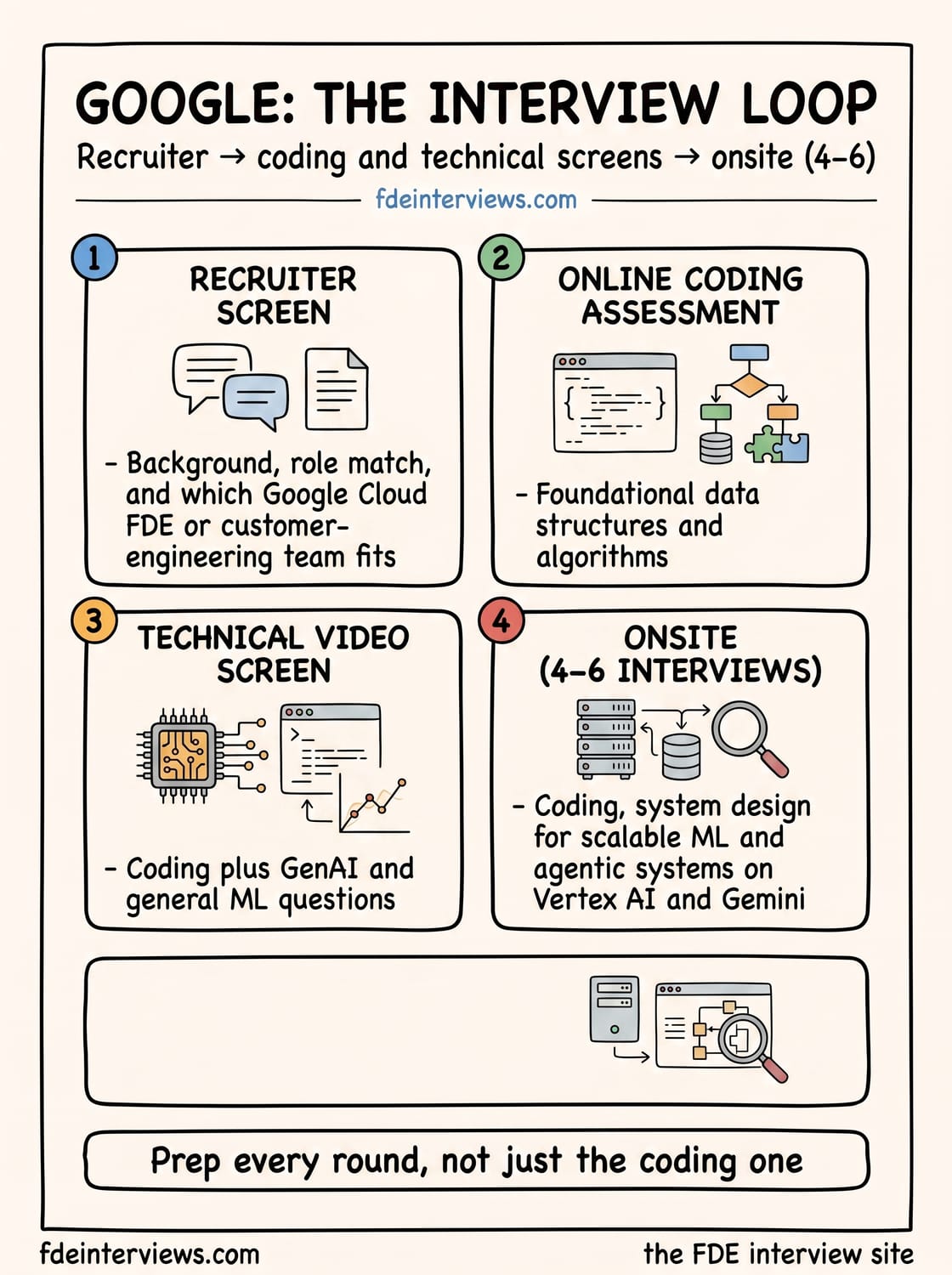
Role Forward Deployed Engineer (Google Cloud); also Customer Engineer / Field Solutions Architect Loop Recruiter → coding and technical screens → onsite (4–6); in 2026 Google introduced a more compressed FDE-specific loop for some candidates
1 Recruiter screen Background, role match, and which Google Cloud FDE or customer-engineering team fits.
2 Online coding assessment Foundational data structures and algorithms.
3 Technical video screen Coding plus GenAI and general ML questions.
4 Onsite (4–6 interviews) Coding, system design for scalable ML and agentic systems on Vertex AI and Gemini, ML breadth and depth, a 'Googleyness' behavioral round, and often a customer case study or technical presentation on taking a solution from proof of concept to production.
WHAT THEY'RE EVALUATING
› Google Cloud significantly expanded its Forward Deployed Engineer program in 2026 to move enterprise customers from AI pilots to production; expect RAG, vector databases, and production GenAI deployment depth› Customer-facing judgment: you code and debug bespoke agentic solutions inside a client's environment, not just design them› A hiring committee matches successful candidates to a specific product teamReports in 2026 describe Google shortening the FDE loop for some candidates (as few as two rounds); confirm your exact loop with your recruiter.
Compiled from our research and publicly available information (candidate reports and company interview guides). Interview loops change and are continuously iterated, and they vary by team, level, and region. Treat this as directional preparation, not an official spec, and confirm the exact rounds with your recruiter or hiring point of contact.
THE ONE-PAGE VERSION
↧ Download Share on X ↗ Share on LinkedIn ↗ Questions modeled on Google loops 147 questions · 25 unlocked for you
01
Walk me through what actually happens when an LLM generates a response. ▼ easy OpenAI Anthropic Google 188 views 2 replies unlocked
The warm-up that quietly filters out candidates who only know LLMs as a magic API. Nail the two-phase inference picture and you set up every later answer about latency, cost, and hallucinations.
02
Walk me through the transformer architecture end-to-end, minus the heavy math. ▼ medium OpenAI Anthropic Google 64 views 1 replies unlocked
Modern LLMs share one architectural skeleton. Learn the five components and you can read almost any model card cold, plus the single distinction that proves to an interviewer you actually understand it rather than the buzzwords.
04
What is a context window, and what are its practical limits in production? ▼ easy ★ Essential OpenAI Anthropic Google 104 views 1 replies unlocked
Everyone can define it; few candidates know why 'advertised context' and 'usable context' aren't the same thing. The cost, latency, and attention caveats that make this answer stand out.
20
A customer says your LLM app is too slow. Give me five levers to reduce latency, and their tradeoffs. ▼ medium ★ Essential OpenAI Microsoft Google 1 replies ○ sign in
TTFT vs tokens-per-second, the output-length lever everyone forgets, and why streaming is the highest-ROI fix that changes no latency at all. The five-lever answer with real numbers.
21
How does prompt caching work, and when does it actually pay off? ▼ medium Anthropic OpenAI Google 1 replies ◆ premium
The KV-cache mechanics behind the discount, the prefix rule that silently breaks caching for most teams, and the workloads where caching cuts bills 50-90% versus the ones where it does nothing.
24
A customer refuses to send PII to an LLM API. What are your options? ▼ medium Microsoft Mistral Anthropic 1 replies ◆ premium
Zero retention, private endpoints, redaction pipelines, or open weights in their VPC, the four-rung ladder for PII-sensitive deployments, and the discovery questions that pick the right rung.
29
The customer's LLM bill is unsustainable. Cut costs 10x without destroying quality. Walk me through it. ▼ hard OpenAI Microsoft Google 1 replies ◆ premium
10x doesn't come from one trick. It's multiplicative: routing x caching x prompt diet x batching x distillation. The stacked-levers playbook with rough multipliers, and the eval gate that keeps quality honest.
32
Design a doc-QA system for a healthcare customer that reliably says 'I don't know' instead of guessing. ▼ hard Anthropic OpenAI Google 2 replies ◆ premium
In high-stakes domains a wrong answer is worse than no answer, but a system that always abstains is useless. The selective-prediction design, the layered abstention triggers, and the two metrics that govern the tradeoff.
40
When do you use long context, RAG, or prompt caching, and what are the failure modes of each? ▼ hard ★ Essential Anthropic Google Cohere 1 replies ◆ premium
Million-token windows didn't kill RAG; they changed when you reach for it. The decision rule that holds up in production, and the silent failure each option hides behind a confident answer.
46
Decoder-only, encoder-only, encoder-decoder: what is each good at, and why does generation use decoder-only? ▼ easy OpenAI Google Anthropic 1 replies ◆ premium
Three transformer families, one distinction that decides everything: which tokens are allowed to see which. The attention mask is the whole answer, and it explains why GPT generates and BERT does not.
47
What is RoPE, why does relative position help, and why does it extend to long context better than learned absolute embeddings? ▼ medium Meta Google Mistral 1 replies ◆ premium
Rotary embeddings encode position as a rotation of the query and key vectors, so attention scores depend only on the gap between two tokens. That relative property is why RoPE generalizes past its training length where learned absolute tables fall off a cliff.
48
Pre-norm vs post-norm transformers: why do large models use pre-norm, and how does it affect training stability? ▼ hard OpenAI Anthropic Google 1 replies ◆ premium
Where you put the LayerNorm changes whether gradients survive a hundred layers. Pre-norm keeps a clean residual highway and well-scaled gradients so deep models train without warmup heroics; post-norm normalizes the output but fights vanishing gradients at depth.
49
Explain FlashAttention: why it never writes the full N x N matrix, and how it speeds up attention without changing the math. ▼ hard NVIDIA OpenAI Google 1 replies ◆ premium
Attention is bottlenecked by moving the N x N score matrix to and from HBM, not by FLOPs. FlashAttention tiles the computation in fast on-chip SRAM and fuses softmax with an online running statistic, so it computes the exact same output while never materializing the full matrix.
50
Prefix caching in a multi-turn chatbot: how do client-side and server-side caching cut redundant compute, and what breaks correctness? ▼ medium Anthropic OpenAI Google 1 replies ◆ premium
Each chat turn resends the whole conversation, so the model re-prefills the same prefix every time. Server-side KV caching and client-side cache breakpoints kill that redundant compute, but exact-prefix matching and stale entries are where teams silently get it wrong.
51
GRPO vs PPO-based RLHF: how does group-relative reward let you drop the value model? ▼ hard OpenAI Anthropic Google 1 replies ◆ premium
PPO needs a separate value network to estimate the baseline for its advantage. GRPO samples a group of answers per prompt and uses their mean reward as the baseline, so the advantage is just how a sample compares to its peers, no critic required.
52
KV-caching in autoregressive decoding: what does it store, why does it cut latency, and how does its memory cost scale? ▼ medium ★ Essential NVIDIA OpenAI Google 1 replies ◆ premium
Without a KV cache, generating token N re-attends over all N-1 prior tokens from scratch every step, turning decoding quadratic. The cache stores each layer's past keys and values so each new token costs one forward step, and its size is what caps your batch and context.
55
Spend a 1000-token test-time budget on a math problem: process-reward scoring with tree search. ▼ expert OpenAI Google DeepMind Anthropic 2 replies ◆ premium
A fixed 1000-token budget forces the search choice. Step-level beam search guided by a process-reward model beats best-of-N and MCTS on accuracy per token for math, and you collect the PRM labels automatically with Monte-Carlo rollouts, no human step annotation.
49
A PM hands you 'add export so customers can get their data out.' Break this into tasks you'd hand to an AI coding assistant. ▼ hard Google Anthropic OpenAI 1 replies ◆ premium
Google's FDE loop added an AI-first round, and this is the opener. The skill being graded is not prompting, it is decomposition: turning a fuzzy sentence into scoped units with named interfaces an assistant can one-shot. Get the seams wrong and no prompt saves you.
50
Your team's AI assistant keeps generating code that violates your security and API conventions. How do you make compliant code the default? ▼ hard Google Stripe Anthropic 1 replies ◆ premium
The naive fix is to nag the model in every prompt. The staff move is to treat your constraints as a versioned policy library injected as system context, so compliance is structural, then verify it with a linter because prompts are advisory, not enforced.
51
Your assistant now writes most of the code. How do you validate AI-generated output at scale so quality doesn't crater? ▼ hard Google OpenAI Anthropic 2 replies ◆ premium
When the model writes the code, your job shifts to specifying and checking it. The strong answer is a multi-layer validation pipeline that tests behaviors and contracts, not strings, plus the uncomfortable reframe that testing is now the bottleneck skill, not typing.
52
An AI assistant just produced code that's subtly wrong. Walk me through how you diagnose why, when the model is a black box. ▼ hard Google Anthropic OpenAI 1 replies ◆ premium
You can't read the model's weights, so you debug the inputs you control. There's a four-bucket triage, prompt, context, model, or spec, that localizes the fault fast, and the real deliverable is feeding each diagnosis back so the same failure can't recur.
53
What are the failure modes you specifically look for when reviewing AI-generated code, and how do you catch each one? ▼ hard Google Stripe Anthropic 1 replies ◆ premium
AI code fails differently from human code: it's confidently plausible. The dangerous defects are the ones that pass a quick read and a happy-path test, missing authorization, hallucinated APIs, hardcoded secrets, unsafe deserialization. Here's the checklist and the automated catch for each.
54
Your team opens 50 AI-authored PRs a day. When do you trust the output, and how do you review that volume without becoming the bottleneck? ▼ hard Google OpenAI Anthropic 1 replies ◆ premium
If you read every AI PR line by line, you become the throttle the assistant was meant to remove. The staff answer is a risk-tiered trust model: route by blast radius, let gates clear the low-risk volume, and spend human attention only where reversibility is low.
68
Implement k-means clustering from scratch. ▼ medium ★ Essential Meta Google Amazon 1 replies ◆ premium
The assign-then-update loop is ten lines; the signal is whether you handle the three things that bite in production: initialization, an empty cluster, and a real convergence test instead of a fixed iteration count.
70
Implement scaled dot-product attention (the forward pass). ▼ hard OpenAI Anthropic Google 2 replies ◆ premium
softmax(QKᵀ/√d_k)·V in four lines, but the grade is the three details people drop: the √d_k scale, subtracting the row max for numerical stability, and getting the causal mask to add -inf before the softmax, not after.
71
Compute the dot product of two sparse vectors. ▼ medium Meta Google 1 replies ◆ premium
The whole question is the representation: store only the nonzeros as index→value, then either two-pointer over sorted indices or hash-join. The follow-up that decides the design is what happens when one vector is dense.
72
Implement linear regression with gradient descent from scratch. ▼ medium Amazon Google Meta 1 replies ◆ premium
An ML coding screen that doubles as a calculus check. Interviewers watch whether you can write the MSE gradient without looking it up, explain what the learning rate actually does, and say out loud when you'd just solve the normal equation instead.
73
Compute the edit distance (Levenshtein) between two strings. ▼ hard ★ Essential Google Meta Adobe 1 replies ◆ premium
A DP classic that screens for one thing: can you define the right subproblem and fill the table without fumbling the indices. The strong version adds the O(min(m,n)) space trick and reconstructs the actual edits when the follow-up lands.
74
Find the length of the longest increasing subsequence. ▼ medium Google Microsoft 2 replies ◆ premium
Almost everyone reaches the O(n²) DP. The signal interviewers want is the O(n log n) patience-sorting trick, plus the honesty to say the array you build along the way is not itself the answer subsequence.
75
Coin change: fewest coins to make an amount. ▼ medium Amazon Adobe Google 1 replies ◆ premium
The question that punishes greedy. Interviewers pick denominations where taking the biggest coin first gives the wrong answer, and they watch whether you reach for DP and handle the impossible-amount case cleanly.
76
House robber: max sum you can take from a row of houses without hitting two adjacent ones ▼ medium Amazon Google 2 replies ◆ premium
The classic linear DP. At each house you either skip it and keep the best so far, or take it and add the best from two back. The signal is collapsing the table to two rolling variables and then handling the circular follow-up cleanly.
79
Find the median of two sorted arrays in logarithmic time ▼ hard Google Amazon Adobe 2 replies ◆ premium
The O(log(min(m,n))) answer binary-searches a partition on the shorter array so the left halves of both arrays together hold exactly half the elements. The whole problem is one invariant plus careful boundary handling for empty sides and odd versus even totals.
81
Validate a binary search tree ▼ medium ★ Essential Amazon Meta Google 2 replies ◆ premium
Almost everyone writes the version that only compares each node to its immediate children, and almost every interviewer has a counterexample ready. The fix is to carry a valid (low, high) range down the recursion, or to check that an inorder traversal is strictly increasing.
82
Compute the diameter of a binary tree ▼ medium Meta Google 1 replies ◆ premium
The longest path between any two nodes need not pass through the root, which is what trips people up. The clean answer is one DFS that returns each node's height while updating a global best as it goes. First, nail down whether diameter counts edges or nodes.
83
Maximum path sum in a binary tree ▼ hard Meta Amazon Google 2 replies ◆ premium
A path can start and end anywhere and bends through at most one node, values can be negative, and you want the maximum sum. The move is a DFS that returns the best downward gain (clamped at zero) while a global max tracks the best path that bridges through each node.
84
Construct a binary tree from its preorder and inorder traversals ▼ medium Amazon Microsoft Google 2 replies ◆ premium
The clean answer hinges on one insight: preorder names the root, inorder splits left from right. The trap is the O(n squared) version that slices arrays and scans for the root; the O(n) version uses a hashmap of inorder indices and passes bounds instead.
86
Sort a k-sorted array, where each element is at most k positions from its final place ▼ medium Amazon Google 2 replies ◆ premium
A full sort throws away the structure you were handed. Because no element moves more than k slots, a min-heap of size k+1 always has the next smallest element on top, sorting in O(n log k) and one pass.
88
Given a biased coin, produce a fair coin flip ▼ medium Google Meta Two Sigma 2 replies ◆ premium
You have a coin that lands heads with some unknown probability p. Build a fair 50/50 flip from it without knowing p. The von Neumann trick is two lines; the part that scores is explaining why the bias cancels and how many flips it costs.
90
Simulate an infection spreading across a grid over time ▼ medium OpenAI Google Amazon 1 replies ◆ premium
A grid where some cells start infected, and each step every infected cell infects its orthogonal neighbors. How many steps until everything is infected, or -1 if some cell is unreachable? This is rotting oranges in disguise, and the multi-source BFS framing is what they want to hear.
01
Explain precision, recall and F1, and which one matters for a fraud-detection customer? ▼ easy ★ Essential Google Scale Microsoft 2 replies unlocked
Every FDE loop opens with this, but the definitions are table stakes. What gets scored is whether you can map each metric to a dollar cost the customer recognizes, here's the framing that does it.
02
Your model has 0.95 ROC AUC. The customer is unimpressed in production. What does AUC actually tell you? ▼ easy Google Scale Meta 1 replies unlocked
A 0.95 AUC model can still flood a review queue with garbage. Knowing when ROC AUC flatters a model, and what to report instead, separates FDEs who've shipped from those who've only run notebooks.
03
Explain the bias-variance tradeoff, and how it shows up in a real customer deployment. ▼ easy ★ Essential Google Microsoft Databricks 1 replies unlocked
The textbook answer gets a polite nod. The version that names which side of the tradeoff a 6-week customer pilot usually dies on gets the hire signal, here's that version.
04
How do you detect overfitting, and walk me through the tools you'd use to fix it. ▼ easy ★ Essential Google Databricks Microsoft 1 replies unlocked
"Use regularization" is the answer everyone gives. The ordered toolbox, and which tool to reach for first when a customer's pilot model collapses in week two, is what actually gets scored.
05
The customer's dataset is 99.5% negatives. Their model shows 99.5% accuracy. Walk me through what you'd do. ▼ medium Scale Google Microsoft 2 replies unlocked
The accuracy trap is the easy part. Interviewers keep pushing: resample or reweight? Does SMOTE survive contact with production? What happens to your probabilities? Here's the full chain.
06
Your model scored 95% in the pilot and 70% in production. What happened? ▼ medium ★ Essential Google Databricks Scale 1 replies unlocked
This exact gap kills more customer pilots than any modeling choice. There's a ranked list of culprits, and one of them hides inside innocent-looking feature pipelines at almost every enterprise.
07
Explain k-fold cross-validation, and when would you refuse to use it? ▼ easy Google Databricks Microsoft 1 replies unlocked
Everyone can describe the five folds. The question is really about the second half, the two data shapes, both everywhere in enterprise data, where standard k-fold quietly lies to you.
08
A customer says 'we want the model to be accurate.' How do you turn that into the metric you'll optimize? ▼ medium Google Databricks Snowflake 2 replies unlocked
This is a discovery question wearing an ML costume. The strongest candidates run a four-step translation from business pain to loss function, and put a number on each error before choosing anything.
09
Explain gradient descent to me like I'm a smart engineer who's never done ML. What can go wrong? ▼ easy ★ Essential Google Meta Scale 1 replies unlocked
A two-minute explanation, then the real test: learning-rate pathologies, why we use mini-batches, and the one practical diagnosis, reading a loss curve, that customer-facing engineers actually need.
10
Tree ensembles vs linear models vs neural networks, how do you choose for a customer's tabular problem? ▼ medium ★ Essential Databricks Google Snowflake 2 replies unlocked
The empirical answer for tabular data hasn't changed in a decade, but interviewers want the why, and the two situations where the default is wrong. A decision table you can defend under panel Q&A.
11
The customer wants to try a fancier model. You think the win is in feature engineering. Make your case, with examples. ▼ medium Databricks Snowflake Google 1 replies ○ sign in
On enterprise data, the feature pipeline routinely buys 2-5x the lift of a model swap. Here's the worked churn example, and the leakage rule every engineered feature must pass, that makes the argument stick.
12
What does cosine similarity actually measure, and why is it the default for comparing embeddings? ▼ easy Google Databricks Scale 1 replies ○ sign in
Every RAG deployment runs on this math, and most candidates can't say why cosine beats Euclidean, or when the two are secretly identical. The 90-second version with a worked example.
13
A customer wants to segment 2 million users. Walk me through clustering, k-means, choosing k, and where it goes wrong. ▼ easy Google Snowflake Microsoft 1 replies ○ sign in
Unsupervised questions filter out candidates who've only done Kaggle. The elbow method is the warm-up, the real scoring is on validation without labels and the marketing-team handoff.
14
When does classical ML beat an LLM, and when is the LLM the right call? A customer wants 'AI' for everything. ▼ hard ★ Essential Google Databricks Scale 1 replies ○ sign in
The 2026 FDE differentiator: customers ask for LLMs by name, and the engineer who knows when a $0 logistic regression beats a $40k/month LLM pipeline, with the cost math, wins the room.
15
A regulated customer asks: 'Why did the model deny this application?' Explain SHAP and how you'd deploy explainability. ▼ medium Google Microsoft Databricks 2 replies ○ sign in
Explainability is where ML deals in banking, insurance and healthcare live or die. What SHAP actually computes, the per-decision worked example reviewers expect, and the trap of reading it as causality.
16
A customer wants to forecast weekly demand. What's different about time-series ML, and how do you avoid embarrassing yourself? ▼ medium Databricks Google Snowflake 1 replies ○ sign in
Time-series is where standard ML habits, random splits, fancy models first, single-number forecasts, fail loudest in front of customers. The baseline discipline and backtesting setup that keep you credible.
17
Your model says '90% probability.' The customer asks if that means it's right 90% of the time. Is it? ▼ hard Google Scale Microsoft 1 replies ○ sign in
Almost never, and the gap between score and probability quietly breaks thresholds, expected-value decisions, and customer trust. What calibration is, how to measure it, and the two fixes that work.
18
Explain what a p-value actually is, to me, and then to a customer's VP of Marketing. ▼ easy Meta Google Microsoft 1 replies ○ sign in
Most working data scientists state the definition wrong, and interviewers know exactly which wrong versions to listen for. The correct one-sentence definition, the VP translation, and the three classic traps.
19
Design an A/B test for a customer's new recommendation model. How long do you run it, and on how many users? ▼ medium ★ Essential Meta Google Databricks 1 replies ○ sign in
"Run it two weeks and see" fails this question. Strong answers work the power calculation backwards from a minimum detectable effect, and know the duration rules that protect against lying-by-novelty.
20
The customer checked the A/B dashboard daily and stopped the test the day it hit significance. What's wrong, and what do you tell them? ▼ medium Meta Google Snowflake 1 replies ○ sign in
Daily peeking can quietly triple your false-positive rate, and almost every customer does it. The math of why, the multiple-comparisons cousin, and how to deliver the bad news without losing the room.
21
The customer can't randomize, every user must get the new model. How do you measure whether it worked? ▼ hard Google Databricks Microsoft 1 replies ◆ premium
Enterprise reality: legal, fairness or ops constraints kill the A/B test, but the exec still demands proof of impact. The quasi-experimental toolkit, and the honest caveats, that let you answer anyway.
22
Six months after deployment, the CFO asks: 'What has this model actually earned us?' How do you answer? ▼ medium Databricks Google Snowflake 1 replies ◆ premium
Accuracy metrics don't survive contact with a CFO. The holdout pattern that turns a model into a permanent revenue receipt, and what to do when nobody set one up six months ago.
23
Your model is live at a customer. What do you monitor, and how do you catch drift before the customer does? ▼ medium Databricks Google Microsoft 1 replies ◆ premium
Models don't crash, they decay quietly while dashboards stay green. The four-layer monitoring stack, data vs concept drift with PSI numbers, and the label-lag problem that makes naive accuracy monitoring useless.
24
Offline the model scores 0.86 AUC. Served live, it's effectively random. Walk me through training/serving skew. ▼ hard ★ Essential Google Databricks Microsoft 1 replies ◆ premium
The most expensive bug class in production ML: two implementations of 'the same' feature that quietly disagree. The diagnostic that finds it in an afternoon, and the architecture that makes it impossible.
25
The customer's platform team wants to buy a feature store. What problem does it solve, and when would you tell them not to? ▼ medium Databricks Google Snowflake 1 replies ◆ premium
Half the value of this question is the second clause. Feature stores solve three specific problems, and FDEs earn trust by naming the team sizes and model counts below which they're expensive overkill.
26
The customer calls: 'The model got worse and we changed nothing.' Walk me through your first two hours. ▼ hard Google Databricks Scale 1 replies ◆ premium
The signature production-ML incident, and a pure FDE test: a ranked differential diagnosis run live on a call, because 'nothing changed' is always false, and one hypothesis explains half of all cases.
27
How often should the customer retrain their model, and what has to be true before you automate it? ▼ medium Databricks Google Microsoft 2 replies ◆ premium
"It depends" is correct and unhelpful. The decay-curve method that replaces guesswork with measurement, trigger-based vs scheduled retraining, and the safety rails without which auto-retraining is an outage generator.
28
You're replacing a customer's live scoring model with a better one. Design the rollout so nothing blows up. ▼ medium Google Databricks Microsoft 3 replies ◆ premium
Offline wins don't justify big-bang swaps, models fail in ways staging never shows. The shadow → canary → ramp playbook, what to compare at each stage, and the rollback discipline that keeps customer trust.
29
Offline metrics improved, but the online A/B shows no business lift. How do you explain the gap, and what do you do? ▼ hard Meta Google Databricks 3 replies ◆ premium
The maturity exam of production ML: a model that's better on paper and worthless in production. Five distinct causes, the funnel diagnostic that separates them, and when the right call is don't ship.
30
Design the path from a notebook pilot to a production ML system at a customer, end to end. ▼ hard Databricks Google Microsoft 1 replies ◆ premium
The capstone panel question that ties the whole track together. The spine, data, training, deployment, monitoring, operating model, plus the maturity-staging judgment that separates architects from slide-readers.
34
A customer wants to auto-decide on a high-stakes classifier. How do you make the probabilities safe to act on? ▼ hard Google Scale Databricks 2 replies ◆ premium
When a model auto-approves loans or routes patients, the probability is the product, not a dashboard number. The calibration-plus-abstention design that lets a customer trust an automated decision, and the subgroup trap that gets it pulled in audit.
35
Offline AUC is 0.91 and falling apart live. You suspect the feature store's point-in-time join. Find the bug. ▼ hard Databricks Google Snowflake 2 replies ◆ premium
The most expensive leakage bug in feature-store ML: training joins that grab feature values from after the label event. The timeline that exposes it, the one query that proves it, and the fix that survives audit.
36
The customer needs this classifier under a 150ms p99 and a $20k/month budget at 50M calls/day. LLM or not? ▼ hard OpenAI Databricks Google 1 replies ◆ premium
A budget-constrained design problem, not an ideology question. The per-call math that rules an LLM in or out, the cascade that keeps quality while cutting cost 90%, and the SLO arithmetic that decides where the LLM is even allowed to sit.
37
The customer's marketplace has network effects, so a user-level A/B test is biased. How do you measure the model's impact? ▼ hard Meta Google Databricks 1 replies ◆ premium
When treatment leaks between units, a clean A/B lies in both directions. The interference taxonomy, when to reach for switchback vs cluster vs geo designs, and the analysis trap that makes naive standard errors useless.
38
The model aced every offline eval and the customer says it's useless. The labels look fine. What now? ▼ hard Scale Google Databricks 1 replies ◆ premium
Not leakage, not skew, not drift: the model learned exactly what you asked, and you asked for the wrong thing. The proxy-label mismatch that passes every test, the audit that catches it, and why this is the failure no metric can see.
39
The customer wants to test five model variants without losing money on the bad ones. A/B test or a bandit? ▼ hard Meta Google Databricks 1 replies ◆ premium
Bandits sound strictly better and usually are not. The regret-vs-inference tradeoff, the three conditions that actually favor a bandit, and the production failure that makes adaptive allocation a debugging nightmare.
40
Walk me through SGD vs mini-batch vs Adam, learning-rate schedules, and what vanishing or exploding gradients look like in practice. ▼ medium Google Databricks Scale 1 replies ◆ premium
Most candidates recite the Adam update equation and stop. The interviewer wants the decision: when plain SGD with momentum still wins, why Adam is the safe default for new architectures, and how you diagnose a training run that is silently dying from a gradient that shrank to zero.
41
Explain backpropagation and why deep networks can be trained at all, without writing a wall of calculus. ▼ medium ★ Essential Google Scale Meta 1 replies ◆ premium
Backprop is just the chain rule run efficiently in reverse, but the question that separates levels is why a hundred-layer network trains when a naive one wouldn't. The credit-assignment intuition plus the three tricks that keep gradients alive.
42
Why did attention and transformers replace RNNs for sequence modeling? Explain it conceptually. ▼ medium Google Scale Meta 1 replies ◆ premium
The answer is not just 'transformers are better.' It is two specific wins: every position can attend to every other in one step (long-range dependencies) and the whole sequence trains in parallel instead of one token at a time. Plus the cost that buys, and where RNNs still make sense.
43
Explain CNN fundamentals (convolution, pooling, parameter sharing). When does classical computer vision still matter? ▼ medium Google Scale Meta 1 replies ◆ premium
Convolution and parameter sharing are why a CNN needs a tiny fraction of the weights a dense net would, and why it generalizes across position. The conceptual answer, the feature-hierarchy picture, and the honest take on when a fine-tuned CNN still beats reaching for a giant vision-language model.
44
Gradient boosting vs random forests: how does each build trees, the bias-variance behavior, and when to pick which? ▼ hard Databricks Google Snowflake 1 replies ◆ premium
Both are tree ensembles, but one averages independent deep trees to kill variance and the other adds shallow trees in sequence to kill bias. That single difference dictates the failure modes, the tuning burden, and which one you hand a customer who will retrain it after you leave.
45
Explain SVMs and the kernel trick: what is the margin, when do kernels actually help, and why did SVMs fade for large datasets? ▼ medium Google Databricks Scale 1 replies ◆ premium
The margin idea is elegant and worth understanding, and the kernel trick is a clever move. But the question that separates levels is why a model that dominated the 2000s is now a niche pick. The scaling math that killed it for big data, and where it still wins.
46
Walk me through Bayes' theorem on a real diagnostic problem: why can a 99%-accurate test still be wrong most of the time it fires? ▼ medium Google Databricks Scale 2 replies ◆ premium
The base-rate trap is the classic, and it is not academic: it is exactly how a high-accuracy fraud or disease classifier drowns ops in false alarms. The worked numbers, the tree you draw on the whiteboard, and the two levers that actually fix it in production.
47
MLE vs MAP: what exactly does the prior buy you, and when does it matter in an applied model? ▼ medium Google Databricks Scale 1 replies ◆ premium
MAP is MLE plus a prior, and that prior is not academic decoration: it is the same thing as regularization, and it is what stops a model from making confident nonsense out of three data points. The connection that makes this an applied answer, not a stats-class recitation.
48
How do you choose and interpret a distribution for a quantity? When is it Bernoulli vs Poisson vs Normal? ▼ medium Google Databricks Scale 1 replies ◆ premium
Picking the wrong distribution silently breaks your model: counts are not Gaussian, and treating them that way predicts negative events and underestimates the variance of busy periods. The decision tree by data type, the variance gotcha, and what each choice implies for the model you reach for.
50
What are Type I and Type II errors? Use an enterprise spam filter to make it concrete and tie each to a business cost. ▼ easy Google Microsoft Databricks 1 replies ◆ premium
A Type I error blocks a real invoice; a Type II error delivers the phishing email. Which one costs the customer more decides where you set the threshold. The spam-filter framing, the precision/recall mapping, and the asymmetric-cost call interviewers want.
53
L1 vs L2 regularization: what does each do to the weights, why does L1 induce sparsity, and when would you prefer L1? ▼ medium Google Databricks Scale 1 replies ◆ premium
L2 shrinks every weight smoothly toward zero; L1 drives many weights to exactly zero, which is automatic feature selection. The geometric reason L1 hits the corners is the part interviewers actually want, plus the call on when sparsity beats smooth shrinkage.
54
What is a confusion matrix, and give a concrete case where accuracy is misleading. ▼ easy Google Microsoft Scale 1 replies ◆ premium
A confusion matrix is the 2x2 of right and wrong predictions per class, and it is the reason a 99% accurate fraud model can be useless. The worked imbalance example, and how reading the matrix as precision and recall fixes the lie.
55
What is a validation set for, and how do you use it during training without overfitting to it? ▼ easy Google Databricks Microsoft 1 replies ◆ premium
The validation set is the one you tune and select on; the test set is the one you only look at once. Confusing them, or tuning so hard you overfit the validation set, is how a model that aced offline metrics dies in production.
56
Explain gradient descent intuitively, and how do you decide when to stop training? ▼ medium Google Databricks OpenAI 1 replies ◆ premium
Gradient descent is walking downhill on the loss surface, one step proportional to the slope. Knowing when to stop is the part that separates people who have trained models from people who have read about them: it is the validation curve, not the training curve, that tells you.
62
A customer has only 200 labeled examples. How do you build a model? ▼ hard Google Scale AI Palantir 2 replies ◆ premium
The amateur move is to train a fresh deep net on 200 rows and overfit instantly. The senior move is to spend almost no labels on training: lean on a pretrained model, use the 200 as a validation set, and design a labeling loop that buys the most signal per label.
63
Which metric do you use to evaluate a ranking system, and why? ▼ medium ★ Essential Google Meta Amazon 2 replies ◆ premium
Accuracy is meaningless for ranking, the whole point is the order. The real question behind the question is whether your relevance is graded or binary and whether one good result is enough, because that picks the metric. Then the trap: your offline NDCG can climb while online engagement falls.
64
Explain reinforcement learning and when it is the right tool. ▼ hard Google DeepMind OpenAI Meta 1 replies ◆ premium
The thing interviewers actually screen for isn't the Bellman equation, it's whether you know when NOT to use RL. Most problems that look like RL are better solved by supervised learning or a bandit, and reaching for full RL when you have labels is a classic over-engineering tell.
66
How do you tune hyperparameters efficiently? ▼ medium Google Amazon Databricks 1 replies ◆ premium
Grid search is the answer that signals you have never paid for compute. The efficient answer is random or Bayesian over a small set of parameters that actually move the metric, with Hyperband killing bad runs early, on a validation set you never let leak.
67
You have 2,000 candidate features. How do you decide which ones to keep? ▼ medium Amazon Capital One Google 1 replies ◆ premium
More features is not more signal, it is more variance, more leakage surface, and a thinner data manifold. The disciplined answer ranks filter, embedded, and wrapper methods by cost, leans on L1, and screens every survivor for leakage and stability.
68
Labeling is expensive. How do you choose what to label next? ▼ hard Scale Tesla Google 2 replies ◆ premium
Random sampling is the baseline you have to beat, and honest candidates admit it sometimes wins. Active learning earns its keep by labeling where the model is least sure, but uncertainty alone gives you a batch of near-duplicates, so you also need diversity, and a cold-start plan.
51
Design a real-time radiology copilot that flags regions and drafts a report in under 2 seconds at 10 studies/sec, recall first. ▼ expert Microsoft Google NVIDIA 1 replies ◆ premium
Ten X-ray studies a second, a 2-second budget, and a missed cancer is unacceptable. The hard parts are recall-first thresholding, a monitor that watches the radiologist, and surviving a new scanner.
53
Build a voice-to-voice agent (ASR to LLM to TTS) that feels natural at under 500ms end to end. Break down the latency budget. ▼ hard OpenAI Sierra ElevenLabs 1 replies ◆ premium
Under 500ms from end of speech to first audio out, across three models and a network. The trick is that you never wait for any stage to finish: you stream and pipeline everything.
56
Design inference batching for a single GPU serving up to 100 inputs per batch while users wait synchronously. Maximize utilization. ▼ hard Anthropic OpenAI Google 2 replies ◆ premium
One GPU, callers blocking on the response, and a hardware unit that is only efficient when fed wide batches. The whole job is trading a few milliseconds of queue wait for a large jump in throughput without ever stalling a request.
58
Distribute a 10GB file from one bandwidth-constrained source to thousands of interconnected hosts, minimizing time to completion. ▼ hard Anthropic Google 1 replies ◆ premium
The source can only upload the file a handful of times before it saturates, but every receiver also has upload bandwidth. The win is making peers serve each other, so total capacity grows with the swarm instead of bottlenecking on one machine.
08
Tell me about a project that failed. Whose fault was it? ▼ medium ★ Essential Palantir OpenAI Google 1 replies unlocked
'The customer was dumb' is an instant fail, but so is theatrical self-flagellation. There's a narrow honest lane between the two, and this is what driving down it sounds like.
09
Estimate: how many LLM tokens per day would a Fortune-500 customer-support org consume? ▼ medium Google Palantir Microsoft 1 replies unlocked
Nobody cares about your final number, they're grading the decomposition, the sanity checks, and whether you convert tokens into dollars unprompted. Here's a clean worked path.
11
Role-play: I'm a VP at a regional bank and I want 'a chatbot.' Run the discovery call. ▼ medium ★ Essential Sierra OpenAI Anthropic 2 replies ○ sign in
The modal opener for FDE customer rounds, and most engineers fail it in the first 90 seconds by pitching architecture. Here's the question sequence that scores, and the trap hidden in the word 'chatbot.'
18
Your demo breaks in front of the customer, mid-demo. What do you do in the room? ▼ medium ★ Essential Snowflake Vercel Google 1 replies ○ sign in
Interviewers sometimes sabotage demos on purpose to ask exactly this. The recovery has a 60-second protocol, and done well, a broken demo can close harder than a perfect one.
23
Present your architecture to a mock customer panel, who will interrupt, object, and try to rattle you. ▼ hard Databricks Snowflake Google 1 replies ◆ premium
The Databricks/Snowflake signature round: the interruptions ARE the interview. Here's how to structure for derailment, the objection-handling loop that scores, and why finishing your deck doesn't matter.
46
Walk me through your first 30, 60, and 90 days in a new customer-facing engineering role. ▼ easy OpenAI Palantir Anthropic 1 replies ◆ premium
The graded shape is specific: learn and ship something small by day 30, own a deployment by day 60, drive a cross-customer improvement by day 90. Vague answers about 'meeting stakeholders and ramping up' fail. Here is the staged plan with what good looks like at each gate.
48
You're the first FDE at a traditional software shop. How do you pick the first AI project, show value in 30 days, and win over skeptics? ▼ hard OpenAI Palantir Google 1 replies ◆ premium
Around 95% of enterprise AI pilots produce no measurable impact, almost always from deployment, not the model. As the first FDE in a skeptical SWE shop, your month-one job is to not be pilot 95: pick a project that can win, prove it in 30 days, and turn the engineers who roll their eyes into the ones who vouch for you.
50
Tell me about a model that passed your evals but failed in production. What happened? ▼ hard ★ Essential Meta Google Amazon 2 replies ◆ premium
Everyone has a model that looked great offline and tanked online. The screen is whether you can tell the root cause from the symptom, and whether your fix was a patch or a guardrail that survives the next model.
52
Tell me about discovering data leakage or train/test contamination in a model you shipped. ▼ hard Google Amazon Capital One 2 replies ◆ premium
A model that's too good is a bug, not a win. The screen is whether your instinct on a suspiciously high number is to celebrate or to get suspicious, and whether you disclosed the leak instead of quietly fixing it.
53
Tell me about a time you disagreed with your manager. ▼ medium Amazon Google Meta 2 replies ◆ premium
The trap is picking a disagreement you won, with a manager who looks foolish in hindsight. The screen is whether you can disagree with data, commit cleanly once decided, and know the one kind of issue worth escalating past a 'no'.
54
Tell me about a time you disagreed with someone and later realized they were right. ▼ medium Anthropic Meta Google 1 replies ◆ premium
The trap is picking a disagreement so trivial that being wrong cost nothing. They want a real call you fought for, the specific evidence that flipped you, and the operating change you carry now so the same blind spot doesn't bite twice.
56
Tell me about a time you balanced model quality against latency or cost in a shipped product. ▼ hard Google OpenAI Meta 1 replies ◆ premium
At 100k QPS you cannot 10x the model for a +2% quality bump. This question screens whether you can find the actual operating point under a real constraint and get product, finance, and the customer to agree to it instead of pretending the tradeoff away.
57
Tell me about a time you mentored or grew other engineers. ▼ medium Google Meta HP 2 replies ◆ premium
The tell of real mentorship is that you made yourself unnecessary. They want a named person, the specific gap you closed, the moment you handed them something scary, and the measurable way they grew, not 'I'm always happy to help juniors.'
60
Tell me about hard negative feedback you received and how you handled it. ▼ medium Amazon Google 1 replies ◆ premium
The safe-but-failing move is feedback that's secretly a humblebrag ('I cared too much'). The graded version is feedback that stung because it was true, a non-defensive intake, and a specific behavior you changed that someone later noticed.
61
Tell me about a technical disagreement with a partner team and how you resolved it. ▼ medium OpenAI Google Meta 2 replies ◆ premium
The losing answer is a personality clash you won by being right. The graded one treats it as an organizational conflict, finds the shared metric both teams actually optimize for, and keeps escalation as a last resort you used cleanly, not a weapon.
62
Tell me about your greatest professional success. ▼ medium Amazon Google Adobe 2 replies ◆ premium
'Proud of' is not a metric. The answer that lands names the business number that moved, your specific hands on it, and how you'd defend the attribution to a skeptic who assumes you're rounding up.
63
Walk me through your depth in your ML specialty, and the hard problems in it. ▼ medium Google Meta Scale AI 1 replies ◆ premium
Surface knowledge recites the SOTA model name. Depth names the failure mode that bites you in production and the open problem nobody has cleanly solved. This is how to sound like you've actually shipped in your area.
64
Why should we NOT hire you? ▼ hard Google Meta 1 replies ◆ premium
The humble-brag ('I work too hard') fails on sight, and a fatal flaw sinks you. The narrow win is a real gap that's yours, a real cost it imposes, and the concrete way you contain it. Here's how to find that lane.
65
Tell me about a time your principles conflicted with commercial pressure. ▼ hard Anthropic OpenAI Google 2 replies ◆ premium
The trap is sounding like an absolutist who would torch every deal on principle. The win is a real story where you held a line with judgment: you found what was actually at stake, drew it narrowly, and paid a cost you can name. Here's the difference.
06
What's the difference between shadow deployment and A/B testing a model? ▼ easy Netflix Capital One Google 2 replies unlocked
They answer different questions, and mixing them up costs you the round: one tests your engineering, the other tests your model's business impact. What each can and cannot catch, and the order a strong candidate always runs them in.
08
How did you ensure quality and testing on top of your MLOps pipeline? ▼ medium Amazon Google Databricks 1 replies unlocked
'We checked accuracy' is the answer that ends interviews. The five-layer test pyramid for ML pipelines, data contracts, transform unit tests, behavioral checks, serving tests, shadow validation, with the gates that actually block promotion.
16
What is training-serving skew, and how do you keep online and offline features consistent? ▼ medium Google Uber Microsoft 2 replies ○ sign in
The bug class with no stack trace: the model is fine, the pipelines are green, and production quietly underperforms offline by five points. Why skew survives even feature-store adoption, and the log-and-wait pattern Google-style answers center on.
23
What metrics do you autoscale inference pods on, and how do you handle cold starts? ▼ medium ★ Essential Google NVIDIA Amazon 1 replies ◆ premium
CPU-based HPA on GPU inference never fires, the trap half of all candidates fall into within a minute. The signals that actually track load, the anatomy of a five-minute cold start, and which mitigations are worth their cost at each layer.
24
Why does naive Kubernetes GPU scheduling strand GPUs, and how would you serve thousands of models cheaply? ▼ hard NVIDIA Google Microsoft 1 replies ◆ premium
The cluster shows eight free GPUs and your four-GPU pod still won't schedule, the fragmentation puzzle GPU-platform rounds open with. Bin-packing vs. spreading, MIG/MPS/time-slicing for the small-model problem, and the pod-per-model math that breaks at scale.
32
Design a multi-model serving platform for LLMs with autoscaling and cold-start handling under a cost ceiling. ▼ hard NVIDIA Google Anthropic 1 replies ◆ premium
The GPU-platform capstone: dozens of models, spiky traffic, a fixed monthly GPU budget, and a p99 SLO that scale-to-zero would wreck. Token-based autoscaling, the three layers of LLM cold start, and the residency tiering that makes the budget math work.
36
Your recommendation service is timing out, drift alarms are firing, and a deploy went out an hour ago. Triage it. ▼ hard Netflix Uber Amazon 1 replies ◆ premium
The staff on-call simulation: three alarms at once, partial information, and pressure to do something. How to separate symptom from cause, the common-cause hypothesis that explains all three, and why mitigating before diagnosing is the senior move, not a shortcut.
37
Containerize a GPU ML pipeline with Docker. How do you match CUDA to drivers and keep it reproducible? ▼ medium NVIDIA AWS Databricks 2 replies ◆ premium
The 'works on my GPU box, CUDA error 803 in prod' bug, solved at the source. What the host driver actually pins, why the toolkit version is fungible, and the multi-stage build that ships a lean reproducible image.
38
Build a data loader that streams training data from S3/GCS with on-the-fly transforms. What are the components and failure modes? ▼ medium AWS Google Databricks 1 replies ◆ premium
The dataset is too big to fit on disk, so you stream it. The components that keep the GPU fed, the throughput math that says whether you'll be I/O-bound, and the failure handling that makes a multi-day run resumable.
01
Explain how the CUDA execution model maps to hardware, grids, blocks, warps, SMs. ▼ easy NVIDIA Google CoreWeave 3 replies unlocked
The NVIDIA warm-up that exposes whether you've written a kernel or just called .cuda(). The mapping from software hierarchy to silicon explains every GPU performance conversation that follows.
05
What is occupancy, and how do you balance it against register and shared-memory usage when choosing block size? ▼ medium NVIDIA Google CoreWeave 1 replies unlocked
Everyone says 'maximize occupancy.' The candidates who get hired at NVIDIA know when 25% occupancy beats 75%, and can explain the resource math that decides it.
06
How do you determine whether a kernel is memory-bound or compute-bound? ▼ medium NVIDIA Google Together AI 3 replies unlocked
The roofline model in one ratio: FLOPs per byte against the hardware's ridge point. Get the H100 arithmetic right and you can classify any kernel, including why LLM decode will never be compute-bound at batch 1.
11
We need to train a 100B-parameter model that won't fit in memory. Design the data and model parallelism. ▼ hard Google Anthropic OpenAI 1 replies ○ sign in
A reported DeepMind research-engineer question. The winning answer opens with a memory budget in bytes, not a list of parallelism buzzwords, here's the full arithmetic and the layout it forces.
16
Your training run compiles and runs, but the loss is flat. Walk me through your debugging process. ▼ hard Google Anthropic OpenAI 1 replies ○ sign in
A reported DeepMind debugging-round prompt. What's scored is your search order, not your bug list, the overfit-one-batch ladder that finds 90% of flat-loss causes in under an hour.
26
How would you migrate a PyTorch workload to TPU? ▼ medium Google Anthropic Apple 1 replies ◆ premium
torch_xla makes the demo run in an afternoon; making it fast is where migrations die. The lazy-tensor mental model, the recompilation traps, and the honest fork between porting and rewriting in JAX.
30
Design the infrastructure to serve a ChatGPT-scale assistant to hundreds of millions of weekly users. ▼ hard OpenAI Anthropic Google 1 replies ◆ premium
The OpenAI capstone design. What separates passing answers: token-based capacity math, KV/prefix-aware routing instead of round-robin, and a degradation ladder for the day demand doubles overnight.
36
Your training run isn't crashing, but step time doubled overnight. MFU dropped from 45% to 22%. Triage it. ▼ hard Anthropic Meta xAI 3 replies ◆ premium
No error, no hang, the loss still moves, but the run is suddenly half as fast and burning the same dollars. The triage that separates a straggler from a fabric problem from broken comm/compute overlap, using the signals nvidia-smi can't give you.
39
Design GPT-scale MoE inference as a global service across regions. How do you lay it out? ▼ hard OpenAI Google DeepSeek 1 replies ◆ premium
A very large sparse model, hundreds of experts, and users on every continent. The layout that keeps experts close to compute, routes around regional skew, and decides what 'global KV cache' can and cannot mean.
44
Extend a 4K-context 7B to 1M tokens: RoPE scaling, the data recipe, eval, and the inference math. ▼ expert Google Anthropic NVIDIA 1 replies ◆ premium
Going 4K to 1M is not one trick. It is RoPE rescaling chosen by frequency band, a long-doc continued-pretrain mix, needle evals that actually catch failures, and KV math that forces ring attention.
38
Reproduce-from-paper: design a production-safe Constitutional-AI-style fine-tuning pipeline that aligns a chatbot to a set of rules ▼ hard Anthropic OpenAI Cohere 1 replies ◆ premium
Turn a constitution of rules into a model that follows them, with no human labels on harmful examples. The strong answer walks the two phases (self-critique SFT, then RL from AI feedback), then spends real time on the part papers gloss: adversarially validating the aligned model holds under attack.
39
Set up a red-teaming evaluation framework for a code-generation model that sometimes emits malicious scripts ▼ hard Anthropic OpenAI GitHub 1 replies ◆ premium
A code model that occasionally produces ransomware, reverse shells, or exfiltration scripts. The strong answer builds an automated loop: adversarial prompt generation, static and behavioral output scanning, layered mitigations, and attack-success-rate per category to prove the mitigations worked.
42
Prove your financial-advice LLM has no internal 'deceptive' policy: use SAEs to find, validate, and suppress deception features. ▼ expert Anthropic Google DeepMind OpenAI 1 replies ◆ premium
SAEs can surface candidate 'deception' features in the residual stream, but a correlated feature is not a cause. The real work, and the honest answer, is causal validation and admitting what interpretability cannot yet prove.
43
Personalize a mobile-keyboard model from on-device typing without raw text ever leaving the phone: federated LoRA with DP-SGD. ▼ expert Apple Google Samsung 1 replies ◆ premium
Fine-tune a LoRA adapter on the user's typing on the phone's neural engine, add noise locally with DP-SGD, and aggregate only adapter deltas, so no individual's vocabulary is recoverable from the global update.
03
Design an evaluation framework for an ads-ranking system. ▼ hard ★ Essential Meta Google Amazon 1 replies unlocked
Anyone can train a pCTR model. The hard part is proving a change is good before it touches revenue, when the model sits inside an auction, the logs only show ads that won, and a 1% calibration error is real money. This is an eval question, not a model question.
05
Design a system to detect bots and inauthentic accounts in real time. ▼ hard ★ Essential Meta Roblox Google 1 replies unlocked
The positive class is maybe 1 in 1,000, your labels arrive late and noisy, and the moment you ship a model the adversary probes it. This is the rare ML problem where the data is actively trying to beat you, so the design is as much about labels, latency, and enforcement cost as about the classifier.
06
Design a CTR and conversion-rate prediction system for ads. ▼ hard Google Meta Amazon 2 replies unlocked
This model's output is not a ranking, it is a price input. A miscalibrated CTR makes the auction bid wrong, so you overpay or underdeliver. Add conversions that land days after the click and advertisers with zero history, and calibration plus delayed feedback become the whole interview.
07
Design an ETA prediction system for a maps or navigation app. ▼ hard Google Uber DoorDash 2 replies unlocked
An ETA is a promise. The interview is whether you model it as a point estimate (and apologize when wrong) or as a distribution where p90 lets you under-promise, plus how you fold live traffic and finished trips back into the model.
08
Design a landmark or image recognition system at scale. ▼ hard Google Apple Pinterest 1 replies unlocked
There are millions of landmarks, most with a handful of photos, and the next photo might be of something not in your catalog at all. A flat classifier dies on the long tail and never says 'I don't know.' The interview is embeddings plus retrieval plus a confident refusal.
More from the tracks Google's loop tests The highest-signal questions across Google's core tracks.
8 questions · 8 unlocked for you
01
Walk me through a RAG pipeline end-to-end, and tell me where it usually breaks ▼ easy OpenAI Scale Cohere 86 views 3 replies unlocked
The warm-up that filters out tutorial-level candidates. Interviewers aren't grading the diagram, they're grading whether you know the three places real pipelines fail and how you'd see it happening.
02
How would you chunk documents for retrieval, and how do you know your chunking is good? ▼ easy ★ Essential Cohere Scale Harvey 1 replies unlocked
Everyone says '500 tokens with overlap.' The candidates who get hired explain why chunk boundaries are a recall problem, name three strategies, and describe the experiment that picks between them.
03
What is a token, and why should an FDE care about tokenization? ▼ easy OpenAI Anthropic Cohere 1 replies unlocked
Tokens drive your customer's bill, their latency, and the weird failures like botched arithmetic. The rough numbers every FDE should rattle off, plus the trap answers interviewers listen for.
09
Why do LLMs hallucinate? ▼ easy ★ Essential Anthropic OpenAI Scale 2 replies unlocked
Every FDE will face an angry customer asking this. The mechanistic explanation interviewers want (why hallucination is the default behavior, not a bug) plus the framing that defuses customer escalations.
01
What's the difference between at-least-once and exactly-once delivery, and why should an FDE care? ▼ easy OpenAI Retool Databricks 1 replies unlocked
Every queue, webhook, and retry loop you'll ever deploy at a customer hides this distinction. Interviewers use it to separate people who've shipped from people who've read about shipping.
05
Explain temperature and top-p. When would you run temperature 0 in an enterprise workflow? ▼ easy OpenAI Anthropic Cohere 1 replies unlocked
A deceptively simple sampling question with one trap (does temperature 0 fix hallucinations?) and one senior move interviewers reward. Know which workflows want zero.
01
Tell me about the most ambiguous project you've owned end-to-end. What did you do in week one? ▼ medium ★ Essential Palantir OpenAI Scale AI 2 replies unlocked
The single most common FDE behavioral question, and the 'week one' follow-up is where most candidates collapse. Here's the structure that signals you can be dropped into chaos and produce order.
02
Why customer-facing instead of pure engineering? Convince me you won't quit in a year. ▼ easy ★ Essential Palantir OpenAI Databricks 1 replies unlocked
This is a flight-risk filter, not small talk, FDE teams lose hires back to pure SWE roles constantly. The answer that passes is built on evidence, not enthusiasm. Here's what it sounds like.
Go deeper on the topics Google's loop tests The tracks that map to a Google Forward Deployed Engineer loop, ordered easy to hard.
The concepts Google's Forward Deployed Engineer loop assumes you know The vocabulary and mental models behind Google's questions, from our curriculum. Start with the foundations free; the deeper, interview-defining ideas are part of premium.
🤖 RETRIEVAL & AGENTSFoundational
Retrieval-Augmented Generation (RAG) RAG grounds a language model in your own data by retrieving relevant passages at query time and putting them in the prompt, so the model answers from real sources instead of memory. It is the default pattern for almost every enterprise FDE deployment, which is why nearly every loop tests it. Foundational
Vector Databases A vector database stores embeddings alongside metadata and answers nearest-neighbor queries fast using approximate indexes. The real interview question is not how they work but when you actually need one instead of a library or plain Postgres with pgvector. Core Sign in
Hybrid Search (Lexical + Vector) Hybrid search runs a keyword retriever (BM25) and a dense vector retriever side by side, then merges their result lists, because each one misses cases the other catches. Vectors lose exact codes and rare jargon, BM25 loses paraphrase, and combining them with Reciprocal Rank Fusion usually beats either alone. Advanced 🔒 Premium
Agent Memory Agent memory is how an agent carries state across turns and sessions. Short-term memory is the conversation and scratchpad living inside the context window, bounded and expensive. Long-term memory is an external store the agent writes to and retrieves from on demand, usually via RAG, so it can recall facts from last week without holding them in the prompt. FDE loops probe this because the hard parts, summarization, what to persist, and stale or contradictory memory, are where agents quietly break. 🧠 FOUNDATIONS OF LLMS & GENAIFoundational
Tokenization & Tokens A language model does not read characters or words. It reads tokens: sub-word chunks produced by a tokenizer, each mapped to an integer the model embeds. Tokens are the unit of the context window and of billing, and the way text splits into them explains a surprising number of model quirks, which is why almost every loop opens here. Foundational
The Context Window The context window is the fixed number of tokens a language model can attend to at once, and input and output share that same budget. Understanding it is what separates engineers who can size a prompt, control cost and latency, and decide when to reach for RAG from those who just paste everything in and hope. Foundational
Embeddings & Vector Representations An embedding turns a piece of text into a list of numbers positioned so that similar meanings land near each other in space, which lets you search by meaning instead of by keyword. Embeddings are the engine under RAG, semantic search, clustering, and deduplication, so FDE loops expect you to explain cosine similarity and the pitfalls that quietly break a vector index. Advanced 🔒 Premium
LoRA and Parameter-Efficient Fine-tuning Full fine-tuning updates every weight in a model, which is expensive to train and produces a full-size checkpoint per task. LoRA freezes the base model and trains small low-rank adapter matrices instead, giving tiny swappable checkpoints; QLoRA adds a quantized frozen base so the whole thing fits on a single GPU. FDE loops probe it because it is how you adapt a model on a customer's data without their budget or their hardware blowing up. ⚙️ SYSTEM DESIGN FOR AI IN PRODUCTIONFoundational
From Proof-of-Concept to Production A notebook that answered one question correctly during a demo is not a deliverable. Production is the unglamorous work that turns a one-time success into a system the customer can run, trust, and operate without you in the room. Closing that gap is most of the FDE job. Core Sign in
AI Cost and Unit Economics Unit economics is the napkin math that decides whether an AI deployment ships: cost per request driven by input and output tokens, multiplied by volume, against the human or manual baseline it replaces. It also governs the API-versus-self-host break-even, which only flips in favor of your own GPUs above a real utilization threshold. Foundational
Retries, Exponential Backoff and Jitter When a call fails on a transient error, retrying immediately is the worst thing you can do: it piles load onto an already-struggling service and synchronizes every client into a stampede. Exponential backoff spaces retries out, and jitter de-synchronizes the clients so they stop arriving in lockstep. Advanced 🔒 Premium
VPC and Air-Gapped Deployment Large enterprises will not let their data leave their security boundary, so you deploy your software inside the customer's private VPC, reach their data over PrivateLink instead of the public internet, authenticate through their SSO, and encrypt everything at rest and in transit. For air-gapped environments you ship self-hosted models too. This is core Forward Deployed Engineer work. 🤝 THE CUSTOMER-FACING CRAFTFoundational
Requirements Discovery Requirements discovery is the work of finding the real problem hiding behind the customer's stated ask. The request they hand you ("build us a chatbot") is almost never the need; the FDE who surfaces who uses it, what success looks like, what data actually exists, and why the deadline is the deadline is the one who ships something people use. Foundational
Scoping Ambiguous Problems Scoping an open-ended prompt ("a city wants to reduce 911 response times") is a structured move, not a flash of inspiration: clarify inputs and constraints, state your assumptions out loud, carve out the smallest useful MVP, name the accuracy/cost/latency trade-offs you are choosing, and plan for what happens when it fails. Diving straight into a model or an architecture is the most common reason candidates get cut in the simulation round. Foundational
Explaining Trade-offs to Non-Engineers An exec does not care whether you chose RAG or fine-tuning; they care what it costs, when it ships, and what it might get wrong. Translating a technical trade-off means converting accuracy, cost, and latency into the decision the business is actually making, framing each option as a choice with a consequence in their terms, and answering the question they will all eventually ask: why does the AI give a different answer every time, and why is that not a bug. Core Sign in
Stakeholder Management A deployment spans the analyst who will use the tool daily and the CTO who signed the check, and those people want different things. Stakeholder management is figuring out who actually decides, building enough trust to be believed when you deliver bad news, and managing expectations so reality never arrives as a surprise. The job is not shipping the system; it is getting people to adopt it, which is a different and harder thing. Where to apply, and official Google resources Straight from Google: open roles and the company's own hiring guidance. Prep here, then apply there.
External links to Google's own pages. Roles and processes change; always confirm on the official site.
GOOGLE INTERVIEW FAQ
What is the Google Forward Deployed Engineer interview process? ▲
Forward Deployed Engineer (Google Cloud); also Customer Engineer / Field Solutions Architect. Typical loop: Recruiter → coding and technical screens → onsite (4–6); in 2026 Google introduced a more compressed FDE-specific loop for some candidates. Stages: Recruiter screen → Online coding assessment → Technical video screen → Onsite (4–6 interviews). Key focus: Google Cloud significantly expanded its Forward Deployed Engineer program in 2026 to move enterprise customers from AI pilots to production; expect RAG, vector databases, and production GenAI deployment depth. Compiled from public reports; loops change over time, so confirm the exact rounds with your recruiter.
Does Google hire Forward Deployed Engineers? ▼
Yes, at scale. Google Cloud runs a large, multi-level Forward Deployed Engineer program, alongside Customer Engineers and Applied AI roles, embedding engineers with enterprise customers to ship agentic solutions on Vertex AI and Gemini Enterprise. It is one of the biggest FDE recruiters in 2026.
What does the Google Cloud Forward Deployed Engineer interview test? ▼
Expect practical coding, GenAI and agent system design, and role-related rounds on taking a Gemini or Vertex AI solution from proof of concept to production, plus customer-facing judgment. Interviewers probe how you scope ambiguous enterprise problems and build reliably.
What is the Google Cloud Forward Deployed Engineer salary? ▼
Reported base for these roles runs roughly 127K to 183K USD depending on level and location, with senior total compensation reported up to around 700K including bonus and Alphabet equity. Figures are approximate and vary by level.
Walk into your Google Forward Deployed Engineer interview ready Unlock every FDE interview answer, ordered easy to hard, plus the full concept curriculum, for 6 months. One payment, no auto-renewal. Free questions and concepts in each track, no card needed to start.
Or create a free account to unlock more free answers per topic.
Other Forward Deployed Engineer interviews to prep Companies whose loops test the same tracks as Google's.
Independent and not affiliated with Google. All trademarks belong to their owners.