Companies / Palantir FORWARD DEPLOYED ENGINEER PROGRAM
Palantir Forward Deployed Engineer interview questions Palantir is the original home of the Forward Deployed Engineer and Forward Deployed Software Engineer roles, embedding engineers with customers to build production software on its platforms. The onsite is best known for the decomposition round, a 60-minute open-ended case where you break a vague, real-world problem into engineering components. Expect at least one Python coding round, a system or data architecture round, and behavioral and culture-fit conversations.
The Palantir Forward Deployed Engineer interview process Documented How the Palantir Forward Deployed Engineer interview experience actually runs — the rounds, what each stage tests, and the signals candidates report.
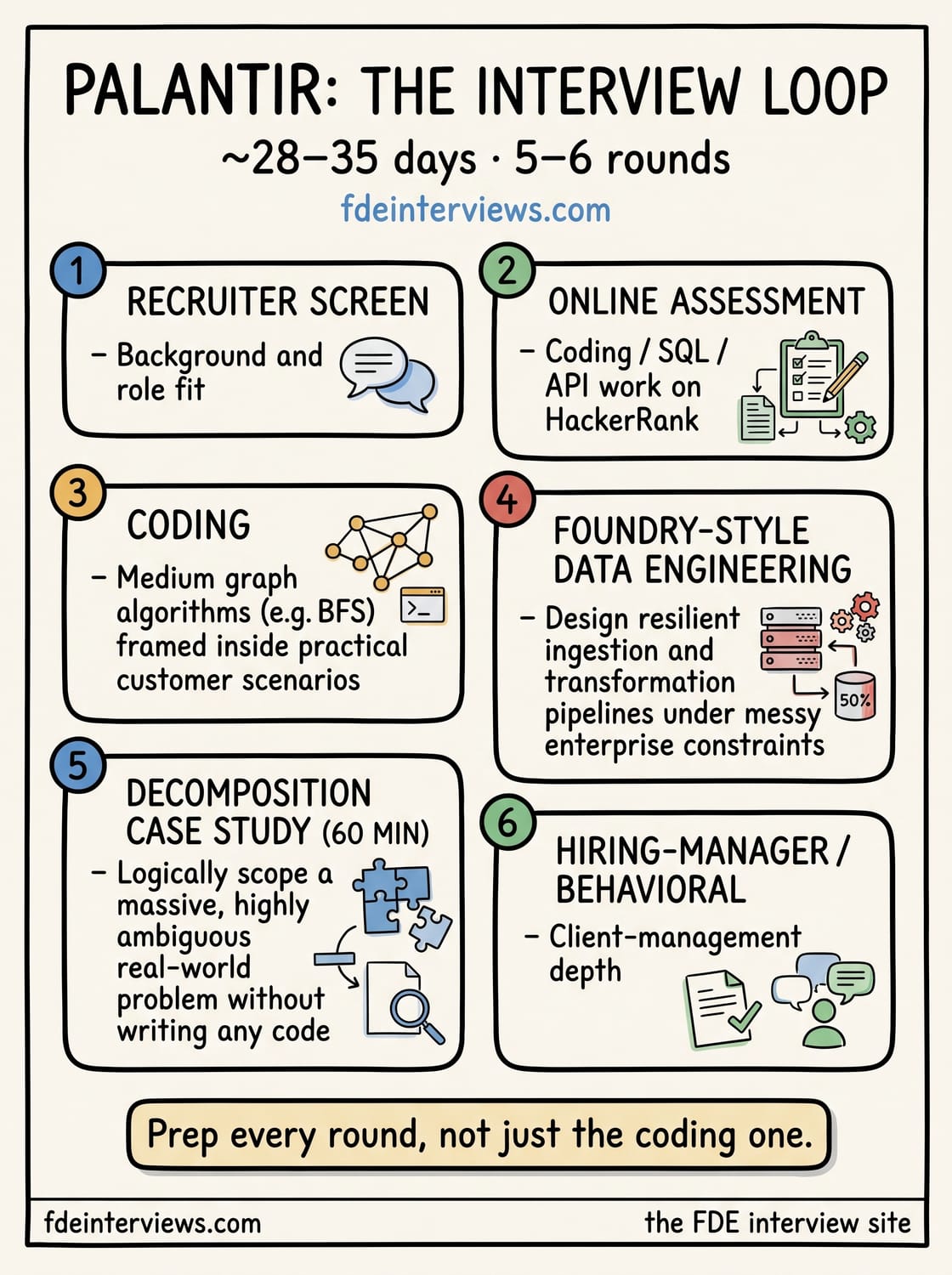
Role Forward Deployed Software Engineer (FDSE), the canonical FDE role Loop ~28–35 days · 5–6 rounds
1 Recruiter screen Background and role fit.
2 Online assessment Coding / SQL / API work on HackerRank.
3 Coding Medium graph algorithms (e.g. BFS) framed inside practical customer scenarios.
4 Foundry-style data engineering Design resilient ingestion and transformation pipelines under messy enterprise constraints: late data (up to 7 days), schema drift, point-in-time joins, backfills.
5 Decomposition case study (60 min) Logically scope a massive, highly ambiguous real-world problem without writing any code.
6 Hiring-manager / behavioral Client-management depth.
WHAT THEY'RE EVALUATING
› Behavioral and client-management questions are embedded in every technical round, not isolated› Customer-framed problem solving over abstract puzzlesCompiled from our research and publicly available information (candidate reports and company interview guides). Interview loops change and are continuously iterated, and they vary by team, level, and region. Treat this as directional preparation, not an official spec, and confirm the exact rounds with your recruiter or hiring point of contact.
THE ONE-PAGE VERSION
↧ Download Share on X ↗ Share on LinkedIn ↗ Questions modeled on Palantir loops 146 questions · 19 unlocked for you
22
Your agent fails 5% of the time mid-workflow, after executing real side effects. Make it safe. ▼ hard Sierra OpenAI Palantir 2 replies ◆ premium
The question that separates demo-builders from production engineers. Idempotency keys, the saga pattern, dry-run modes, approval tiers: the distributed-systems toolkit applied to agents, with the trap most answers miss.
25
The customer's system of record is a legacy GUI/API they can't change. Build an agent on top, where do you put the brittleness? ▼ hard Palantir Sierra Microsoft 1 replies ◆ premium
The most FDE question in the bank: every real deployment hits an unchangeable legacy system. The answer is an architectural principle, concentrate brittleness in one owned layer, plus what to do when the GUI is the only API.
44
Design a Graph-RAG pipeline that turns a question into Cypher, runs it, and heals its own broken queries. ▼ expert Palantir Glean Neo4j 1 replies ◆ premium
A multi-hop question over a property graph is a query-generation problem, not a similarity-search one. The staff-level move is grounding generation in the live schema and closing an auto-healing loop on the DB's own error messages.
50
A regulated customer's data cannot leave their VPC, but they want RAG with a frontier model. Design it. ▼ hard ★ Essential Anthropic Glean Palantir 1 replies ◆ premium
The hard part is not the retrieval pipeline, it is the boundary. Embeddings and the index live inside the VPC; the only question is whether the generation model is an in-VPC open model or an external API with a zero-retention DPA, and what crosses that line.
54
Build an agent that reroutes shipments when a hub goes down, and design the eval suite that keeps it from overspending. ▼ hard New Palantir OpenAI Anthropic 2 replies ◆ premium
Every eval question in the prep canon is about answer quality. This agent does not produce answers, it moves freight. You cannot score a reroute for faithfulness, and the candidate who tries has not understood what they built.
62
Finance says one in five numbers from your text-to-SQL feature is wrong. Find which, and why, before they stop trusting all of them. ▼ hard New Databricks Snowflake Glean 3 replies ◆ premium
A query that errors is a bug. A query that runs and returns a plausible wrong number is a product teaching a finance team, one figure at a time, not to trust it. The diagnosis is a classification exercise, and the fix is almost never a better prompt.
67
A chunking change shipped last week. Aggregate recall barely moved, and support says answers got worse. Find the regression. ▼ hard New Palantir Glean Hebbia 2 replies ◆ premium
The eval set says recall fell 2.3 points, which is inside the noise you would expect from a re-index. Support says the product got worse. Both are right, and the reason is that one document class lost 49 points of recall while everything else improved slightly.
01
Two Sum: return indices of the two numbers that add to a target ▼ easy ★ Essential Meta Scale Palantir 1 replies unlocked
The most common screen opener, and interviewers use it to check whether hashmap thinking is reflexive. Here's the one-pass answer, the narration that earns points, and the duplicate-handling edge case most candidates fumble.
03
Merge overlapping intervals ▼ easy Palantir Meta OpenAI 1 replies unlocked
The interval pattern shows up everywhere in FDE loops: calendars, flight segments, log windows. Master the sort-then-sweep idiom here and three other interview questions fall out for free.
04
Insert a new interval into a sorted, non-overlapping interval list ▼ easy Palantir Meta 1 replies unlocked
The follow-up interviewers reach for when merge-intervals goes too smoothly. The three-phase scan is elegant, but only if you've internalized the overlap condition most candidates have to re-derive under pressure.
10
Design and implement an LRU cache with O(1) get and put ▼ medium ★ Essential Palantir Meta xAI 1 replies unlocked
The single most-asked design-a-data-structure question in FDE loops. There's an interview-legal Python shortcut and a from-scratch version, and knowing when to offer which is half the grade.
12
Number of islands: count connected regions in a grid ▼ medium ★ Essential Meta Palantir xAI 1 replies ○ sign in
The canonical grid question, and the template for every flood-fill, shortest-path, and region-labeling variant FDE loops throw at you. BFS vs DFS vs union-find: here's which to write and which to merely mention.
13
Shortest path in a grid with obstacles ▼ medium Meta xAI Palantir 1 replies ○ sign in
The follow-up to number-of-islands, and the question where candidates reveal whether they understand WHY BFS finds shortest paths. Plus the two variants (weights, eliminating obstacles) that decide hard-screen outcomes at xAI.
14
Word search: does a word exist as a path of adjacent cells in a letter grid? ▼ medium Meta Palantir xAI 1 replies ○ sign in
The third member of the grid trilogy, and the one that tests backtracking discipline: marking, unmarking, and the early-exit pruning that turns a timeout into a pass.
16
Flight segments (start, end, seats): find the maximum simultaneous passengers ▼ medium Palantir Meta 1 replies ○ sign in
The Palantir coding-screen classic. It looks like merge-intervals but needs a different weapon, the sweep line, and the boundary-tie detail decides whether your answer is right or off by a planeload.
17
Parse server logs and report the top-K users by error count per hour, handling malformed lines ▼ medium Palantir Anthropic Retool 1 replies ○ sign in
The quintessential FDE practical: messy real-world input, grouping, ranking, and a hidden rubric line for how you treat malformed data. Most candidates parse happily and lose the round on the lines that don't parse.
19
Build a CSV diff tool: report added, removed, and changed rows between two files, with composite keys ▼ medium Palantir Retool Scale 1 replies ○ sign in
Every data migration at every customer site needs this exact tool, which is why Palantir and Retool keep asking it. The diff is a dict comparison; the grade hides in keys, duplicates, and column drift.
25
Fuzzy-match entities across two customer lists: normalization, edit distance, and scaling past O(n×m) ▼ hard Palantir Scale Glean 1 replies ◆ premium
Palantir's bread and butter: 'Acme Corp.' and 'ACME Corporation, Inc.' are the same customer; prove it in code. Normalization does more work than the clever algorithm, and blocking is what makes it run before the heat death of the universe.
28
Build a task scheduler: dependencies (topo sort), then priorities, then a concurrency limit ▼ hard xAI Palantir OpenAI 1 replies ◆ premium
Kahn's algorithm gets you level one. The round is won at level three, where 'run up to K tasks at once' breaks naive topo sort, and the indegree bookkeeping you chose at L1 either saves you or sinks you.
40
You're handed docs for an API you've never seen: use it to find the shortest path between two nodes ▼ medium Palantir 1 replies ◆ premium
Palantir's signature coding genre isn't an algorithm; it's working from unfamiliar documentation: a graph API, a custom serialization spec, a mini query language. The behaviors graders score, plus the BFS-over-an-opaque-client worked example.
43
Build a rules engine: evaluate boolean expressions like `age > 18 and country in ["US","CA"]` over a record ▼ hard Palantir Retool OpenAI 2 replies ◆ premium
The build behind every access policy and routing rule a customer wants to edit without a deploy. The trap is operator precedence: candidates who tokenize fine still get `a or b and c` wrong, and that's the whole grade.
47
Build a tiny query planner: choose index vs full scan, push down predicates, estimate cost ▼ hard Palantir Databricks Snowflake 1 replies ◆ premium
Executing a query is the easy half; deciding HOW to execute it is the staff-level half. The interesting failure is choosing an index that returns 90% of the table, where a full scan is faster, and a planner that knows that beats one that always uses the index.
55
Refactor a tangled 200-line function so it's testable. Walk through your approach. ▼ medium Anthropic OpenAI Retool 1 replies ◆ premium
The function reads a file, parses it, computes a metric, and prints, all tangled together. The move interviewers want is not prettier code, it's pulling pure logic out from side effects so each piece can be tested in isolation.
57
Build a CLI that ingests a folder of documents and outputs a JSON index of extracted entities. ▼ medium Palantir Harvey Hebbia 1 replies ◆ premium
A classic FDE take-home shape: messy real documents in, structured index out. The grade is in the seams between reader, extractor, and writer, and in what happens when one file is garbage.
67
Find near-duplicate documents in a 1TB corpus without comparing every pair. ▼ hard Scale AI Palantir Databricks 1 replies ◆ premium
All-pairs comparison is O(n^2) and dies long before 1TB. The senior move is MinHash plus LSH: hash documents so only likely-similar pairs ever land in the same bucket, then verify just those.
92
Shortest path across a grid to collect every key, where locked doors open only once you hold the matching key. ▼ hard New Palantir 2 replies ◆ premium
It looks like the grid BFS everyone has written a hundred times, and the usual visited set is exactly what makes it wrong. The fix is one line and it is the whole point of the question.
93
From a stream of badge scans, find the employees whose movements are impossible. ▼ medium New Palantir Scale 2 replies ◆ premium
A stateful pass over sorted events, which most candidates get working in ten minutes. The reason it is asked is the next ten: in this domain a false positive is a person accused of something.
94
Design a parking garage (or an elevator bank, or chess). The low-level design round. ▼ medium ★ Essential New Palantir 2 replies ◆ premium
The round that punishes fluency. Candidates who can draw a class diagram in ninety seconds usually score worst, because they modeled the nouns in the prompt instead of the operations the system has to support.
31
Estimate the number of gas stations in the United States, then tell me how you'd verify it with data. ▼ medium Palantir 1 replies ◆ premium
The classic market-sizing question with Palantir's twist: the estimate is the warm-up, and the scored move is the verification plan. Two independent decompositions, a cross-check, and the datasets that settle it.
51
Handed a messy new customer dataset: your first exploratory steps, and how do you handle missing values? ▼ medium Databricks Scale Palantir 1 replies ◆ premium
Profile before you model: shape, types, target balance, leakage check. Then the part most candidates botch, that a missing value is often the most predictive feature in the table, so you flag it before you fill it. The first-hour playbook and the imputation decisions that survive production.
62
A customer has only 200 labeled examples. How do you build a model? ▼ hard Google Scale AI Palantir 2 replies ◆ premium
The amateur move is to train a fresh deep net on 200 rows and overfit instantly. The senior move is to spend almost no labels on training: lean on a pretrained model, use the 200 as a validation set, and design a labeling loop that buys the most signal per label.
69
A bank wants one fraud model across three systems it acquired. Each one labeled fraud differently. Scope the first 90 days. ▼ hard New Palantir Scale Databricks 2 replies ◆ premium
Everyone spots that the customer records need resolving. The failure that actually sinks this project is quieter: the word fraud means three different things in the three datasets, so the union of their labels trains a model that is confidently wrong.
70
Two annotators labeled 500 support tickets and disagree on 30%. The customer wants to train on these labels next week. What do you do? ▼ medium New Scale Palantir Databricks 2 replies ◆ premium
Thirty percent disagreement is not a fact about the annotators. It is a fact about the task definition, and on a skewed label set it can mean the labels are worse than chance. The week is spent on the guideline and the gold set, not on the model, because no model trains past the noise in its labels.
03
Write SQL for the top 3 products by revenue in each region, per month. ▼ medium ★ Essential Snowflake Databricks Palantir 2 replies unlocked
The single most-reported live-SQL question in data-platform FDE screens. The pattern is standard, the points are in tie handling, the QUALIFY shortcut, and one aggregation trap most candidates miss.
04
A table has duplicate rows for the same business key. Write SQL to keep only the latest version of each. ▼ easy Retool Meta Palantir 1 replies unlocked
Every pipeline eventually double-loads data, so every FDE screen eventually asks this. There's one canonical idiom, plus a determinism detail that decides whether your dedupe is rerun-safe.
06
Find users who logged in on 3 or more consecutive days (gaps-and-islands). ▼ medium ★ Essential Meta Palantir Databricks 2 replies unlocked
The hardest 'standard' SQL interview pattern, asked everywhere from Meta to Palantir. There's a three-line trick that turns consecutive runs into a GROUP BY key, once you've seen it, you can't unsee it.
10
After adding a join, your row count and revenue totals exploded. What happened and how do you detect it? ▼ easy ★ Essential Palantir Retool Meta 2 replies unlocked
Join fan-out is the bug behind half of all 'the dashboard numbers are wrong' escalations an FDE will ever field. The mechanism, the 30-second detection query, and the three legitimate fixes.
12
You're handed raw JSON events in a Snowflake VARIANT column. How do you query and model them? ▼ medium Snowflake Databricks Palantir 1 replies ○ sign in
Snowflake's signature semi-structured question. Dot-notation, LATERAL FLATTEN for nested arrays, the casting traps, and the schema-on-read vs flattened-model judgment call interviewers really want to hear.
13
A customer's query on a 2-billion-row table takes 40 minutes. Walk me through your diagnosis. ▼ hard ★ Essential Databricks Snowflake Palantir 1 replies ○ sign in
The Databricks signature triage question. Strong candidates don't list optimizations, they run a diagnostic decision tree: plan first, then scan, shuffle, join strategy, files. Here's the tree.
14
Explain Snowflake micro-partitions and clustering, and when a bigger warehouse will NOT make a query faster. ▼ hard Snowflake Microsoft Palantir 1 replies ○ sign in
Snowflake's signature internals question, and the trap is in the second half: most candidates can define micro-partitions, but the scoring is on knowing the four cases where scaling up burns credits for zero speedup.
15
Why is Parquet the default for analytics? What does columnar storage actually buy you over CSV? ▼ easy Databricks Snowflake Palantir 1 replies ○ sign in
A warm-up that quietly reveals whether you understand why analytical engines are fast at all. Compression, projection, predicate pushdown, and the one workload where columnar is the wrong choice.
17
Spark: what's the difference between wide and narrow transformations, and why are shuffles expensive? ▼ medium Databricks Palantir Microsoft 1 replies ○ sign in
The Databricks screen opener that decides whether the rest of the interview goes deep or stays remedial. Definitions are table stakes, the points are in explaining what a shuffle physically does and how to see one in the Spark UI.
18
Your Spark join is skewed, 199 tasks finish in seconds, one runs for an hour. Fix it. ▼ hard Databricks Palantir Microsoft 2 replies ○ sign in
The Databricks signature deep-dive. Everyone says 'salting', almost nobody can write the salt correctly or explain why AQE might make hand-salting unnecessary. The full playbook, in the order a senior engineer actually tries it.
19
A customer's Delta table has 4 million small files and every query crawls. What happened, and how do you fix it? ▼ medium Databricks Palantir Snowflake 1 replies ○ sign in
The small-files problem is the #1 self-inflicted lakehouse wound FDEs find in the field. The causes are always the same three things, and the fix has a prevention half most candidates forget.
20
Design a star schema for a ride-sharing company's analytics. ▼ medium Databricks Snowflake Palantir 1 replies ○ sign in
The dimensional-modeling staple. The trip fact table is the easy part, interviewers score grain declaration, the surrogate-key rationale, and how you handle the rider who changes cities. Here's the full shape.
24
ETL vs ELT, what changed, and when is classic ETL still the right call? ▼ easy ★ Essential Snowflake Palantir Microsoft 1 replies ◆ premium
Sounds like a definition question; it's actually a judgment question. The economics that flipped the industry to ELT, and the four cases (starting with PII) where transforming before load is still non-negotiable.
25
Design a daily pipeline that survives reruns, late-arriving data, and a 3-year backfill, without double-counting. ▼ hard ★ Essential Databricks Palantir Snowflake 2 replies ◆ premium
The pipeline-design question that exposes whether you've ever been paged. One property, idempotency, solves reruns, late data, and backfills at once, and there are exactly three patterns that deliver it.
26
You must ingest from a customer source that ships nulls, duplicates, and surprise schema changes. Design defensive ingestion. ▼ medium Palantir Databricks Retool 1 replies ◆ premium
Pure FDE territory: the customer's data is always dirtier than scoped. The layered defense, contracts, quarantine, drift handling, and the alert-severity matrix that keeps you from crying wolf.
27
Two customer lists, millions of rows, no shared key, names and emails almost match. Dedupe and merge them. ▼ hard Palantir Retool Databricks 1 replies ◆ premium
Palantir's home turf: entity resolution disguised as a dedupe task. The naive O(n²) comparison is the trap, blocking, match scoring, transitive closure, and the golden-record question are where the interview actually happens.
28
Design CDC from a customer's Oracle ERP into the lakehouse, including deletes and schema evolution. ▼ hard Databricks Palantir Snowflake 2 replies ◆ premium
The integration question that decides data-platform FDE offers. Log-based vs query-based capture, why deletes break naive designs, the apply-merge that keeps order, and the snapshot step everyone forgets.
30
The nightly job that took 1 hour now takes 9, since a new source was onboarded. Triage it live. ▼ hard Databricks Snowflake Palantir 1 replies ◆ premium
The capstone triage scenario data-platform FDEs get role-played through. A 9x blowup with an obvious-looking suspect, the scoring is on your diagnostic order, the questions you ask, and not stopping at the first plausible cause.
35
Model a restaurant business using Palantir's Entity-Event-Document method. ▼ hard Palantir 1 replies ◆ premium
The Deployment Strategist data-modeling case. It looks like schema design; it's graded as ontology thinking, entities with identity, events that link them in time, documents as evidence, plus privacy designed in, not bolted on.
36
Palantir is planning the next tennis Grand Slam. Verify that 2 pm is the best start time, using any public data. ▼ hard Palantir 1 replies ◆ premium
The verbatim Deployment Strategist case. The trap is accepting the premise, 'best for whom?' is the first scored move, and the second is designing a natural experiment from public data instead of hand-waving at 'analytics.'
38
A nightly job drifted from 30 minutes to 5 hours over six weeks with no code change. Find the cause. ▼ hard Databricks Snowflake Palantir 1 replies ◆ premium
The regression with no smoking gun, no deploy to blame, no single bad night. Staff-level triage is about reading the trend, not the last run, and the four slow-burn causes that a one-night comparison can't see.
39
Design a backfill for an aggregate table that takes late and out-of-order events without double-counting or holes. ▼ hard Databricks Snowflake Palantir 1 replies ◆ premium
The aggregate-restatement problem that breaks naive backfills: events arrive days late and out of order, so any partition you already published may be wrong. The staff answer is event-time partitioning plus bounded restatement, not a bigger watermark.
40
Model a dimension bitemporally so you can answer 'what did we believe the customer's plan was, as of last Tuesday?' ▼ hard Palantir Snowflake Databricks 1 replies ◆ premium
SCD2 tracks when an attribute was true; bitemporal also tracks when you knew it. The question separates engineers who can audit a number from those who quietly overwrite history when a correction arrives.
41
Join two petabyte fact tables where both are skewed on the same key. Neither fits in memory. Make it finish. ▼ hard Databricks Palantir Snowflake 1 replies ◆ premium
Basic salting assumes one side is a small dimension you can explode. When both sides are huge and skewed, exploding either one blows up the cluster. The staff move is to split hot keys out and handle them on a different plan entirely.
42
Your CDC stream replays a batch and a customer issues a GDPR deletion mid-stream. Keep the silver mirror exactly-once and compliant. ▼ hard Databricks Snowflake Palantir 1 replies ◆ premium
CDC design questions usually stop at the happy-path MERGE. This one stress-tests it: an at-least-once stream that double-delivers, hard deletes, soft deletes for audit, and a GDPR erasure that must physically purge even the bronze change log. The guarantees have to compose.
43
Build a streaming aggregation with exactly-once output, bounded state, and a defined policy for events that arrive an hour late. ▼ hard Databricks Snowflake Palantir 1 replies ◆ premium
Streaming interviews separate people who have run a job at 3am from people who have read the docs. The hard parts are not the windowed aggregate, they are bounding state so the job does not die, and choosing what a late event does to an already-emitted result.
44
The customer says the synced orders table 'does not match' their ERP. Show me the queries you run. ▼ hard New Palantir Databricks Scale 2 replies ◆ premium
The most common escalation in any data deployment, and the one that quietly ends trust in the platform. Four causes produce it, one of them means nobody is wrong, and you cannot tell them apart without running the ladder in order.
45
Find the users who were active in January but not in February. ▼ medium ★ Essential New Palantir Databricks Scale 2 replies ◆ premium
Four lines of SQL, and one of the three obvious ways to write it returns an empty result set instead of an answer. Not wrong rows. Zero rows, silently, on production data that looks fine.
46
Find the customers whose return rate exceeded 30% last quarter. ▼ medium New Palantir Databricks Scale 2 replies ◆ premium
Everyone writes the join and the ratio. Then the result comes back dominated by people who bought one thing and sent it back, and the list is useless to the person who asked for it.
47
Sync a customer's on-prem Postgres to your cloud at 10,000 updates/sec. You may not install anything on the DB server. ▼ hard New Scale Palantir Databricks 2 replies ◆ premium
The constraint is the question. It rules out the two approaches most candidates reach for, and the approach that survives has one failure mode that can take the customer's production database down.
05
It's Friday evening at a customer site and they want a hotfix shipped now. How do you do it safely, and when do you refuse? ▼ easy Palantir Retool Microsoft 2 replies unlocked
This isn't a deployment question, it's a judgment question wearing one. Interviewers are scoring whether you have a decision framework, a safety checklist, and the spine to say no to a customer politely.
14
Your product deploys into dozens of customer environments. Design secrets management across all of them. ▼ medium Palantir Retool Microsoft 1 replies ○ sign in
API keys for systems you don't own, in environments you can't always reach, audited by security teams who don't trust you. The strong answer has one organizing principle, and a concrete story for rotation and the air-gapped case.
15
You get a vague prompt like 'design a system to detect fraud.' What do you do in the first ten minutes? ▼ medium ★ Essential Palantir OpenAI Microsoft 1 replies ○ sign in
The Palantir decomposition round has no right answer, it has a right METHOD, and it's the most-failed interview in the FDE loop. Here is the four-move rubric interviewers actually score: clarify, model, spine, iterate.
16
Decompose: design a system to detect credit-card fraud. ▼ hard Palantir Databricks Microsoft 1 replies ○ sign in
The classic Palantir decomposition prompt. The winning answer hinges on one asymmetry candidates rarely surface unprompted, and on starting with something embarrassingly simpler than an ML model.
17
Decompose: design a system to coordinate disaster response for a city. ▼ hard Palantir Microsoft 1 replies ○ sign in
The most open-ended prompt in the Palantir canon, no scale given, no user given, no disaster given. What separates passing answers is one design assumption about the data that almost nobody states out loud.
18
Decompose: merge patient records across a network of hospitals. ▼ hard Palantir Databricks Microsoft 2 replies ○ sign in
The purest data-modeling prompt Palantir asks, the whole interview lives in the entity-resolution edge cases. Twins, maiden names, shared insurance IDs... and one architectural decision about merging that candidates get fatally wrong.
19
Decompose: design a system to route a fleet of delivery trucks. ▼ hard Palantir Microsoft Databricks 1 replies ○ sign in
Looks like an algorithms question; it's actually an operations question wearing one. The candidates who fail reach for 'solve VRP'; the ones who pass design for the 2pm reality that invalidates every morning plan.
20
Decompose: predict flight delays, and survive the interviewer changing the rules every five minutes. ▼ hard Palantir OpenAI Databricks 1 replies ○ sign in
The decomposition prompt we use to teach the skill that actually decides these interviews: graceful iteration under perturbation. Your score isn't your design; it's the delta when the design gets punched.
23
Your product embeds inside a customer's app. Design auth: SSO, SAML/OIDC, and row-level security. ▼ medium Glean Retool Microsoft 1 replies ◆ premium
Enterprise deals die in this design review. The answer has three layers most candidates blur together: who you are, what you can see, and how an embedded product proves both, plus the permission-staleness trap that fails Glean loops.
24
Your demo runs on a laptop. Now deploy it in the customer's VPC with no internet egress. What breaks? ▼ hard ★ Essential Palantir Anthropic Microsoft 1 replies ◆ premium
The defining Palantir-style deployment question. Everything your laptop did silently (package pulls, API calls, telemetry, auth callbacks, clock sync you never thought about) becomes a named workstream. Strong answers produce the checklist by category, not by anecdote.
25
Run a schema migration on a customer's live production database, zero downtime. Walk me through it. ▼ medium Palantir Retool Databricks 1 replies ◆ premium
The pattern is expand-contract; the interview is everything around it: the backfill that locks the table, the rollback nobody rehearsed, and the fact that it's the customer's database, not yours. One named technique carries the whole answer.
29
Your product runs in 30 customer environments you can't SSH into. Design how you monitor, debug, and upgrade the fleet. ▼ hard Palantir Retool Databricks 1 replies ◆ premium
The question that defines forward-deployed engineering as a discipline: production you're responsible for but can't touch. The answer is a system (version skew, telemetry tiers, diagnostic bundles, release trains), not a collection of favors from customer IT.
30
Your pilot wowed the customer. Take it to production: 99.9% SLA, real users, their security team watching. Design the path. ▼ hard ★ Essential Palantir OpenAI Anthropic 2 replies ◆ premium
The capstone FDE question, where every topic in this category shows up as one workstream. The rubric isn't the target architecture; it's whether you can sequence the gap-closing while the customer keeps using the pilot.
31
Decompose: help an Uber Eats driver decide which orders to accept, using historical and live data, including past tips ▼ hard Palantir 1 replies ◆ premium
A live-reported Palantir FDSE decomp with a built-in twist: after you design for the driver, the interviewer flips you to Uber's side. The expected-value-per-hour model, the tip-prediction ethics trap, and how to survive the flip.
32
Decompose: allocate hospital resources, beds, staff, equipment, across competing patient needs ▼ hard Palantir 1 replies ◆ premium
A reported Palantir FDSE decomposition where the fatal move is putting triage inside an algorithm. The bed-capability data model, the visibility-before-optimization v1, and the conflicting-priorities answer that keeps clinicians in charge.
37
Deploy into a customer's air-gapped, continuously-audited environment (FedRAMP/IL5-style). Design for the audit, not just the gap. ▼ hard Palantir Anthropic Microsoft 1 replies ◆ premium
No egress is the easy half. The hard half is that an auditor will read your logs, your access trail, and your model-update process for the next three years. The strong answer designs the evidence the audit consumes as a first-class output.
40
Decompose: design a system to run a container port terminal, ships, cranes, yard, and trucks. ▼ hard Palantir Anthropic Flexport 1 replies ◆ premium
A port is three coupled scheduling problems in a single prompt: where ships dock, which cranes work them, and where containers land in the yard. The strong answer decomposes them, names where they couple, and refuses to solve the whole thing as one giant optimizer.
41
Decompose: detect coordinated fraud rings, not just individual fraudulent transactions. ▼ hard Palantir Stripe Anthropic 1 replies ◆ premium
Per-account scoring catches the lone fraudster and misses the ring whose accounts each look clean. The strong answer reframes the problem as a graph, makes entity resolution the step everything else depends on, and treats a flagged ring as a case for an investigator, not an automatic block.
42
A customer's data lives in an eventually-consistent store. How do you reason about what consistency your AI workflow actually needs? ▼ hard Palantir Anthropic Databricks 1 replies ◆ premium
CAP is a trap if you recite it. The interviewer wants to see you map a customer's real datastore to a real failure mode, then decide where stale reads are free and where they corrupt an agent's decision.
44
A service you deployed at a customer corrupts a record intermittently under concurrency. How do you find it and fix it? ▼ hard Databricks Stripe Palantir 3 replies ◆ premium
It reproduces once in a thousand runs, never on your laptop, and the customer's data is wrong. This question separates engineers who name the race and reach for the right lock from those who sprinkle mutexes and pray.
46
How do you design a customer deployment so their team can run it without you, and you make yourself obsolete? ▼ medium Palantir Anthropic OpenAI 1 replies ◆ premium
The best FDE deployment is the one that doesn't need the FDE anymore. This question screens for whether you build for handoff from day one or quietly make yourself indispensable, which is the failure mode that looks like success.
48
Design a safety-enforced LLM API gateway: intercept prompts and outputs, apply dynamic policy, add under 5% latency, support streaming ▼ hard Anthropic OpenAI Cloudflare 2 replies ◆ premium
A gateway that screens every prompt and streamed token against a live policy without blowing the latency budget. The strong answer separates the policy decision from its data, runs deterministic checks inline and model checks in parallel, and redacts a leaking secret mid-stream before it renders.
49
Orchestrate a multi-agent system over a 500-page merger agreement to produce a redlined risk summary that never contradicts the source. ▼ expert Harvey Hebbia Palantir 1 replies ◆ premium
Five LLM agents over a hundred steps, and the bar is zero contradictions with a 500-page contract. The real test is the state and grounding layer, not the agent prompts.
50
Adapt a pretrained LLM for intelligence analysis inside an air-gapped facility, on classified data you are never allowed to see. ▼ expert Palantir Scale AI Anduril 1 replies ◆ premium
No data leaves, you cannot pre-inspect the corpus, and your toolchain arrives on a single USB. Design adaptation and evaluation when you will never observe a single input or output.
62
Their order system goes down for four hours a week and cannot be changed. Design the queue that sits between it and your pipeline. ▼ hard Palantir Databricks C3 AI ◆ premium
Every integration lesson assumes a queue and nobody designs one. Ordering per entity rather than globally, a dead letter path somebody actually reads, and what your pipeline does when the consumer is slower than the producer for four hours.
65
Decompose: a city wants to cut 911 response times. You have call, traffic, and ambulance GPS data. ▼ hard ★ Essential New Palantir OpenAI Scale 2 replies ◆ premium
The most-reported decomposition prompt in the FDE canon. Almost every candidate builds a routing model, and almost every candidate is optimizing the wrong term of the equation.
66
Decompose: design a data platform for an enterprise with 500 disparate data sources. ▼ hard New Palantir Databricks 2 replies ◆ premium
The number 500 is the trap. Candidates hear it as a scaling problem and design a pipeline factory, when the interviewer is watching to see whether you refuse to ingest 500 things at all.
67
Decompose: here are 8,000 taxi trips. Propose a product, sketch the components and APIs, buildable in a week. ▼ hard New Palantir 2 replies ◆ premium
A dataset lands in your lap with a one-week deadline attached. Most candidates start exploring the data. The ones who pass start by working out which questions this data physically cannot answer.
68
Design the system that assigns analysts to investigations by skill, clearance and availability. ▼ hard New Palantir Scale 2 replies ◆ premium
It reads as an optimization problem and it is not, quite. One of the three inputs can never be traded against the others, and a design that scores all three has quietly built a compliance incident with a scheduler attached.
69
A customer runs 50 notebooks by hand every morning and wants it automated. IT will not approve any new cloud service. ▼ medium New Palantir Databricks 2 replies ◆ premium
The obvious engineering answer is to rewrite the notebooks properly and schedule them. Do that and you will have built something correct that the people who own the work can no longer maintain.
70
Pick a product feature. What are the P0s, what's the data model, how do you know it works, and what do you show executives? ▼ hard New Palantir 2 replies ◆ premium
The only round where you choose the problem, which sounds like a gift and is where most candidates lose it. Four things get graded in one flow, and the fourth is the one engineers skip.
71
A service you deployed on-premise grows memory over 72 hours. You have no shell access to the box. Diagnose it and say when it falls over. ▼ hard New Palantir Databricks Snowflake 4 replies ◆ premium
Three different causes produce the same rising line, and resident memory alone cannot tell them apart: a leak climbed 25.2 MB an hour and fragmentation climbed 22.8. The gauge that separates them costs nothing and has to have been shipped before the incident.
72
An urgent fix has to reach a live customer instance that has no CI/CD and a strict zero-downtime change-control policy. Ship it. ▼ hard New Palantir Databricks Snowflake 4 replies ◆ premium
Every instinct says move fast. The arithmetic says otherwise: eight hours of preparation reached a fixed system 26% sooner than shipping immediately, because each failed attempt costs a two-day approval cycle and you only get one shot per cycle.
73
A customer wants AI coding agents working in their codebase. How do you assess whether it is ready, and what do you fix first? ▼ hard New Palantir Cognition Cursor 2 replies ◆ premium
The instinct is to grade the codebase. Grade the feedback loop instead: a repo with no docs and a 90-second test command is friendlier to an agent than a beautifully documented one whose suite takes 40 minutes and flakes 8% of the time, and the arithmetic on that second number is worse than it looks.
01
Tell me about the most ambiguous project you've owned end-to-end. What did you do in week one? ▼ medium ★ Essential Palantir OpenAI Scale AI 2 replies unlocked
The single most common FDE behavioral question, and the 'week one' follow-up is where most candidates collapse. Here's the structure that signals you can be dropped into chaos and produce order.
02
Why customer-facing instead of pure engineering? Convince me you won't quit in a year. ▼ easy ★ Essential Palantir OpenAI Databricks 1 replies unlocked
This is a flight-risk filter, not small talk, FDE teams lose hires back to pure SWE roles constantly. The answer that passes is built on evidence, not enthusiasm. Here's what it sounds like.
03
This role is 50–75% travel, sometimes living at customer sites for weeks. Honestly, how will you handle that? ▼ easy Palantir Databricks Snowflake 1 replies unlocked
There's no trick here, except that interviewers are listening for one specific word: a plan. The candidates who fail give enthusiasm; the ones who pass give logistics.
05
Tell me about learning an unfamiliar domain fast. How fast, and how did you validate you understood it? ▼ easy Harvey Palantir Scale AI 1 replies unlocked
FDEs change domains every deployment, so interviewers test for a repeatable learning system, and most candidates fail the second half: proving the understanding was real. Here's the method and the validation move.
06
Describe your worst production incident at a customer. What did you tell them, and when? ▼ medium Palantir OpenAI Microsoft 2 replies unlocked
The incident is the setup; the disclosure timeline is the test. Interviewers are timing the gap between 'you knew' and 'they knew', here's the answer that builds trust instead of torching it.
08
Tell me about a project that failed. Whose fault was it? ▼ medium ★ Essential Palantir OpenAI Google 1 replies unlocked
'The customer was dumb' is an instant fail, but so is theatrical self-flagellation. There's a narrow honest lane between the two, and this is what driving down it sounds like.
09
Estimate: how many LLM tokens per day would a Fortune-500 customer-support org consume? ▼ medium Google Palantir Microsoft 1 replies unlocked
Nobody cares about your final number, they're grading the decomposition, the sanity checks, and whether you convert tokens into dollars unprompted. Here's a clean worked path.
10
Tell me about turning a skeptical stakeholder into a champion. ▼ medium ★ Essential Databricks Microsoft Palantir 1 replies unlocked
Every deployment has a skeptic, and 'I showed them data and they came around' is the answer everyone gives. The scored version starts with why they were right to be skeptical.
16
A customer arrives with 30 AI use cases. Design the workshop that picks the first one. ▼ medium Palantir Microsoft Scale AI 1 replies ○ sign in
The first use case decides the whole account, pick a flashy-but-doomed one and there's no second. Here's the value × feasibility × data-readiness workshop that strong FDEs run, hour by hour.
17
Here's an engineer's status update full of jargon. Rewrite it as the steering-committee email. ▼ easy Palantir Microsoft Databricks 1 replies ○ sign in
A live translation test of the FDE's core skill: same facts, different altitude. There's a four-line formula execs actually read, and one translation error that destroys trust.
20
You're alone on-site. The customer asks for something out of scope, and your team is asleep in another timezone. Decide now. ▼ medium Palantir Scale AI OpenAI 1 replies ○ sign in
The pure autonomy test: no one to ask, a customer waiting, and a scope line in front of you. Strong candidates reveal a decision rule, not a guess. Here's the rule.
22
Mid-deployment, the data is far dirtier than scoped and the timeline is now impossible. Draft the conversation with the exec sponsor. ▼ hard Palantir Databricks Scale AI 1 replies ◆ premium
Every enterprise AI deployment hits this wall, interviewers want to know if you deliver the bad news early, with options, or sit on it hoping. Here's the conversation script, beat by beat.
24
A customer engineer is blocking your integration access, your product threatens his job. Handle it. ▼ hard Palantir Databricks Microsoft 1 replies ◆ premium
The Palantir classic. He's not irrational, your product might really make his role redundant, and escalating over him is the losing move. Here's the playbook that converts the blocker.
27
You discover the pilot's success metric is being gamed, someone is cherry-picking easy test queries. What do you do? ▼ hard Palantir Scale AI OpenAI 1 replies ◆ premium
An integrity trap with a political twist: the person gaming your metric is usually your own champion. Blowing the whistle loudly and looking away both fail, here's the third path.
29
Why Palantir? And what are your views on our government work? ▼ medium Palantir Scale AI 2 replies ◆ premium
A genuine filter, not small talk, Palantir interviewers have heard every dodge. The answer that works engages the controversy directly, with a position you can defend under two rounds of pushback.
38
You're at the offer stage. How do you evaluate an FDE package, and what do you negotiate? ▼ hard Palantir OpenAI Distyl 1 replies ◆ premium
FDE comp spans roughly $150K to $550K+ for the same title, because some companies pay it on the engineering ladder and some on a field ladder with variable comp. The first question to ask, and the traps in comparing OTE to base.
39
Role-play: a customer panel where the eng lead has decided he wants you replaced. Win the room, or at least the next meeting. ▼ hard Palantir Databricks OpenAI 1 replies ◆ premium
The eng lead isn't testing your architecture, he's already decided you should go and is performing it for the room. Trying to win the technical argument is the trap. Here's how to split his audience from his position and leave with a next meeting.
40
The pilot quietly missed its success metric and the go/no-go is in ten days. Salvage it honestly, or recommend killing it. ▼ hard OpenAI Databricks Palantir 1 replies ◆ premium
You hit 71% against an 85% bar nobody wants to say out loud, and the easy moves (quietly redefine the metric, ask for 'one more month') are how pilots rot in purgatory. Here's the honest salvage path, and how to recommend a kill without losing the account.
41
Scope grew, the timeline slipped, and the customer's CEO has called an escalation meeting tomorrow. Walk in and run it. ▼ hard Palantir Databricks Snowflake 3 replies ◆ premium
Both dials broke at once and now the most senior person in the building wants answers. The instinct to lead with explanation is how you lose the room in the first minute. Here's the structure that turns an execution interrogation into a decision meeting you control.
42
A whale customer wants something you believe crosses a line, and your own AE is leaning on you to make it work. Decide. ▼ hard Anthropic OpenAI Palantir 2 replies ◆ premium
The conflict isn't you versus the customer, it's you versus your own quota-carrying colleague who wants the deal. The answer that passes refuses the line without grandstanding, finds the compliant adjacent path, and accepts the churn if there isn't one. Here's how to hold it without becoming the obstacle.
43
Your deployment caused a public AI incident. The customer's board wants you in the room to present the postmortem. Prepare it. ▼ hard Anthropic OpenAI Palantir 1 replies ◆ premium
A board isn't an engineering audience and the postmortem they want isn't the one you'd write for your team. Lead with the wrong thing and you confirm their fear that this is unmanageable. Here's the board-grade structure, blameless but accountable, that restores confidence.
46
Walk me through your first 30, 60, and 90 days in a new customer-facing engineering role. ▼ easy OpenAI Palantir Anthropic 1 replies ◆ premium
The graded shape is specific: learn and ship something small by day 30, own a deployment by day 60, drive a cross-customer improvement by day 90. Vague answers about 'meeting stakeholders and ramping up' fail. Here is the staged plan with what good looks like at each gate.
47
Tell me about a time you persuaded a resistant team to adopt an engineering practice you believed in. ▼ medium Palantir OpenAI Databricks 1 replies ◆ premium
A research team that owns its own way of working does not adopt your process because you're right. The candidates who win this question don't argue, they run a small proof that makes the practice obviously cheaper than the status quo, then let the team claim it.
48
You're the first FDE at a traditional software shop. How do you pick the first AI project, show value in 30 days, and win over skeptics? ▼ hard OpenAI Palantir Google 1 replies ◆ premium
Around 95% of enterprise AI pilots produce no measurable impact, almost always from deployment, not the model. As the first FDE in a skeptical SWE shop, your month-one job is to not be pilot 95: pick a project that can win, prove it in 30 days, and turn the engineers who roll their eyes into the ones who vouch for you.
49
Two months before launch, the model is 20% below target on a critical edge case. How do you triage, brief the business, and resolve it? ▼ hard OpenAI Anthropic Palantir 1 replies ◆ premium
The gap is real, the date is close, and the business is about to ask if you'll make it. The wrong first move is to start tuning prompts. The strong move is to split the failure into causes you can act on, give the business an honest forecast with options, and protect the launch even if you can't fully close the gap.
66
You're leaving a customer site after a multi-month build. How do you hand off the AI system so they don't call you every week? ▼ medium Palantir OpenAI Anthropic 2 replies ◆ premium
The screen is whether you build for your own replaceability or your own indispensability. Strong answers treat the handoff as a deliverable with a graduation criterion, not a final week of doc-dumping. Here is what to leave behind, how to transfer it, and the trap that sounds generous.
67
Ninety days in, adoption is 12% and the customer blames the product. What do you do? ▼ hard ★ Essential New Palantir OpenAI Databricks 2 replies ◆ premium
The deployment worked. The software runs, the data flows, the demo landed. Nobody is using it. Two of the three research sets we vetted surfaced this from different angles, and it is the failure mode that ends renewals.
68
Eight months into a multi-year deployment, the executive who sponsored the whole thing resigns. What now? ▼ hard New Palantir Databricks OpenAI 2 replies ◆ premium
Nothing about the software changed. The single person whose belief the contract rested on is gone, and the replacement has more to gain from cancelling your project than from finishing it.
69
Your customer urgently needs a feature. Your own product team has looked at it and said no. Resolve it. ▼ hard New Palantir OpenAI Databricks 2 replies ◆ premium
The structural tension of the job in one question. You are the customer's advocate inside your company and your company's representative at the customer, and this is the day those two roles openly disagree.
70
A customer emails: 'the AI platform is giving incorrect answers.' No logs, no screenshots, no examples. Go. ▼ medium New Palantir OpenAI Anthropic 2 replies ◆ premium
The most common real ticket in applied AI, and it contains almost no information. What you do in the first hour decides whether you spend a day on this or three weeks.
71
Why this company specifically? ▼ easy New Palantir OpenAI Anthropic 2 replies ◆ premium
Asked in every loop, prepared for by almost nobody, and it has a single mechanical test that tells you whether your answer is any good before you ever say it out loud.
72
Tell me about a time you failed at something that mattered to you. ▼ hard New Palantir 2 replies ◆ premium
Palantir hiring managers are reported to spend a large part of the final round on this one question. It is not a stress test, and treating it like one is how strong candidates talk themselves out of an offer.
73
You're embedded with five executives, each certain their request is the top priority. Set the sequence. ▼ hard New Palantir Databricks OpenAI 2 replies ◆ premium
The trap is that it looks like a prioritization problem you can solve with a scoring rubric. You do not have the authority to rank these people's work, and the moment you try, you have made yourself the obstacle.
74
Tell me about a pattern you spotted across customers that changed how your team worked. ▼ medium New Palantir Databricks OpenAI 2 replies ◆ premium
The question that separates a forward deployed engineer from a very good consultant. One delivers each engagement. The other notices that the third engagement looked like the first two and does something about it.
75
In the learning round you get a topic you have never seen, some time with the material, and then you teach it back. How do you use the time? ▼ medium New Palantir 1 replies ◆ premium
Candidate reports describe a Palantir round where you are handed unfamiliar material, given time with it, and asked to explain it. It is the job in miniature: an FDE learns a customer's domain in a week and has to be useful by Thursday. The scoring is on what you chose to teach, and on what you admitted you did not learn.
04
Walk me through the OWASP LLM Top 10, which two risks would you prioritize for an enterprise agent deployment? ▼ medium ★ Essential Microsoft Palantir Scale 2 replies unlocked
Reciting all ten gets you a pass on memory and a fail on judgment. The question is really a prioritization exercise, here's the two-risk answer that maps to how agents actually get breached, and the trap hiding in 'walk me through.'
07
Explain MITRE ATLAS. How would you map an observed attack on an AI system to its tactics and techniques? ▼ medium Microsoft Palantir Scale 1 replies unlocked
ATLAS questions filter candidates who can name the framework from those who can run an incident through it. The mapping exercise, one concrete attack, kill-chain stage by stage, is what the interviewer actually wants to hear.
16
Design a PII redaction system for an LLM pipeline, PII enters at user input, retrieved context, tool results, and output. Guard all four. ▼ hard ★ Essential Palantir Microsoft Glean 1 replies ○ sign in
The four-point redaction design is becoming the standard FDE privacy round. Most candidates fortify the chat box and lose on the other three doors, here's the full design, including the de-redaction map that makes it usable.
19
The customer says 'our data can't leave our environment.' Walk me through the deployment options and what each really buys. ▼ medium Anthropic Palantir Microsoft 2 replies ○ sign in
'Can't leave our environment' means four different things to four different stakeholders. The FDE skill is decomposing the demand into the actual requirement, and knowing which deployment tier each requirement really needs.
20
A hospital wants an LLM feature over patient records. What does HIPAA actually require of your design? ▼ medium Microsoft Palantir Salesforce 1 replies ○ sign in
HIPAA-with-LLMs questions test whether you know the three things that gate the deal: the BAA, the minimum-necessary standard, and audit controls. Engineers who can name 45 CFR obligations in design terms win these rooms.
22
Explain the EU AI Act's risk tiers and what they mean for a customer deploying your AI system in Europe. ▼ medium Microsoft Salesforce Palantir 1 replies ◆ premium
The AI Act question is a classification exercise in disguise: interviewers give you a use case and watch whether you can tier it, name the obligations, and know whose job each one is, provider or deployer.
24
Design data governance for a regulated customer: RBAC, dynamic masking, and row access policies, from day one, not bolted on. ▼ medium Snowflake Palantir Salesforce 1 replies ◆ premium
A Snowflake solutions-loop classic that generalizes to every AI deployment: why masking retrofits fail, what a role hierarchy actually looks like, and the policy-attachment model that makes governance survive schema growth.
29
Design the audit trail for an AI agent that takes actions in customer systems. What do you log, and what makes it defensible? ▼ hard Palantir Salesforce Microsoft 2 replies ◆ premium
When the agent does something expensive, 'what happened and why' must be answerable in minutes, to an auditor, from records they trust. Most logging designs answer 'what'; the AI-specific work is 'why', and tamper-evidence is what makes it count.
30
Your deployed AI product just caused real harm at a customer. Run the incident response, first hour, first day, first week. ▼ hard OpenAI Anthropic Palantir 1 replies ◆ premium
The capstone governance round: AI incidents break standard IR playbooks in three specific places, containment without rollback, blast-radius over probabilistic systems, and root cause for nondeterministic behavior. Interviewers grade you on knowing which three.
34
Write the incident runbook for a data-leak-via-model event: the assistant showed one customer's data to another. ▼ hard OpenAI Glean Microsoft 1 replies ◆ premium
Cross-tenant or cross-user data exposure through a model is the breach that starts regulatory clocks. The runbook has to answer 'whose data, to whom, how many' from logs that most teams never designed for, and contain a leak that may live in a cache or a fine-tuned model, not a deploy.
35
A customer's CISO wants to see your AI risk management mapped to the NIST AI RMF. How do you operationalize it? ▼ hard Microsoft Palantir Anthropic 1 replies ◆ premium
NIST AI RMF is voluntary, which is exactly why a CISO uses it as a shared yardstick. The strong answer turns Govern, Map, Measure, Manage into artifacts you already produce, and uses the Generative AI Profile to name the LLM-specific risks the core framework leaves abstract.
36
Threat-model a multi-agent system where agents call each other. Where are the trust boundaries and how does one compromise spread? ▼ hard Anthropic Microsoft Salesforce 1 replies ◆ premium
When agents call agents, one agent's output is another's untrusted input, and a single injected instruction can propagate across the whole graph with accumulated privileges. The strong answer treats every inter-agent edge as a trust boundary and bounds privilege per agent, not per system.
37
Design a fully on-premise diarization and summarization pipeline for sensitive meeting recordings that provably does not retain transcripts ▼ hard Palantir Anthropic Microsoft 1 replies ◆ premium
Sensitive meeting audio in, speaker-attributed summary out, and a hard guarantee that the raw transcript never lands on disk. The strong answer keeps everything on-prem, processes transcripts in memory only, and proves non-retention with architecture and audit, not a policy promise.
More from the tracks Palantir's loop tests The highest-signal questions across Palantir's core tracks.
8 questions · 6 unlocked for you
01
What's the difference between at-least-once and exactly-once delivery, and why should an FDE care? ▼ easy OpenAI Retool Databricks 1 replies unlocked
Every queue, webhook, and retry loop you'll ever deploy at a customer hides this distinction. Interviewers use it to separate people who've shipped from people who've read about shipping.
02
Explain how rate limiting works, fixed window, sliding window, token bucket. When does each break? ▼ easy ★ Essential OpenAI Anthropic Glean 1 replies unlocked
A staple at OpenAI and Anthropic in both coding and design rounds. Most candidates can name the algorithms; few can say which one lets 2x your limit through, and that's the part that gets scored.
08
A customer's app calling your API times out intermittently. You can't see their code. Debug it. ▼ medium ★ Essential OpenAI Anthropic Retool 1 replies unlocked
The signature FDE debugging genre: a moving fault, an opaque client, and a customer who's sure it's your fault. The winning method splits the problem at the boundary, and knows the four classic culprits hiding on their side.
06
Estimate the capacity and cost of an app with 50k DAU making 10 LLM calls each. What do you provision for? ▼ medium ★ Essential OpenAI Anthropic Microsoft 2 replies unlocked
A Fermi estimate with a paycheck attached. The interviewers' favorite filter: candidates who jump to a dollar figure miss the two numbers that actually break deployments, peak QPS and tokens-per-minute limits.
41
Given a file-system hierarchy and timestamped permission changes, can user X access file F at time T? ▼ medium ElevenLabs 1 replies ◆ premium
The reported ElevenLabs live round, written in a shared Google Doc, no execution, no autocomplete. Inherited folder permissions plus permission-change timestamps, and the two-axis resolution rule that keeps the code to thirty lines.
03
What do p50, p95, and p99 latency actually mean, and why do production engineers obsess over the tail? ▼ easy Vercel OpenAI Microsoft 2 replies unlocked
Averages lie, and interviewers know most candidates quote them anyway. The fastest way to sound production-grade in any latency discussion is to reason about percentiles correctly, including the one trap almost everyone falls into.
02
Group anagrams: cluster a list of strings into anagram groups ▼ easy Meta Glean Scale 1 replies unlocked
A 5-minute warm-up that quietly tests the most useful idea in practical coding: choosing a canonical key. The sorted-string vs character-count tradeoff is exactly what interviewers want to hear you reason about.
34
The ElevenLabs case study: a customer wants to automate a process with voice AI, run discovery, then diagram it live ▼ medium ElevenLabs 1 replies ◆ premium
The round is conversational discovery plus live Excalidraw diagramming, and it's graded on sequence: candidates who draw before asking fail. The discovery battery, the voice-pipeline boxes worth drawing, and the latency budget that anchors the whole design.
Go deeper on the topics Palantir's loop tests The tracks that map to a Palantir Forward Deployed Engineer loop, ordered easy to hard.
The concepts Palantir's Forward Deployed Engineer loop assumes you know The vocabulary and mental models behind Palantir's questions, from our curriculum. Start with the foundations free; the deeper, interview-defining ideas are part of premium.
💻 CODING & ENGINEERING CRAFTFoundational
Parsing Messy, Real-World Data Customer files are dirty: inconsistent quoting, missing headers, junk rows, encodings that lie. The job is to parse defensively, skip and log bad rows instead of aborting the whole batch, and keep parsing pure and separate from business logic so it stays testable and deterministic. This is most of what early FDE data-ingestion work actually is. Foundational
Big-O That Actually Matters On a deployment, Big-O is not a whiteboard puzzle; it is the one calculation that tells you whether the customer's data fits in the approach you picked. The skill is spotting the term that dominates at their scale, knowing when brute force dies and you need an index or ANN, and recognizing when constant factors and memory decide the outcome instead of the exponent. Core Sign in
Testability and Dependency Injection Code that reaches out to the clock, the network, the filesystem, or a random generator cannot be tested deterministically, because its output depends on the world. The fix is to separate pure logic from side effects and inject the things that touch the world (the clock, I/O, randomness) so a test can pass fakes. When you inherit untestable code, pin its current behavior with a characterization test first, then refactor under that net. Core Sign in
Streaming and Backpressure Streaming processes data one chunk at a time so memory stays flat no matter how big the input is. The moment a producer outruns its consumer, you need backpressure: a bounded buffer that makes the producer wait instead of piling unbounded work into memory. In Python this is generators and chunked reads for the streaming half, and a bounded queue (or a blocking put) for the backpressure half. Get it wrong and a 50 GB file or a fast upstream OOMs the box. ⚙️ SYSTEM DESIGN FOR AI IN PRODUCTIONFoundational
From Proof-of-Concept to Production A notebook that answered one question correctly during a demo is not a deliverable. Production is the unglamorous work that turns a one-time success into a system the customer can run, trust, and operate without you in the room. Closing that gap is most of the FDE job. Core Sign in
AI Cost and Unit Economics Unit economics is the napkin math that decides whether an AI deployment ships: cost per request driven by input and output tokens, multiplied by volume, against the human or manual baseline it replaces. It also governs the API-versus-self-host break-even, which only flips in favor of your own GPUs above a real utilization threshold. Foundational
Retries, Exponential Backoff and Jitter When a call fails on a transient error, retrying immediately is the worst thing you can do: it piles load onto an already-struggling service and synchronizes every client into a stampede. Exponential backoff spaces retries out, and jitter de-synchronizes the clients so they stop arriving in lockstep. Advanced 🔒 Premium
VPC and Air-Gapped Deployment Large enterprises will not let their data leave their security boundary, so you deploy your software inside the customer's private VPC, reach their data over PrivateLink instead of the public internet, authenticate through their SSO, and encrypt everything at rest and in transit. For air-gapped environments you ship self-hosted models too. This is core Forward Deployed Engineer work. 🗄️ DATA & SQL ENGINEERINGFoundational
SQL Window Functions Window functions compute a value across a set of rows related to the current row without collapsing them, so you can rank, compare to a neighbor, or run a cumulative total while keeping every row. They are how analysts answer 'compared to what?' questions in pure SQL, and most interviewers use them to tell people who know SQL from people who know GROUP BY. Core Sign in
Idempotent Data Pipelines Pipelines retry, get re-run, and get backfilled, and every one of those re-runs must produce the same result as running once. Idempotency is the property that makes that true: write by key with upsert or partition overwrite, never blind append, so a retry cannot double-count. It is the single property that makes a pipeline safe to operate, because the alternative is a 2 a.m. page where you cannot tell if it is safe to run the job again. Core Sign in
Data Quality and Validation A deployment lives or dies on the customer's data, and that data is worse than their sample suggested. The job is to build automated quality gates (schema, null, range, uniqueness, freshness) at the boundary, quarantine bad records instead of failing the whole batch, and alert on the rate so a Tuesday-shaped degradation surfaces before a dashboard goes wrong. This is the difference between a pipeline that fails loudly and one that lies quietly. Advanced 🔒 Premium
Gaps and Islands Gaps and islands is the SQL pattern for collapsing a sequence of rows into the contiguous runs (islands) and the breaks between them (gaps). The trick is a difference of two row numbers that stays constant inside a run, giving every row in the same island an identical group key you can then aggregate. It powers sessionization, login streaks, and contiguous date-range queries, and interviewers love it because the naive self-join answer is both slow and wrong on ties. 🤝 THE CUSTOMER-FACING CRAFTFoundational
Requirements Discovery Requirements discovery is the work of finding the real problem hiding behind the customer's stated ask. The request they hand you ("build us a chatbot") is almost never the need; the FDE who surfaces who uses it, what success looks like, what data actually exists, and why the deadline is the deadline is the one who ships something people use. Foundational
Scoping Ambiguous Problems Scoping an open-ended prompt ("a city wants to reduce 911 response times") is a structured move, not a flash of inspiration: clarify inputs and constraints, state your assumptions out loud, carve out the smallest useful MVP, name the accuracy/cost/latency trade-offs you are choosing, and plan for what happens when it fails. Diving straight into a model or an architecture is the most common reason candidates get cut in the simulation round. Foundational
Explaining Trade-offs to Non-Engineers An exec does not care whether you chose RAG or fine-tuning; they care what it costs, when it ships, and what it might get wrong. Translating a technical trade-off means converting accuracy, cost, and latency into the decision the business is actually making, framing each option as a choice with a consequence in their terms, and answering the question they will all eventually ask: why does the AI give a different answer every time, and why is that not a bug. Core Sign in
Stakeholder Management A deployment spans the analyst who will use the tool daily and the CTO who signed the check, and those people want different things. Stakeholder management is figuring out who actually decides, building enough trust to be believed when you deliver bad news, and managing expectations so reality never arrives as a surprise. The job is not shipping the system; it is getting people to adopt it, which is a different and harder thing. Where to apply, and official Palantir resources Straight from Palantir: open roles and the company's own hiring guidance. Prep here, then apply there.
External links to Palantir's own pages. Roles and processes change; always confirm on the official site.
PALANTIR INTERVIEW FAQ
What is the Palantir Forward Deployed Engineer interview process? ▲
Forward Deployed Software Engineer (FDSE), the canonical FDE role. Typical loop: ~28–35 days · 5–6 rounds. Stages: Recruiter screen → Online assessment → Coding → Foundry-style data engineering → Decomposition case study (60 min) → Hiring-manager / behavioral. Key focus: Behavioral and client-management questions are embedded in every technical round, not isolated. Compiled from public reports; loops change over time, so confirm the exact rounds with your recruiter.
Does Palantir hire Forward Deployed Engineers? ▼
Yes. Palantir popularized the Forward Deployed Engineer and Forward Deployed Software Engineer roles, which embed with customers to ship production software on Foundry and related platforms.
What does the Palantir Forward Deployed Engineer interview test? ▼
The onsite centers on the decomposition round, an open-ended case that tests how you break ambiguous problems into engineering components. It also includes Python coding, system or data architecture, and behavioral rounds.
What is the Palantir Forward Deployed Engineer salary? ▼
Reported total compensation commonly ranges from roughly 200K to 290K USD at common levels, with staff-level FDEs reported above 600K. These figures are approximate and depend on level, base, stock, and bonus.
What are the Palantir decomposition and learning rounds? ▼
The decomposition round is an open-ended case, less technical than a traditional system design, where you break a vague customer problem into practical engineering components. Interviewers reward thorough problem understanding with real clarifying questions, a workable solution under the stated constraints, and pointing out optimizations or extensions that add customer value. Candidates fail by making large assumptions without clarifying, misreading the problem, or jumping to an impractical answer. The learning round tests how fast you pick up something unfamiliar, often an API or library you have not seen, and apply it to a small implementation while narrating how you validate your understanding.
Walk into your Palantir Forward Deployed Engineer interview ready Unlock every FDE interview answer, ordered easy to hard, plus the full concept curriculum, for 6 months. One payment, no auto-renewal. Free questions and concepts in each track, no card needed to start.
Or create a free account to unlock more free answers per topic.
Other Forward Deployed Engineer interviews to prep Companies whose loops test the same tracks as Palantir's.
Independent and not affiliated with Palantir. All trademarks belong to their owners.